Trump's Reposted Post About Halting Drills Is a Signal — and a Test
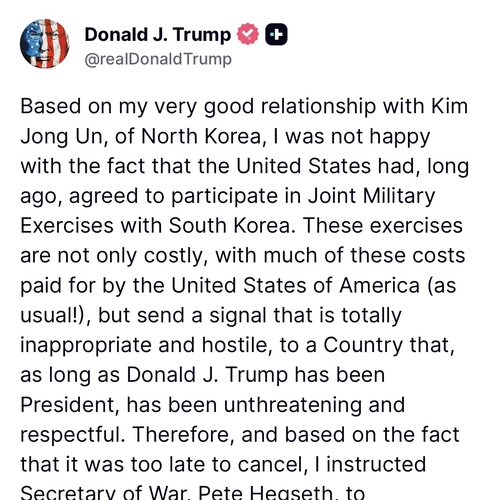
Donald Trump reposted a nearly identical message about scaling back US-South Korea military exercises, changing only the verb tense. The move is less about policy than it is about probing Kim Jong Un's responsiveness and testing alliance nerves.
The post that wasn’t really a post
Donald Trump posted something on Truth Social on August 25 that was virtually identical to what he had already posted nine days earlier — same argument, same framing, same claim that US-South Korea joint military exercises were a relic of the past he no longer supported. The only substantive change? Verb tense. Sentences that had been written in the present were quietly converted to the past.
On its face, this looks like a clerical error or a moment of digital carelessness. It isn’t. The repetition, with the tense adjustment, is deliberate. And what Trump was adjusting wasn’t grammar — it was his own posture toward Pyongyang.
The original post, published on August 16, framed the United States as already committed to scaling back drills, citing Trump’s personal relationship with Kim Jong Un as justification. The revised version, posted on the 25th, reframed that commitment as already having happened — as if the decision were settled rather than still aspirational. Trump left the post up. He also posted critical remarks about Canada in the half hour following it. He did not delete either.
What North Korea is doing with the signal
North Korea’s public response has been characteristically muted. Official channels have not welcomed the suggestion. But behind that cool exterior, Pyongyang is almost certainly conducting its own calibration exercise: How far will Trump go? How much of a concession is this signal worth? What other cards is he willing to play before he commits to something concrete?
That probing behavior is exactly what Trump’s repeated messaging enables. By keeping the option of drill reductions on the table without formalizing it — without any agreement, without verification, without a reciprocal move from North Korea — Trump is creating a permanent state of diplomatic limbo. In that limbo, Pyongyang gets to spend its time figuring out what’s real and what’s theater. And the United States gets to look generous without actually giving anything away.
The photos Trump posted the day before — images from the 2018 and 2019 summits with Kim, presumably sourced from his archives — reinforce the message. They say: I know him. We had something. We can have it again. The implication is that personal chemistry between two leaders can substitute for the architecture of deterrence that has kept the Korean Peninsula from descending into war for eight decades.
Why Seoul should be nervous
The South Korean government has not publicly addressed the repost. That silence is itself a signal — one that Washington may be interpreting as acceptance, or at least non-resistance. But Seoul’s quiet doesn’t mean it agrees. It means it is navigating an alliance where the president of the United States is broadcasting policy preferences on social media before they reach State Department channels or Seoul’s diplomatic desk.
US-South Korea joint military exercises are not merely training events. They are the operational backbone of the extended deterrence guarantee that underpins the entire security architecture of Northeast Asia. Scaling them back — even rhetorically, even before any formal decision — sends a message to Beijing and to Tokyo that the United States is drifting away from its commitments in the region. That drift is the very thing China has been banking on since the Trump administration’s first term.
The Korean Military demilitarized zone sits on one of the most heavily fortified borders in the world. The exercises conducted there are defensive by design. They are also predictable, transparent, and conducted with full notification to Beijing and Tokyo. Removing that predictability doesn’t make the region safer. It makes it more dangerous.
The credibility problem
Trump’s approach to North Korea has always been transactional. Personal relationships with autocrats, public flattery, the anticipation of a Nobel Prize — these are the ingredients he has assembled into a consistent strategy. The problem with that strategy is that it treats deterrence as optional. Every time the United States signals that it is willing to unilaterally reduce its defensive posture in exchange for a handshake, it teaches its allies that the American security guarantee is negotiable. That lesson travels fast in East Asia.
Japan is watching. South Korea is watching. Taiwan is watching. The question they are all asking — sometimes out loud, sometimes not — is whether the United States will stand by its commitments when a crisis actually comes, or whether those commitments are contingent on the mood of the president and his relationship with a given adversary.
Trump’s repost of the drill-scaling message, unchanged except for verb tense, suggests the latter. It suggests that the commitment to the alliance is secondary to the pursuit of a personal deal with Kim Jong Un. And it suggests that Washington’s policy toward the Korean Peninsula may be driven less by strategic calculation than by the impulses of a man who treats diplomacy like a reality television show.
What happens next
If Trump is serious about reducing the drills, the logical next step would be a formal announcement through the appropriate channels — the Pentagon, the State Department, Seoul. So far, nothing of the sort has appeared. The post remains up. The rhetoric continues. Pyongyang continues to probe.
The most likely outcome is not a dramatic escalation and not a breakthrough. It is the slow erosion of alliance certainty. Trump keeps the option open. Allies keep adjusting their expectations. Adversaries keep testing the boundaries. And the security architecture that has held since 1953 becomes, year by year, less reliable.
That is not a prediction. It is a pattern. Trump has done this before — with Iran, with NATO, with trade partners. He signals flexibility, creates uncertainty, and waits to see how much he can extract before committing to anything real. The repost is another turn in that cycle.
The question for Seoul and Tokyo is whether they will keep accommodating the uncertainty or start preparing for a world in which the American security umbrella is less comprehensive than it once was. That preparation shouldn’t wait for Trump to finish his latest social media phase.