Trump Is Threatening Tariffs on Korea's Chip Giants Unless They Build in America
US Commerce Secretary Howard Lutnick signaled a new tariff regime that would punish Samsung and SK Hynix unless they build fabs in America. The move could reshape Korea's export engine and strain the oldest US alliance in Asia.
The Tariff Trap
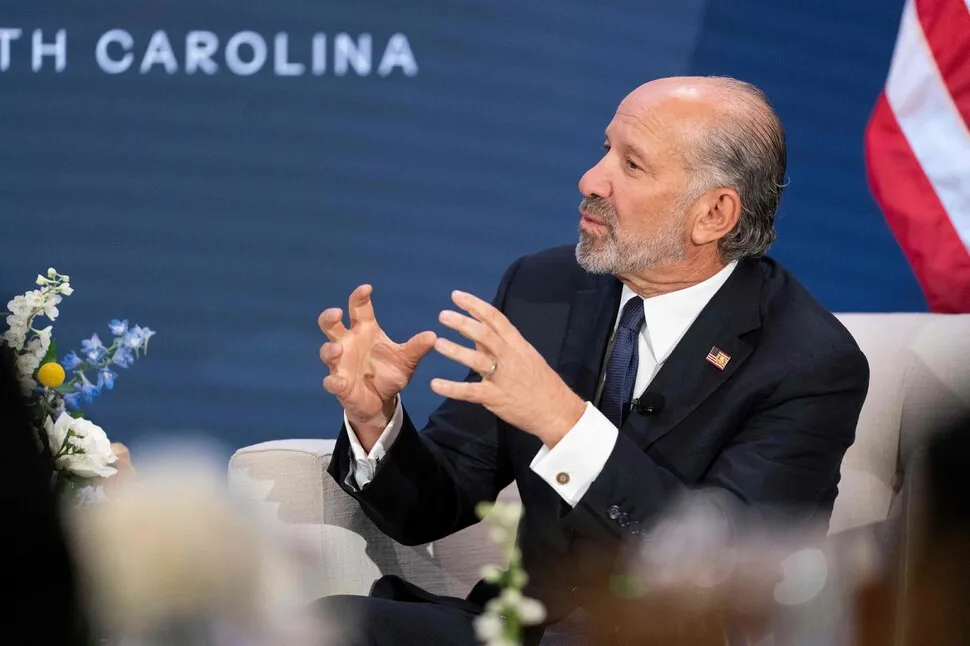
Howard Lutnick did not mince words at the G20 innovation ministers meeting in Chapel Hill on November 2. The US Commerce Secretary told CNBC that America’s new semiconductor tariff policy would be simple: produce here and you keep your tariffs off; produce elsewhere and you pay a heavy price for access to the world’s largest chip market.
He called it a “targeted” and “thoughtful” approach. The companies hearing that language in the audience were Samsung and SK Hynix, which together account for the bulk of South Korea’s semiconductor exports and have no major fabrication plants in the United States.
This is not a vague threat. It is a policy framework — modeled explicitly on the pharmaceutical sector’s trade-offs with Washington — about to land on two of Korea’s most strategic corporations.
How the Leverage Works
Lutnick pointed to the existing precedent: the US has already granted tariff relief to drugmakers that commit to producing in America and accept federal price controls through the most-favored-nation pricing regime. The message to semiconductors is identical in structure, if more aggressively applied.
The scope is expanding too. Trump’s administration already slapped a 25 percent tariff on certain advanced chips — including NVIDIA’s H200 AI processors — back in January. The new policy, Lutnick signaled, would stretch well beyond bare silicon. Data center servers, laptops, gaming consoles — any finished product containing American-imported chips could become a tariff target.
That is a significant escalation. It shifts the pressure from component manufacturers to the global ecosystem of electronics brands that rely on Korean memory chips, creating a cascade of compliance costs far wider than the fab sector alone.
The Numbers Behind the Threat
Lutnick asserted that roughly $1.2 trillion in semiconductor investment commitments have already been pledged toward US fabrication capacity. He also claimed the US share of global chip production — below 2 percent when Trump took office — could climb to 40 percent.
Taiwan is expected to announce an additional $20 billion to $30 billion in investment next week, building on the $50 billion it committed under the US-Taiwan trade agreement. TSMC’s Arizona fab is already a visible symbol of this redirection.
But Korea is different. Samsung and SK Hynix dominate global memory chip production — DRAM and NAND flash — sectors where US companies have no comparable capacity to fall back on. Micron exists, but it is a fraction of the duopoly that Seoul holds over the memory market. Washington cannot simply replace Korean supply the way it is attempting to absorb Taiwan’s advanced logic fabrication.
What This Means for Korea
Semiconductors represent roughly one-fifth of South Korea’s total exports. Samsung Electronics alone accounts for a meaningful share of GDP. This is not a diversified economy absorbing a regulatory nuisance — this is a country whose export engine runs largely on the products most directly affected by Lutnick’s policy.
Korea faces a stark choice. Build fabs in America, which means massive capital expenditure in a labor-cost environment far higher than home, on top of existing investments in Texas and elsewhere. Or accept tariffs that erode the price competitiveness of chips shipped from South Korea and its other overseas sites.
Neither option is cost-free. But the first option cedes strategic leverage — it places Korean technology and manufacturing capacity on US soil, where it becomes more exposed to US jurisdiction, audit, and future policy shifts. The second option damages export revenues immediately.
The Alliance Fracture Point
The deeper story here is not about tariffs. It is about what happens when the United States treats its closest military ally in Asia the same way it treats competitors.
Lutnick’s framework does not distinguish between friend and foe. A company is either building in America or it is not. That is the beauty of the design from Washington’s perspective — it eliminates diplomatic friction in the calculus. But it is also the most alarming feature for Seoul, which has long relied on the assumption that economic statecraft would be tempered by strategic partnership.
Korea’s government is already grappling with how to respond without appearing to capitulate or provoke. Prime Minister Han Duck-soo has hinted at dialogue with Washington, but the substance of any negotiation remains unclear. Korea cannot credibly threaten retaliation — it is too dependent on the US market and the US security umbrella. And it cannot easily accelerate domestic fab construction in America given the capital intensity and timeline involved.
Who Wins and Who Loses
The clear winner in this dynamic is the United States, which gains leverage over supply chain decisions it cannot otherwise influence. If the policy forces even a fraction of Korean memory capacity onto US soil, Washington achieves a strategic objective that decades of subsidy alone failed to secure.
Chinese AI firms and other non-aligned chip buyers lose — they face higher costs and tighter access constraints as the tariff net widens to include finished electronics.
Korea loses the most. Its export competitiveness takes a direct hit, its negotiating position weakens, and its industrial strategy — built on specialization in memory semiconductors produced at home — faces an existential question it was never designed to answer.
Samsung and SK Hynix will likely announce some American investment to defuse the immediate threat. But the scale, speed, and terms of that investment will determine whether this is a managed adjustment or a structural realignment of Korea’s economic positioning — one that benefits Washington far more than Seoul.