Trump's Threat, Then the Handshake: Inside the US-Iran Hormuz Negotiations
Hours after threatening to annihilate Iran, Trump's envoys met for three hours with Iranian intermediaries over the Strait of Hormuz. What signals of de-escalation look like from New York may not be what markets need to hear.
The Day Trump Threatened Annihilation — Then Sat Down With Iran’s Intermediaries
The sequence matters more than either event alone. On the twenty-second, Donald Trump stood at the United Nations and told the world the United States could quickly annihilate the Islamic Republic. Hours later, his presidential envoy Steve Witkoff and Jared Kushner sat across from Iranian intermediaries for three hours in a New York room that neither side fully described to the press.
Trump called it very productive. He said further talks were imminent, that momentum toward an agreement was significant, and that a deal would clearly benefit Iran as well. He also said he expected any agreement to land after November’s midterm elections — a timeline that immediately raised questions about whether the negotiations were moving toward something real or merely managing a crisis until domestic politics allowed for a visible win.
Iran’s side, confirmed by state media, sent Foreign Minister Abbas Araghchi to meet Witkoff after what Araghchi described as strong requests from the American envoy. The timing was deliberate. The same day, Araghchi also met with the Qatari prime minister, EU foreign policy chief Kaja Kallas, and Italian Foreign Minister Antonio Tajani — all of them discussing the Strait of Hormuz.
The Seven-Day Countdown Nobody Is Talking About Quietly
The most consequential detail did not come from Trump’s speech. It came from an unnamed Iranian official speaking to Reuters: Iran had delivered a new proposal through intermediaries the previous week, and if its conditions were met, the Strait of Hormuz could be reopened within seven days.
The conditions were blunt. End the US-led maritime blockade. Unfreeze Iranian assets. Halt all military operations on every front.
That last point is the one that makes this not a nuclear negotiation but a wartime negotiation. Iran is asking for a full stop to what it calls active conflict across multiple theaters, not just a pause in naval incidents in the Persian Gulf. The US has spent months accusing Iran of violating a truce by attacking commercial shipping. Iran is now effectively saying the truce cannot hold until those attacks stop and the blockade lifts.
The market does not yet price in the possibility that Hormuz could actually reopen in a week. It prices in the possibility that it stays closed for longer. The gap between those two scenarios is where the next move will be made.
Trump’s Two-Front Performance
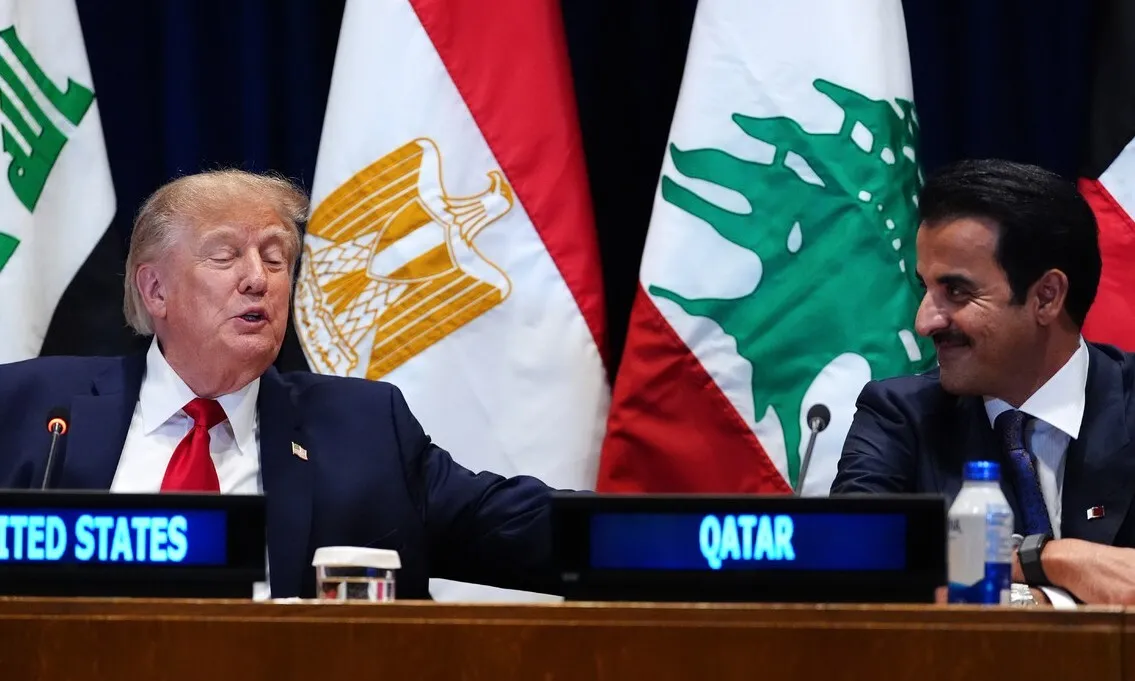
Trump’s UN appearance was calibrated for two audiences simultaneously. In the main hall, he demanded every country join the pressure campaign against Iran, framed the choice as between Iranian reconstruction and Iranian destruction, and warned that the decisive moment was still ahead. At a separate multilateral meeting with leaders from the GCC, Jordan, Egypt, and Turkey, he told the same twelve leaders the United States was one hundred percent with them.
That pairing is not accidental. The hard rhetoric in the general assembly buys political cover at home. The soft outreach to Gulf leaders buys insurance that any deal Trump eventually cuts will not look like a retreat to his allies. It is the same rhythm that has defined his middle-eastern diplomacy before: maximum pressure in public, backchannel flexibility in private.
The Qatari Proposal That Could Change the Table
Reuters reported, citing regional sources, that Qatar has floated a framework for a collective security structure in the Gulf that would include Iran alongside the Arab Gulf states. Trump raised the idea directly with GCC leaders and Jordanian, Egyptian, and Turkish representatives. Iran is reportedly reviewing the proposal.
This is the thing English-language coverage has largely missed. Qatar has been the informal mediator between Washington and Tehran for years, but a formalized Gulf security architecture that includes Iran would be a structural shift — not just a diplomatic courtesy. It would mean Iran gets a seat at a table its Gulf neighbors have spent a decade trying to keep it out of. It would also mean the US is implicitly endorsing that inclusion as part of a broader de-escalation package.
If Hormuz reopens on Iran’s terms, the Gulf security question becomes the next question. If it does not, the next question is what happens when the seven days pass and nothing changes.
Who Wins, Who Loses, What Happens Next
Iran wins if the blockade lifts and its assets unfreeze. It wins even more if the Gulf security framework gives it a recognized role in regional stability talks. It loses if the US frames any deal as a concession extracted after a threat of annihilation — that framing leaves no political space for Iranian leaders to tell their public this was a negotiation rather than a surrender.
The US wins if Trump can claim a deal was reached without appearing to back down from his own rhetoric. The risk is that the gap between annihilation and accommodation is too wide to bridge in a single negotiation cycle without both sides looking foolish.
Gulf states win if Hormuz reopens and their waters stop becoming a combat zone. They lose if the deal leaves Iran stronger in the region without any enforceable guarantees against future aggression.
Oil markets win if Hormuz reopens quickly. They lose if the seven-day window passes and the next crisis starts over whether the interim talks were real or performative.
The next few days will tell whether this is de-escalation or a dangerous pre-deal posture. The signal is simple: do Iranian and American teams keep meeting, and does Iran begin taking mines out of the strait? Or do the intermediaries disappear and the threats return to the airwaves?
Trump says the momentum is significant. The question is whether momentum is enough to override the politics on both sides.