Trump-Xi-Putin Nonproliferation Summit: Why Excluding Ukraine Matters
The White House confirmed a Trump-Xi-Putin trilateral on nuclear arms control in Shenzhen — and explicitly ruled out Ukraine. That selective agenda signals a seismic realignment in how the world's most dangerous relationships are being managed.
The Room Where It Happens (And The Room Where It Doesn’t)
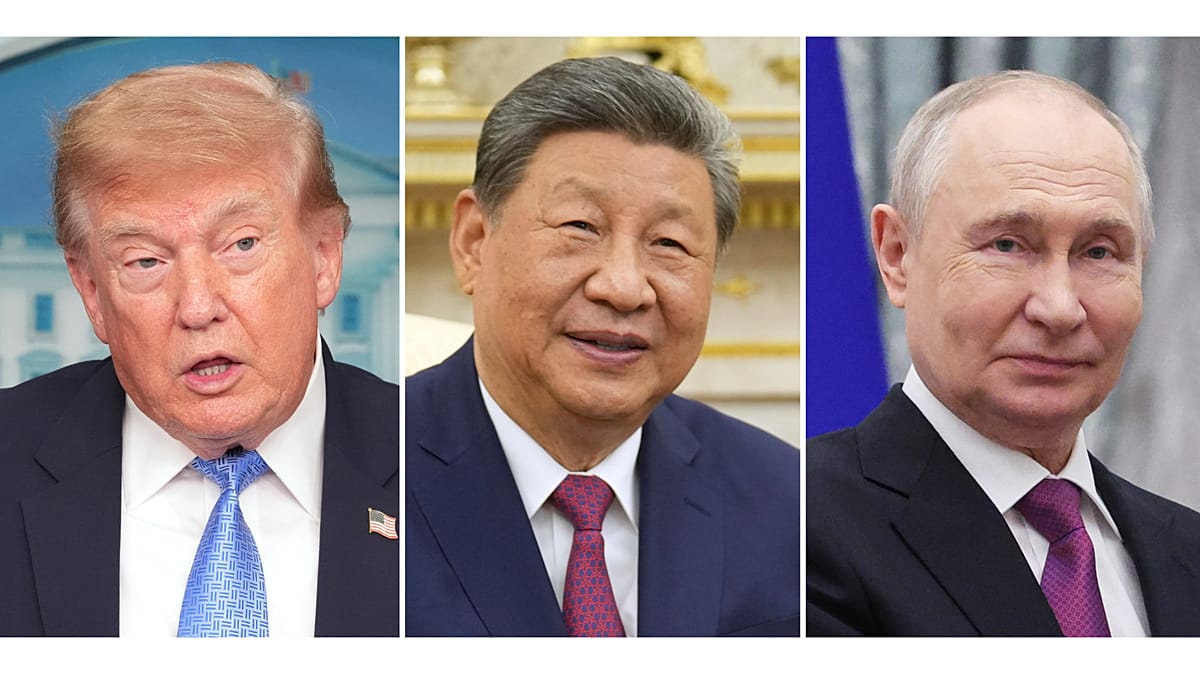
The White House announcement on Friday carried enough surface intrigue: Donald Trump, Xi Jinping and Vladimir Putin converging in Shenzhen next week on the sidelines of APEC. Three heads of state from the world’s second-, third- and fourth-largest nuclear arsenals sharing a stage at an economic forum is already unusual. But the detail that actually rearranges the geopolitical board is what got left out.
Ukraine won’t be discussed. Not there, not now.
A senior US official told AFP that Washington has “a whole other track” for negotiations with Kyiv and Moscow, and that because “China is not really a part of that track, it doesn’t seem appropriate to have the Ukraine discussion” at the trilateral. Translation: the Trump administration has drawn a sharp line between its nuclear posture management and its war-diplomacy track, and it is choosing to prioritize the former with Beijing and Moscow simultaneously present.
That separation is far more consequential than any headline photo-op.
The Yalta Parallel Isn’t Metaphorical
When diplomats and historians hear about a US-Russia-China trilateral on nuclear arms control, they tend to reach for the Yalta comparison — FDR, Churchill and Stalin carving up the postwar order in February 1945. The parallel draws easily. But unlike 1945, when two democratic allies joined a Soviet leader to redraw the map of Europe, this meeting brings together an American president operating on transactional logic, a Chinese premier positioning his country as the indispensable arbiter of Eurasian security, and a Russian leader whose military is still grinding through eastern Ukraine.
What makes this moment distinct from Yalta is the absence of Europe’s agreement. Kyiv is not at the table. Brussels is not in the room. The Ukraine war — the single largest conventional conflict in Europe since World War II — is being bracketed off as a side issue while the nuclear triad manages its own relationship.
That bracketing sends a message to every capital watching: the great powers are developing a bilateral-plus format that can operate independently of their European commitments. For NATO allies, that is an alarm bell wrapped in diplomatic language.
Who Gains When Nuclear Talks Run Parallel to Ukraine Peace Efforts
Let’s map the incentives.
Moscow gains enormously from a front-row seat at a US-China nuclear dialogue. Even if no treaty emerges — and none likely will before 2027 — the mere fact of sitting across from both Washington and Beijing lifts Russia from pariah status into the center of a new strategic triangle. Putin gets photographed alongside Xi and Trump as an equal participant in global security governance. That normalization, however cosmetic, is exactly what his domestic audience needs and what his sanctions-isolated economy cannot deliver on its own.
Beijing gains even more structurally. Hosting the meeting grants China the ceremonial role of facilitator — a position it has been cultivating for years through its Belt and Road Initiative and its declared intention to serve as a “responsible stakeholder” in global governance. More importantly, a direct US-China nuclear arms-control conversation acknowledges that Washington treats Beijing as a peer in strategic stability, not just a competitor in technology and trade. That acknowledgment shifts the perceptual landscape around Taiwan and the South China Sea without either side having to say it aloud.
Washington gains a controlled narrative. Trump has built his foreign-policy brand on personal diplomacy with adversarial leaders, and adding Xi and Putin to that roster extends the template. The non-proliferation framing gives him a concrete achievement to sell domestically — reducing nuclear dangers is universally palatable, hard to criticize, and visually straightforward. Meanwhile, excluding Ukraine protects him from accusations that he is sacrificing Kyiv’s interests for a photoshoot with autocrats. The separate-track line does exactly that work: it says the US hasn’t abandoned Ukraine, it just hasn’t brought everyone to the same table.
Kyiv loses the only leverage it had in this configuration: the knowledge that any serious US-Russia accommodation would require at least a tacit Chinese nod. By keeping China formally uninvolved in the Ukraine track, Washington has given Putin and Xi an opportunity to signal strategic alignment without Kyiv’s shadow hanging over it.
The Timetable Nobody Is Talking About
Here is the operational reality beneath the announcements: the New Strategic Arms Reduction Treaty (New START), the last remaining major bilateral nuclear restraint agreement between the US and Russia, expires in February 2026 unless extended or replaced. That deadline is fourteen months away — close enough that any productive conversation between these three leaders should logically address what comes after New START, not just abstract principles of non-proliferation.
Trump’s stated concern that “this proliferation is very dangerous” points directly at that expiration cliff. But extending New START requires Russian consent, and Russia has shown every indication it wants to move beyond the treaty’s constraints — particularly its ceiling of 1,550 deployed warheads, a limit that would barely cover Russia’s current stockpile once modernization cycles complete. A trilateral framework that somehow incorporated China’s estimated 600 warheads (and growing) would face mathematically impossible verification challenges under existing protocols designed for a bipolar world.
So the Shenzhen meeting may accomplish precisely nothing concretely on the treaty-timing front — or it may open a backchannel that reshapes the entire calendar. The difference between those outcomes depends on whether Moscow and Beijing see strategic value in a formal arrangement or prefer the ambiguity that keeps Western defense planners guessing.
The China Host Advantage
Shenzhen is no accident as a venue. The city embodies China’s economic transformation story — from fishing village to tech capital in four decades — and it sends a quiet message about what kind of world order Beijing envisions. This is not a summit convened at a neutral European site or a traditional diplomatic capital. It is hosted in the engine room of China’s technological ambition, a place where Huawei and Tencent were born.
Chinese Foreign Ministry spokesperson Mao Ning said Beijing was looking forward to achieving “more practical results” in AI, trade, connectivity and the digital economy alongside the security discussions. That dual agenda is deliberate: China wants to tie nuclear risk-reduction credibility to its broader claim that it offers a superior model of development-led governance compared to the liberal international order.
For Western observers, the lesson is simple but uncomfortable. China is not waiting to be invited into European security architectures. It is building alternative venues where it sets the terms.
What Comes Next
Elon Musk’s presence in Shenzhen — though excluded from the trilateral itself — should not be read as incidental. His inclusion signals the breadth of Trump’s portfolio approach to diplomacy: business leaders, technologists and heads of state all feeding into a single strategy of personal relationship-building across rival camps. Whether that model produces durable agreements or merely efficient theatre remains the open question.
The ASEAN stopover in the Philippines before Shenzhen is also telling. Trump is threading the Southeast Asian alliance system on the way to a meeting that effectively bypasses it. That sequence suggests Washington’s priority hierarchy: Indo-Pacific partnerships matter, but the nuclear triangle with Beijing and Moscow matters more right now.
All three participating capitals remain silent publicly on the announced meeting. That silence is itself data. None of them wants to look eager. All of them need something from the outcome. And none of them will reveal what that is until after the cameras stop rolling.