Ukraine Just Proved Drones Can Close a Nuclear Power's Sky
Zelensky's claim that Ukrainian drones have effectively closed Russian airspace isn't propaganda—it's a new doctrine of aerial warfare. The implications for global aviation, European security, and NATO strategy are just beginning to unfold.
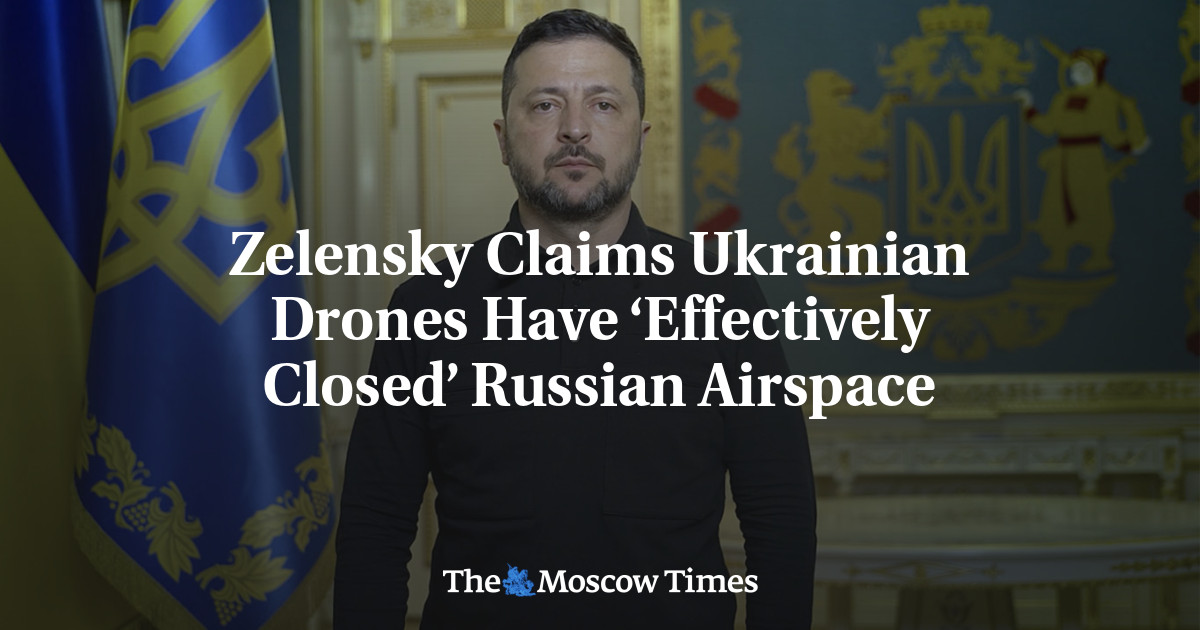
The Sky Above Russia Is No Longer Safe
Volodymyr Zelensky did not mince words on Tuesday. Ukrainian drones, he claimed, have effectively closed Russian airspace. It sounds like something out of a war propaganda bulletin—except the evidence is already visible on flight boards, in airline filings, and in the quiet recalculations of risk analysts across Europe.
By Wednesday morning, Moscow’s Sheremetyevo airport reported 21 canceled flights and 235 delays. Vnukovo, another major hub that has historically been more resilient to operational disruptions, saw 22 cancellations and 94 delays. Turkish carrier Pegasus Airlines quietly pulled six arriving and six departing flights, citing “technical and operational” reasons. Lufthansa had already begun rerouting several European services away from Russian airspace two weeks prior, but this latest escalation pushed the shift from caution to strategy. The aviation world was already making its own calculation, and it was not optimistic: Russian airspace, as a practical and commercial matter, is compromised.
What makes Zelensky’s claim striking is not the ambition of it but the credibility behind it. This is not a threat about what Kyiv might do. It is a statement about what it already has done—repeatedly, successfully, and with systems that cost a fraction of what Russia spends on air defense. The mathematics of this conflict are ugly for Moscow. A Shahed drone costs roughly $20,000 to $50,000 on the open market. An S-400 interceptor missile runs north of $4 million per shot. Ukraine has been winning that exchange rate for over a year. Now it is converting that tactical advantage into something far more consequential: the denial of sovereign airspace to a nuclear-armed state at scale.
A New Doctrine of Denied Access
Military analysts have long studied the concept of “anti-access/area denial”—A2/AD—primarily in the context of sea lanes and expensive missile systems. China has built vast A2/AD bubbles in the South China Sea using billion-dollar radar networks and long-range surface-to-air missiles. Russia itself deployed S-400 systems along the Syrian coast to keep NATO aircraft at a distance during its earlier intervention there. These were capital-intensive, high-tech solutions designed to keep adversaries out of contested zones through sheer defensive density.
Ukraine is now achieving something qualitatively different: denied access to its own neighbor’s airspace using platforms that cost tens of thousands of dollars each, not tens of millions. The Shahed drones Iran supplies, the domestic Soviet-era modifications produced in hidden factories across western Ukraine, the commercial quadcopters repurposed for bombing runs by volunteer engineers in Kyiv basements—they form a layered, affordable, and relentless challenge that no traditional air defense system can permanently solve. Each layer consumes a different tier of Russia’s defenses. Cheap drones draw out the expensive interceptors. Mid-tier systems like the Buk and Tunguska are overwhelmed by saturation. And even when they hit, the attrition rate favors the attacker. Russia has lost hundreds of air defense positions since 2022, many of them to drone strikes launched from thousands of kilometers away.
Osprey Flight Solutions, an aviation risk advisory firm based in London, put the trajectory bluntly in a client alert Wednesday. Daily Ukrainian strikes deeper inside Russia are near-certain through 2026, including near Moscow and St. Petersburg. The firm added that the frequency of strikes could increase in the short term and warned that miscalculation or misidentification of threats is likely in the conflict zone. This is not speculation. Osprey’s assessments are grounded in flight-tracking data, radar signatures, and direct engagement with European and North American carriers that are already adjusting their operational models.
That last point matters more than it might appear. When a commercial flight crosses a warzone—however indirect the connection—every defense operator is under pressure to respond. An unidentified object appears on radar. The rules of engagement are strained. The chance of error rises. The risk to civilian aviation is no longer hypothetical. In March 2023, a Ukrainian drone struck near Domodedovo airport, one of Moscow’s three major hubs, forcing an emergency closure for two hours. A similar incident involving a misidentified commercial aircraft could trigger a diplomatic crisis far beyond the battlefield.
Who Blinks First
Russia’s transportation minister, Andrei Nikitin, responded to Zelensky’s warning with characteristic defiance. Civil aviation authorities were “constantly improving flight safety and airport security requirements,” he told Interfax, claiming there were solutions for everything. He stressed coordination with the Defense Ministry and the National Guard. “We will not allow any significant disruption to civil aviation.”
Words, so far, have not matched the disruption. Flight cancellations at Moscow’s two busiest airports are the most visible symptom. But the deeper story is economic, and it is far more damaging. Russia’s domestic air network—dominated by Aeroflot and its subsidiaries—has been quietly straining under the weight of sanctions, spare-parts shortages, and pilot defections even before the drone campaign escalated. In 2023, Aeroflot reported a net loss of nearly $2 billion. Its fleet age has been rising because replacement aircraft from Airbus and Boeing are blocked by sanctions and insurance restrictions. Every cancellation now feeds into that pressure. Every grounded plane accelerates wear on the remaining airframes. Every diverted route burns more fuel and reduces profitability on routes that were already marginal.
Europe is watching, too. The question lurking beneath Nikitin’s reassurances is whether this model could apply elsewhere. If Ukraine can close large swaths of Russian airspace with relatively inexpensive drones, what stops other actors—from state sponsors to non-state groups—from replicating the playbook against European skies? The answer is already emerging: nothing stops it. That is the uncomfortable reality NATO and EU defense planners are confronting. The technology to build, modify, and deploy these systems is widespread. The business models are proven. The only barrier has been the absence of a conflict that forces the innovation to mature—and Ukraine has provided exactly that crucible.
The ICAO Factor
Ukraine’s move to formally notify the International Civil Aviation Organization that Russian airspace is unsafe is arguably the most legally significant step in this episode. The ICAO does not enforce anything. It has no enforcement mechanism, no standing military, no authority to compel compliance. But its notices shape how airlines, insurers, and governments classify risk. When Kyiv files that notification, it shifts the burden of proof onto Moscow. If a plane is hit, or if a near-miss occurs, the record will show that the danger was officially flagged. Liability frameworks that currently protect carriers operating through Russian airspace begin to erode. Insurance premiums rise. Routes become commercially unviable even where they remain technically legal.
It also creates a template. Other conflict zones will study this move. In a future dispute over the South China Sea, or the Strait of Hormuz, or the Baltic approaches, expect to see similar ICAO filings as a low-cost way to exert leverage without firing a missile. A small state facing a much larger adversary does not need to destroy the opponent’s navy to make its waters unusable. It needs to convince the world that those waters are unsafe—and the ICAO notification is the most efficient tool available for that purpose. It is diplomacy through hazard notice. It is asymmetric coercion dressed in bureaucratic language.
The precedent is already being cited in classified briefings across NATO capitals. Analysts from the Royal United Services Institute and the International Crisis Group have both referenced Ukraine’s ICAO filing in recent internal discussions about how to handle airspace disputes in the South China Sea. The message is clear: the tool exists, it works, and it will be used again.
What Comes Next
Three things are likely in the months ahead. First, Russian airspace closures will become more routine and more fragmented. Rather than declaring whole sectors unsafe, Moscow will impose rolling restrictions that create uncertainty—exactly what disrupts scheduling, drives up insurance premiums, and chips away at commercial viability. A single confirmed drone strike near an airport triggers a blanket closure for hours or days. The pattern rewards unpredictability and punishes anyone trying to plan around it. Airlines that once flew through Russian airspace on routes between Europe and Asia will treat it as a variable to be minimized rather than a corridor to be trusted.
Second, European carriers will begin pricing Russian overflight risks into their routes more aggressively, possibly rerouting entirely around Russian territory even where flights are technically permitted. The additional fuel burn and flight time are costly, but the cost of a single incident—whether a strike, a misidentification, or an insurance claim—would be catastrophic. Emirates, Qatar Airways, and Turkish Airlines have already begun adjusting their Siberian routes. European carriers are following, though more cautiously, given the tighter margins in the post-pandemic recovery.
Third, and most consequential, defense industries across Europe will accelerate programs aimed at countering swarm drone attacks—not just on the ground but in the air corridors that sustain civilian and military mobility. The Czech Republic, Poland, and the Baltic states are already investing in portable counter-drone systems for critical infrastructure. Germany has launched a national drone defense strategy. NATO is expected to formalize a collective air corridor protection framework by late 2026. The money will flow, the procurement will accelerate, and the technology will improve. But the fundamental asymmetry remains: it is always cheaper to build a drone than to build the system that shoots it down.
The Era of Contested Skies
The era of uncontested airspace, even far from any battlefield, may be ending. Ukraine has not won the war yet. But on Tuesday, it changed the rules of how the war is fought above the ground—and in doing so, it handed the rest of the world a preview of what comes next. The sky above Russia is no longer safe. The sky above every nation with an airport, a pipeline, a power grid, or a commercial airline route is less safe than it was a year ago. The technology has proven itself. The doctrine has been tested. The question now is not whether this model will spread but how quickly.
For Ukraine, the immediate stakes are tactical and strategic. Every kilometer of Russian airspace denied to Moscow weakens the logistical backbone of the war effort. Fuel depots, ammunition stocks, command centers—all of it becomes vulnerable to a threat that is cheap, abundant, and relentlessly adaptive. For the rest of the world, the lesson is structural. The monopoly on air dominance that superpowers have enjoyed since the Second World War is fracturing. It will not vanish overnight. But the trajectory is clear, and it points toward a future where the sky belongs not to the side with the most expensive fighters but to the side willing to saturate it with the cheapest possible tools.