Ukraine's Grain Standoff: A Double Crisis Threatening Global Food Supply
As Russian attacks paralyze Black Sea ports and drought shrinks Danube routes, Ukrainian farmers face an economic collapse that could reshuffle global grain markets. With exports down millions of tons and domestic prices cratering, the question is who fills the void—and who pays the price.
When Export Routes Die, Who Pays?
Ukraine’s Black Sea ports—once responsible for roughly 90 percent of the country’s agricultural exports—are effectively closed. Russian attacks on civilian shipping have turned what was a vital commercial artery into a kill zone. And now, with a historic drought simultaneously crippling Danube water levels, Kyiv faces a supply chain collapse that could rewrite global grain flows.
This is not a temporary disruption. It is a structural crisis.
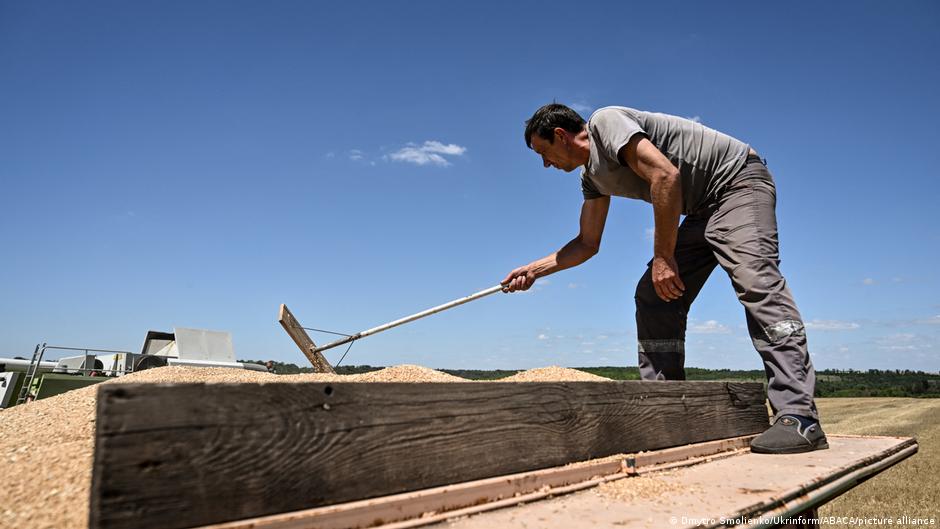
More than 28 million tons of grain and pulses have already been harvested this season. But there is nowhere to sell it. Farmers are storing what they can find space for, or leaving crops in fields they cannot afford to harvest. The cash shortage is so acute that planting winter wheat—usually an August ritual in southern Ukraine—may not happen at all.
The domestic fallout is staggering. Prices for food-grade wheat have plummeted 30 to 35 percent. Production costs can no longer be covered. The Ministry of Agrarian Policy estimates annual losses from unsold produce at approximately $20.5 billion. That number will grow.
The Math Behind the Blockade
Denys Marchuk of the All-Ukrainian Agrarian Council put the problem bluntly: “Right now, we can barely sell our harvest. Instead, we’re storing what we have harvested — that’s if we find storage space. At the same time, we are wondering what to do because we need money, especially so we can plant in fall.”
Corn presents a particular challenge. This year’s harvest could reach 33 million metric tons, yet storage shortages may exceed 10 million tons by autumn. In frontline regions, where silos have been destroyed, the equation is even bleaker. Some farmers are calculating that leaving corn in the field and harvesting it in spring costs less than the electricity required to dry it now.
It is an absurd proposition. Crops left standing through winter lose weight and quality. Pest damage increases. But when the alternative is operating at a loss, rational actors make irrational choices.
Maksym Hopka of the Ukrainian Agribusiness Club projects exports will fall by roughly 9 million metric tons between August and October alone—a $1.9 billion hole in a single quarter. Output in July was already down a quarter from the previous month; August could see another decline exceeding 50 percent.
The EU Has Changed Its Mind
In 2022, the European Union moved quickly to absorb Ukrainian grain through “solidarity lanes”—temporary corridors that waived quotas and duties. Farmers were desperate; the political will was real.
That support has evaporated. Trade has reverted to pre-war conditions with customs restrictions and quotas reestablished. The EU’s tolerance for Ukrainian agricultural flooding its markets has expired.
Oleg Nivievskyi of the Kyiv School of Economics noted the shift explicitly: “If we look at trade with the EU, we have gone from a free system to the pre-war trade regime with customs restrictions and quotas.”
Infrastructure tells the same story. Ukraine’s railways are running 30 percent fewer trains than before the full-scale invasion, hamstrung by repeated Russian strikes on tracks and repair needs. Road transport faces a shortage of truck drivers—many mobilized for combat. European rail networks are already at capacity during harvest season.
The Danube, long imagined as a fallback route, is running dangerously low. Extreme heat and drought have reduced barge loads and slowed transit times. What should be a secondary corridor is barely functional.
Why This Matters Beyond Ukraine
The second-order effects are already rippling outward. Grain price surges are being confirmed across multiple outlets as export chokepoints intensify. Buyers in the Middle East, North Africa, and Asia—many of whom have relied on Ukrainian wheat and corn as a stable, affordable source—are reassessing their supply chains.
Who replaces Ukraine? Argentina and Brazil face their own production variables. Russia, ironically, is now positioned as a more reliable exporter despite its own logistical constraints. The Black Sea blockade is inadvertently reinforcing Moscow’s agricultural leverage.
Domestically, the crisis threatens Ukraine’s next planting season. Without revenue from the current harvest, farmers cannot finance inputs for winter crops. A planting shortfall would compound the export gap next year. The cycle is self-reinforcing.
What Happens Next
Agriculture Minister Taras Vysotsky insists the priority remains restoring safe shipping routes to Odesa. He called rail and dry-port alternatives “temporary measures”—a candid admission that no comparable medium-term substitute exists.
The government has extended loan programs to farmers and requested €220 million in EU aid for small and medium agricultural businesses. It is triage, not strategy.
Nivievskyi argued that Ukraine needs a long-term export plan developed from the beginning of the war—not improvised solutions. “The government needed to put in place logistics to ensure that the blockade of one route did not paralyze the entire sector,” he said.
That moment of strategic reckoning has passed. What remains is damage control: finding buyers for grain that cannot move, keeping farmers solvent until the next harvest, and waiting for a military resolution to the port blockade that may not come soon.
The deeper story is that Ukraine’s agricultural economy—once a pillar of its sovereignty and a key weapon in the information war against Russia—is now hostage to infrastructure it cannot protect and markets it can no longer reach. The war is not just being fought on land. It is being fought on the seas, in the skies, and in the absence of grain shipments that should be moving right now.
For global food markets, the message is clear: when Ukraine cannot export, prices rise everywhere. And when Ukrainian farmers cannot plant next season, the consequences extend well beyond this year’s harvest.