Ukraine's Drone Race: 400 Interceptors vs Russia's Jet Attack Swarms
Ukraine is racing to field 400 interceptor drones by late October as Russia scales up jet-powered Geran attacks. But engine shortages, F-16 maintenance bottlenecks, and a looming budget gap threaten to blunt Kyiv's aerial defense.
The speed problem
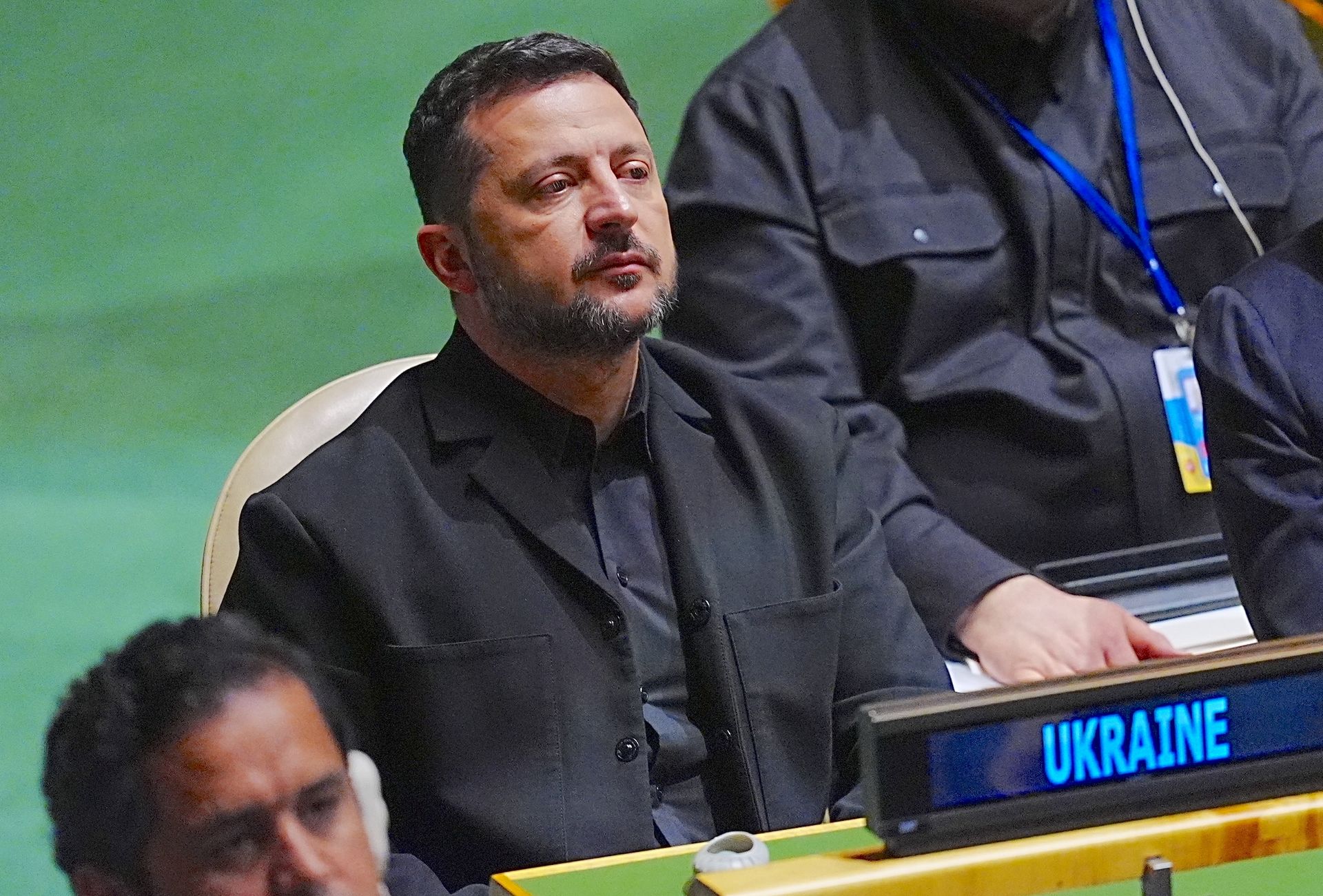
Fifty-seven percent. That is the figure President Volodymyr Zelensky offered on Sept. 28 when describing how many Russian jet-powered Shahed-type drones Ukraine manages to shoot down. He called it “much less than necessary.” In a conflict where Russia launched roughly 500 drones in a single day — half of them the faster jet variants — 57 percent is not a defensive success rate. It is a near-crisis.
Zelensky’s remedy is starkly simple in scale if not in execution: produce up to 400 interceptor drones by the end of October. The timing is aggressive. The logistics are questionable. And the broader contest it reveals — who builds faster, who builds smarter — may well define the next phase of this war.
A two-track response
Ukraine is running five distinct interceptor designs through testing simultaneously. Only one is close to production — the model expected to reach around 400 units in the coming weeks. The other four remain in development. This is not a single weapon system being rushed to market; it is a portfolio approach, betting that at least one design can scale fast enough to matter.
The urgency comes from a shift in Russian doctrine. Moscow has moved from slow, propeller-driven Shahed-136s — which, while numerous, gave Ukrainian air defenses a window to react — to jet-powered variants: the Geran-4 and Geran-5. These travel significantly faster, compressing the decision cycle for defenders and making traditional anti-air systems far less effective.
Russia’s targeting pattern is equally deliberate. Civilian infrastructure is the focus: supermarkets, schools, shopping malls, telecommunications hubs, data centers, gas stations, medical facilities. The attacks on Kyiv, which intensified over the past week, are not aimed at front-line troops. They are aimed at breaking the civilian backbone that keeps a modern state functional.
The engine chokepoint
Here is where the 400-drone target runs into hard physics. Ukraine imports most of the engines required for its interceptor drones. Domestic production remains insufficient. You cannot manufacture high-speed interceptors at scale without engines — and you cannot import them at the pace required without supply chains that are themselves under strain from global demand and sanctions complications.
This is not a new problem for Ukraine’s defense industry. It is a structural one. The country has demonstrated remarkable agility in drone development — the Magura maritime drones and the Lancet counter-battery systems are testaments to that. But moving from prototype to mass production requires an industrial base that Ukraine is still building, not one it already possesses.
The engine shortage is a bottleneck that no amount of willpower can bypass. It means the 400-unit target may be optimistic, or it may arrive in November instead of October, or it may arrive with a subset of airframes ground-dependent because engines are allocated to other programs first. None of these outcomes are speculation — they are the direct consequence of a country trying to industrialize a response to a threat that is itself industrializing.
The F-16 maintenance gap
Zelensky raised another friction point: roughly half of Ukraine’s F-16 fleet is undergoing scheduled maintenance or repair in Europe at any given time. The jets arrived in summer 2024 and have been pressed into both offensive and defensive roles — intercepting missiles and drones during raids, and striking Russian positions along the front line. That dual mission accelerates wear.
The practical consequence is that F-16s are often unavailable precisely when Russian drone swarms peak. Kyiv has asked to move some maintenance work to Ukrainian soil so aircraft can return to service faster. Whether that is feasible depends on infrastructure, expertise, and spare parts — none of which are trivial to establish under wartime conditions.
This maintenance gap matters beyond Ukraine. It signals a broader vulnerability in the F-16 program as deployed to a high-intensity conflict: the logistical tail that Western allies maintain overseas becomes a strategic liability when the planes needed most are thousands of kilometers away, sitting in hangars.
The budget hole
Perhaps the most consequential detail in Zelensky’s interview was his note about a budget shortfall limiting the development and mass production of critical defensive weapons. A country at war for over three years, dependent on external financial support, facing escalating defense costs — the math does not favor indefinite expansion.
The 400 interceptor drones are a line item. So is F-16 maintenance. So is the ongoing procurement of air defense systems, artillery, and ammunition. Ukraine is not just racing against Russian production; it is racing against its own fiscal constraints and the political timelines of foreign donors.
What this means beyond the battlefield
The interceptor-drone race is a microcosm of a larger transformation in modern warfare. Jet-powered attack drones represent a tier shift — they compress defense reaction times, degrade the effectiveness of legacy anti-air platforms, and force adversaries to build new counter-systems from scratch. Ukraine’s response, five designs in parallel and a target of 400 units, reflects the kind of adaptive industrial mobilization that democracies have struggled to achieve in recent decades.
NATO defense planners are watching closely. If Ukraine can field a scalable interceptor program, it validates a model that could be replicated across allied nations facing similar drone threats. If it stalls — and the engine shortage and budget gap make stalling very possible — it is a cautionary signal about the limits of rapid industrial scaling under fiscal constraint.
The global arms market is already shifting. Countries from Georgia to Romania to Taiwan are investing in drone-interceptor programs. The question is whether they can build the supply chains and domestic production capacity that Ukraine currently lacks. The answer will determine who wins the next aerial exchange — and how expensive it is to lose.
Ukraine’s 400 drones are a bet that speed of adaptation can compensate for scale disadvantages. The question is whether the bet pays off before the budget runs out.