Russia's Winter Grid Offensive Targets Ukrainian Electricity, Heating
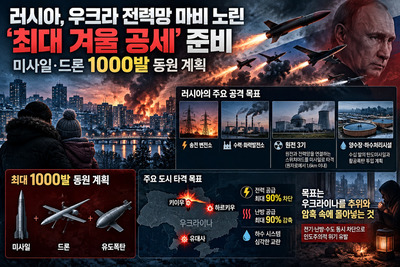
Moscow is preparing its largest winter energy strike since the invasion began, targeting Ukraine's power grid, heating systems, and water infrastructure with up to 1,000 missiles and drones. The escalation forces Europe to confront a grim reality: Kyiv's defenses may not hold.
The Target Isn’t Just Power — It’s Everything
Russia is preparing a winter offensive that marks a deliberate and visible shift in how it intends to wage this war. The latest intelligence, confirmed by intercepted Russian documents obtained by Ukraine and reported by the New York Times, outlines a plan to strike Ukraine’s power grid, heating networks, and water systems simultaneously — using up to 1,000 missiles, drones, and guided bombs this season.
What makes this campaign different from previous rounds of energy strikes is scope and coordination. This is no longer just about knocking out a single power plant or transformer station and waiting for repairs. The plan targets transmission substations, hydroelectric and thermal plants, district heating boilers, and — for the first time at this scale — water pumping stations and sewage treatment facilities. The objective is not merely to disrupt. It is to collapse essential services in Kyiv, Kharkiv, and Odesa simultaneously, cutting electricity and heating supply by up to 90 percent and creating what one Kyiv official described as a humanitarian crisis of proportions not seen since the early months of the full-scale invasion.
The documents, dated August, were presented by Ukraine’s Energy Minister Denys Shmyhal at a meeting in Paris two weeks before the latest reporting. President Volodymyr Zelenskyy confirmed the intelligence during his September visit to New York, warning that Russian forces are mobilizing for a large-scale new attack.
The strategic logic behind the plan is legible. Moscow has spent 2025 watching Ukraine rebuild its energy defenses with Western support — installing protective enclosures around transformers, deploying mobile generation units, and hardening key nodes in the transmission network. The Russian document acknowledges these measures directly and designs around them. Rather than attacking reinforced power plants, the plan shifts focus to the less-protected periphery: water infrastructure, distribution substations, and heating boilers that serve civilian districts. These targets are smaller, more numerous, and harder to defend in bulk.
Nuclear Infrastructure in the Crosshairs
One detail in the Russian document deserves particular attention. The plan specifically names Ukraine’s three operational nuclear power plants as targets, but not the reactors themselves — the switchyards that connect them to the national grid. These outdoor switching stations sit less than 1.6 kilometers from the reactors. A successful strike would effectively shut down nuclear generation without triggering a radiological incident, a calculated move that walks the line between military escalation and red-line avoidance.
It is a narrow path. Russia has struck near-nuclear facilities before. A repeat action this winter would force European governments into a far more uncomfortable calculation than they have faced so far. The International Atomic Energy Agency has repeatedly urged all sides to treat nuclear sites as off-limits, but Russian planners appear to have determined that disabling grid-connected generation at these facilities achieves strategic effect without crossing the taboo that has held since Chernobyl and Fukushima.
The geopolitical implications are immediate. If Russia strikes near-nuclear infrastructure and causes a prolonged shutdown of Ukraine’s largest power sources, the resulting blackout would amplify every other effect of the winter offensive. Nuclear plants typically provide roughly a quarter of Ukraine’s electricity. Losing that capacity on top of targeted strikes on thermal and hydro assets would push the grid toward total collapse far more quickly than any single vector could accomplish.
Why Water Matters
The inclusion of water infrastructure among primary targets is a signal. In previous winters, Russia focused on electricity and heating. This time, the calculus has expanded. Water pumps and sewage systems are interdependent with power — without electricity, pumps stop. Without functioning sewage, public health deteriorates rapidly. A coordinated attack on both creates compounding failures that no amount of short-term backup can sustain.
Ukrainian authorities have publicly acknowledged that emergency water reserves and alternatives are insufficient for a prolonged, multi-city disruption. That admission alone raises the stakes for European partners. Unlike electricity, which can be partially restored through distributed generation and cross-border imports, water infrastructure is geographically fixed and mechanically simple — pumps require continuous power, and replacement parts for industrial-scale pumping stations are not stockpiled in emergency warehouses.
The secondary effects are significant. Without pressurized water, hospitals cannot maintain sanitation protocols. Fire departments lose the ability to respond to fires in buildings left unattended during blackouts. Cold weather exacerbates every deficit: frozen pipes burst without pressure relief, and displaced residents seeking warmth in centralized locations increase the risk of respiratory outbreaks. The chain of consequences extends far beyond the initial strikes.
Defenses Are Being Tested Already
Russia has already begun this winter’s campaign. On October 30, a wave of missiles and drones struck a major thermal power plant in Kyiv, causing localized power and water outages. Ukraine’s air defense forces report a significant increase in the number of jet-engine drones and ballistic missiles deployed — systems that are harder to intercept than the Iranian-made Shahed drones used extensively in previous seasons.
Kyiv has responded by investing hundreds of millions of dollars in protective structures around substations, rapid repair capabilities at power plants, and distributed small gas-turbine generation. The think tank Ukraine Facility Platform estimated that roughly 5 gigawatts of restored generation capacity could be knocked offline again with only a few concentrated strikes. The math is unfavorable for Ukraine.
Air defense remains the critical bottleneck. Ukraine’s inventory of interceptors is stretched thin across a front line that spans thousands of kilometers. Each incoming wave of missiles and drones forces a trade-off: defend the grid or defend the cities. Russian planners understand this dynamic and are designing their strikes to exploit it. The October 30 attack, for instance, targeted a power plant within Kyiv’s city limits — forcing air defense commanders to choose between protecting civilians and protecting the infrastructure that keeps the entire metropolitan area functional.
Europe Is Watching — and Worrying
German Chancellor Friedrich Merz issued a stark warning this week, describing the coming months as potentially the harshest winter Ukraine has faced since the war began, and explicitly flagging the possibility of additional hybrid attacks beyond conventional strikes. Merz’s statement carries weight because Germany remains one of the largest single providers of air defense systems and military aid to Ukraine. If Berlin is sounding the alarm publicly, the threat is no longer theoretical within NATO corridors.
The broader implication is logistical. Europe’s own energy infrastructure — particularly in eastern member states — has grown more integrated with Ukrainian needs through cross-border electricity trading and mutual aid agreements. A total Ukrainian grid failure would send shockwaves through regional markets and strain already-tight European reserves heading into peak demand season. Poland, Slovakia, and Hungary have all reported increased electricity flows from Ukraine during recent cold snaps, making the prospect of an abrupt loss of that supply a tangible concern for European grid operators.
There is also a political dimension. Winter suffering in Ukraine has historically tested Western resolve. The memory of the 2022 energy crisis — when European governments scrambled to fill storage facilities and ration gas — is fresh enough to influence decision-making. But the calculus has shifted. In 2022, Europe was defending its own supply chains. This time, the question is whether European publics will accept the political and economic costs of extending aid to a country facing systematic infrastructure destruction on a scale that outpaces reconstruction.
What Happens Next
Ukraine’s ability to withstand this offensive depends on three variables: the speed and volume of incoming air defense aid from NATO partners, the resilience of its patched-together generation fleet, and Russia’s willingness to escalate further if conventional strikes fail to break Ukrainian morale.
Russia appears to have concluded — correctly — that Ukraine’s grid is now more vulnerable than at any point since 2022. The document’s emphasis on simultaneous, multi-vector strikes suggests Moscow believes Kyiv’s defenses are stretched thin. Whether that assessment proves accurate will determine not just Ukraine’s winter, but the political trajectory of Western support for the war.
The real test will come in December and January. If major cities lose heat and water for extended periods, the humanitarian picture will force decisions that European governments have so far tried to avoid. Aid packages will face harder scrutiny. Public opinion in key capitals will shift. The question is no longer whether Ukraine can survive the winter — it is whether the coalition supporting it can sustain the political will to keep helping it do so. Moscow’s strategy, as revealed in these documents, is designed to make that question unbearable.