Ukraine's Kerch Bridge Strike Changes the War's Geometry
Kyiv's destruction of the Kerch Bridge road span isn't just retaliation — it's a deliberate strategy to strangle Russia's Crimean supply line before any diplomatic settlement takes shape.
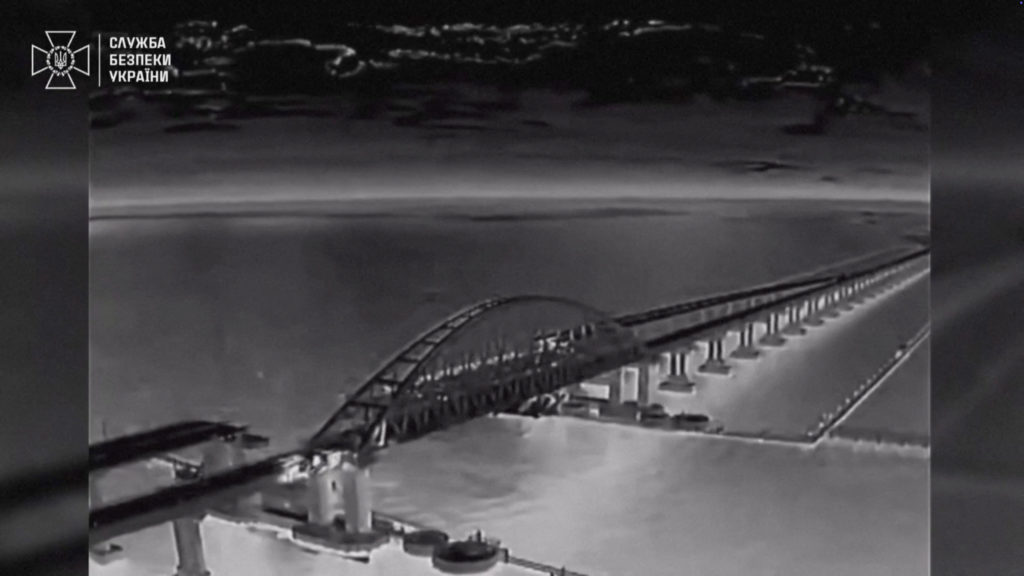
The bridge fell. Something else rose with it.
When a section of the Kerch Bridge collapsed into the sea overnight, it wasn’t just concrete and steel hitting water. It was Ukraine sending a message to every capital watching the war: the terms of any settlement will be written by what happens on the battlefield, not in meeting rooms.
President Volodymyr Zelenskyy called it “unprecedented.” That understates it. This was the first time Ukrainian forces have taken out a load-bearing arch on the road span of a structure Moscow treats as sacred territory. The railway below remained standing but damaged — a detail that matters enormously.
Why this matters right now
The timing isn’t coincidental. U.S. President Donald Trump is preparing to meet Chinese President Xi Jinping and Russian President Vladimir Putin in China this week. Diplomatic channels are humming. And Ukraine struck one of Russia’s most symbolically charged infrastructure projects with a precision campaign that took weeks to set up.
Zelenskyy described seven stages of preparation — knocking out defense systems, radars, electronic warfare equipment — before unleashing domestic long-range drones, Neptune missiles, and Flamingo precision-guided munitions on Monday night. The operation wasn’t improvised. It was planned, patient, and executed.
This is Ukraine demonstrating that it can still choose when and where to fight, even as Russia maintains air superiority claims and fires ballistic missiles at Kyiv’s civilian bridges.
The logistics layer Western analysts ignore
Most coverage focused on the symbolism: the “symbol of occupation cracked,” as Ukraine’s General Staff put it. The optics matter. But the real story is logistical.
The Kerch Bridge carries the bulk of military supplies from mainland Russia into occupied Crimea. It is the single most critical node in Russia’s southern flank. Severing the road link disrupts truck convoys carrying fuel, ammunition, and personnel. Damaging the rail span complicates heavier freight. Either way, Crimea’s garrison — estimated at over 150,000 troops — faces a harder supply line.
Russia’s installed governor Sergei Aksyonov reported halted traffic but said rail was restored by Tuesday afternoon. Kremlin spokesman Dmitry Peskov promised reconstruction would make the bridge “even better.” That may be true短期内. But delays compound. Every day without full capacity strains Russian logistics across an already overstretched front.
The escalation ladder both sides are climbing
Russia responded with its own demonstration of reach. Seven ballistic missiles struck two of Kyiv’s main bridges — the Pivnichnyi and Pivdennyi crossings over the Dnipro River. At least two people died. Commuter lines stretched across remaining crossings.
Moscow also claimed strikes on military industrial facilities, energy infrastructure, and port assets. In Zaporizhzhia, attacks on industrial districts killed two and wounded 18. In Bashkortostan, nearly 1,300 kilometers inside Russia, authorities reported repelling a massive drone assault on petrochemical plants near Ufa and Salavat. Independent outlet Astra documented a large fire at the Gazprom Neftekhim complex there.
Russia’s Defense Ministry reported downing 1,441 Ukrainian drones on the same night — the second consecutive day breaking its own interception records. Those numbers suggest Ukraine is launching more drones than ever, and Russia is struggling to keep up despite layered air defenses.
It is a war of attrition being fought simultaneously at the tactical level and the strategic one.
What this means for diplomacy
Here is what English-language coverage is underweighting: Ukraine is restructuring the battlefield before the negotiators arrive. The Kerch strike shows Kyiv still possesses offensive capability deep behind Russian lines and is unwilling to let diplomatic processes freeze territorial facts on the ground.
Rustem Umerov, head of Ukraine’s Foreign Intelligence Service, confirmed that working talks occurred Monday between Ukrainian, American, and European partners, including envoys Steve Witkoff, Jared Kushner, and Alexus Grynkewich. France, Germany, the United Kingdom, Italy, Poland, NATO, and the European Commission participated. They discussed Abu Dhabi talk outcomes and next steps.
Meanwhile, the United Kingdom announced £240 million in winter air defense support — more than 1,000 short-range missiles and over a dozen radars. Defense Secretary Wes Streeting called the bridge strike evidence of “Ukrainian ingenuity and absolute determination.”
But the weapons pipeline cannot compensate for lost ground. Ukraine’s message through the Kerch operation is clear: every territory Russia holds was taken by force, and Ukraine retains the ability to inflict cost on the infrastructure that makes occupation sustainable.
Who wins, who loses, what happens next
Ukraine wins credibility with Western backers who worry about fatigue. It proves the war is not stalled. It demonstrates that Moscow’s homeland claims — that Ukraine cannot strike deep — are false.
Russia loses something it cannot easily replace: the illusion of permanence around Crimea. The bridge was supposed to bind the peninsula to Russia forever. Now it is damaged, repairable yes, but no longer invulnerable.
The question ahead is whether Kyiv can sustain this tempo. Drone production, missile stocks, and soldier readiness are finite resources. Russia has deeper industrial bases and a wartime economy fully mobilized.
What comes next likely involves continued strikes on Crimean logistics — airfields, fuel depots, troop concentrations — and sustained pressure on Russian rear-area industry. The Kerch Bridge was not the end game. It was an opening move in a broader campaign to make occupation too expensive to maintain.
If Trump, Xi, and Putin do meet this week, they will discuss diplomacy. Ukraine has just ensured the conversation starts from a different baseline.