Ukraine's Record Drone Surge Reveals Russia's Shrinking Air Defense Bubble
Ukraine's 1,600-drone assault on Moscow—its largest ever—marks a pivot to long-range indigenous missiles and exposes the thinning Russian air defense perimeter around its own heartland.
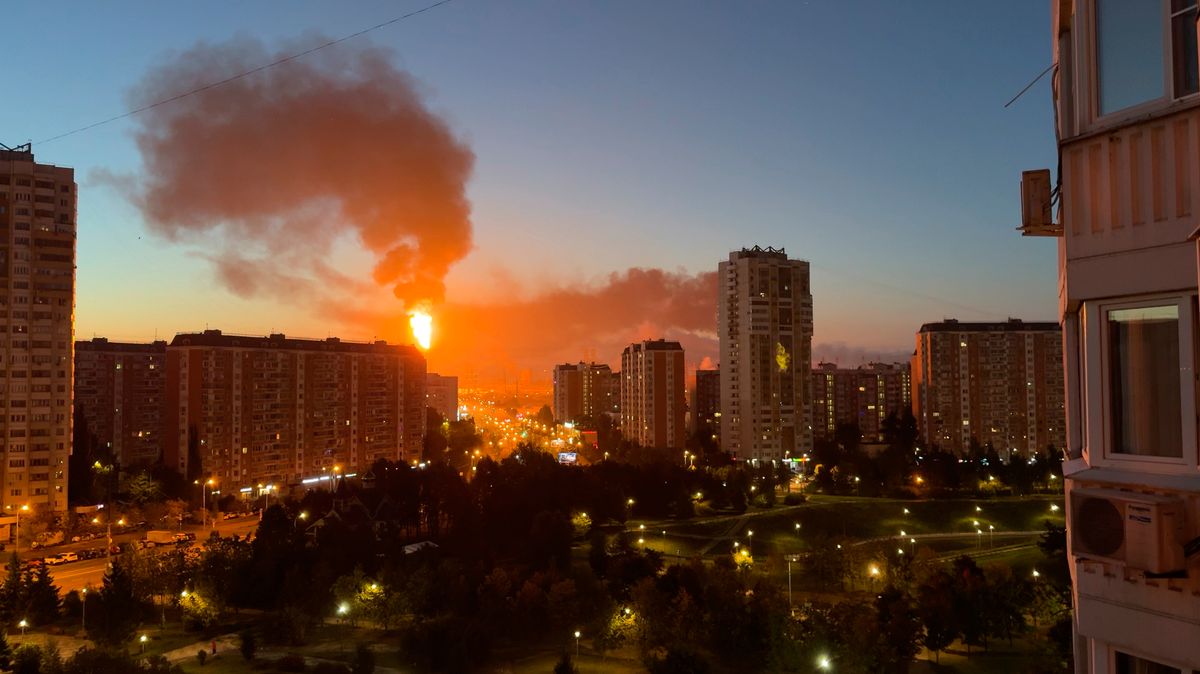
The numbers are staggering, but the story is deeper.
On September 20, Ukraine unleashed 1,600 drones at Russia—its single largest aerial strike of the war. Four-fifty of those targets reached Moscow itself. The gaspronymef Moscow refinery in Kapotnya, which supplies roughly 40 percent of the capital’s fuel, erupted in flames. A residential tower in Ramenskoye took a direct hit, forcing the evacuation of 600 people. Two civilians died; twenty were wounded, including three children. Four airports grounded all flights. A Turkish Airlines passenger plane en route from Istanbul turned back mid-flight to avoid the chaos.
What happened that night is not merely a headline number. It is a signal that Ukraine’s air strategy has moved into a qualitatively different phase.
The FP-7 is the real story.
President Volodymyr Zelensky confirmed that Ukraine used a new domestically produced ballistic missile—the FP-7, code-named Pelican—in its first combat strike against Russian territory. This changes the calculus. Previous Ukrainian long-range systems, including the Hedgehog and various cruise missile variants, already threatened deep into Russia. But a ballistic missile operates on a fundamentally different trajectory. It flies higher, faster, and on an arc that complicates interception. Russian air defense belts, built around layered short- and medium-range systems like the Buk and Tor, are designed primarily to catch drones and cruise missiles that hug terrain. Ballistic threats force those same systems to engage at steeper angles and shorter reaction windows.
Zelensky framed the strike explicitly as a financial operation. “We hit Russia’s key oil and logistics facilities,” he said, “cutting off the billions of dollars that sustain the war machine.” That framing matters. It tells us this was not a sporadic retaliation but a targeted campaign against the revenue streams that fund Moscow’s military apparatus. The Kapotnya refinery is not a minor target. It is a linchpin of Moscow’s fuel supply, and its destruction sends a message: no Russian city is outside Ukraine’s reach if it houses critical energy infrastructure.
The election timing was deliberate, not incidental.
The strike fell on the final day of Russia’s State Duma elections, the first parliamentary vote since the full-scale invasion in 2022. The Kremlin presented the process as a controlled demonstration of national unity. The opposition party Yabloko had been removed from the ballot by a Supreme Court ruling. Turnout and results were predictable. Into this theater Ukraine launched its biggest operation yet.
Russia’s response was immediate and bitter. The Central Election Commission accused Ukraine of a cyber and drone terror campaign designed to disrupt online voting. Moscow claimed its systems held, but the optics were toxic for a regime that depends on images of normalcy and control. Putin’s power base was being showcased on the very night his adversary proved it could strike at the center of that power.
That Ukraine chose election day is not accidental. It is the kind of strategic signaling that separates tactical strikes from psychological operations. The message was not just about damaging a refinery. It was about showing that Russia’s electoral theater cannot proceed without the sky above it being contested.
The Trump ceasefire claim rang hollow overnight.
On September 14, former U.S. President Donald Trump asserted that both sides had agreed to halt attacks on energy infrastructure. Neither Kyiv nor Moscow formally confirmed any such deal. Within days, Ukraine was burning Russian fuel facilities and Russia was flattening Ukrainian neighborhoods. The episode confirms what many analysts suspected: unilateral declarations about ceasing infrastructure strikes have no traction when both sides benefit from inflicting economic pain on each other. Ukraine’s economy has been under relentless bombardment; hitting Russia’s energy export nodes is both retaliation and deterrence. That Trump’s claim collapsed so quickly says more about the limits of off-script diplomacy than about either government’s willingness to negotiate.
Russia struck back, but at what cost?
In the same 24-hour window, Russia launched 138 drones and jet-engine-equipped UAVs at Ukraine. Eight civilians died in Kyiv’s Pasaty district and the Sumy region—a mother and two children in one home, four more killed in a vehicle strike. Russia’s defense ministry claimed precision hits on the Fire Point weapons manufacturer in Kyiv and cargo ships at Odessa port. Whether those claims hold up remains unclear, but the human toll is unambiguous.
The exchange reveals a grim symmetry. Both sides are inflicting maximum pain on civilian-adjacent infrastructure. Both are testing whether the other’s population will fatigue. Neither is pulling back. The question now is who breaks first—and whether either side can afford to keep escalating without crossing a line that invites outside intervention.
What happens next.
Moscow’s air defense bubble has clearly contracted. The 1,600-drone figure alone does not prove that, but the combination of volume, diversification, and the FP-7’s introduction does. Russia spent years building a layered defensive perimeter around its major cities. Ukraine’s latest operation shows that perimeter is penetrable—not because Russia’s systems are weak, but because Ukraine has learned to saturate them. One hundred and sixty drones are a nuisance. Sixteen hundred are a coordinated storm.
The financial angle will intensify. Expect more strikes on refineries, rail terminals, and storage depots deeper inside Russia. Each one chips away at the logistics that feed both the front line and the domestic economy. Russia’s response will likely follow the same pattern: more drones toward Ukrainian cities, more claims of precision strikes, more civilian casualties that serve as bargaining leverage rather than bargaining chips.
The war is no longer being fought only in the Donbas or along the southern front. It is being fought in the sky above Moscow and Kyiv, in the language of drones and missiles, and in the political narrative each side tries to project to its own people and to the world. Ukraine’s record strike proves it has the range, the weapons, and the audacity to keep raising the stakes. Russia’s air defense may adapt, but adaptation takes time—and time is something neither side has in abundance.