US-China Rebrand AI as 'SI' — And What That Silence Means
Trump and Xi agreed to call AI 'superintelligence' and set up a bilateral dialogue. Neither side has used the term domestically. The gap between the press release and reality reveals who actually controls the AI governance narrative.
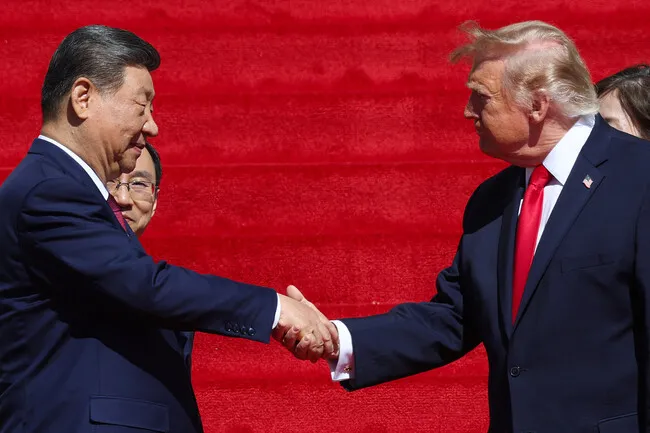
The term changed. The power dynamics didn’t.
The White House fact sheet released after Donald Trump and Xi Jinping’s Washington meeting contained a line that looked like a small bureaucratic adjustment. The two leaders had agreed, on the record, to replace “artificial intelligence” with “superintelligence” in their bilateral communications. They also agreed to install a new dialogue framework — the US-China Superintelligence Dialogue — with a first meeting scheduled before November, plus a dedicated bilateral communication channel for SI-related incidents.
That last detail is the one most English-language coverage will miss: it’s an explicit acknowledgment that both governments now treat the trajectory of AI development as a bilateral strategic risk, not just a domestic regulatory question. Crisis communication channels exist between nuclear powers for a reason. The implication here is that superintelligence is entering the same category as other existential-tier strategic risks.
But read past the headline and the story fractures quickly.
China never agreed to the language. It agreed to the structure.
The Hani report notes plainly that China has not officially used the term “superintelligence” domestically. Trump announced the rebranding in his September 22 UN address. The White House fact sheet reflected it. Beijing went along with the framework — the dialogue, the communication channel — without adopting the terminology that Trump insists on.
This is diplomatic pattern recognition, not speculation. Beijing has consistently preferred language that emphasizes capability and development over risk and governance when discussing AI. The Chinese state media apparatus rarely uses terms that foreground existential risk narratives around AI. That’s not accidental. It’s strategic positioning: risk framing invites restraint. Capability framing invites investment.
The agreement, then, is asymmetric on its face. The US gets the terminology win — the rebranding it wanted inscribed in a joint fact sheet. China gets a structured dialogue with the United States that keeps it at the table on AI governance without ceding any semantic ground. Both sides can tell their domestic audiences they won.
What the SI framework actually contains
The dialogue’s stated purpose is exchanging views on the risks and benefits of superintelligence. The communication channel is meant for incident response. That’s all the White House disclosed. No enforcement mechanism. No alignment benchmark. No timeline beyond “before November.”
For comparison, the UK-led AI Safety Summits have produced multi-lateral declarations with specific institutional commitments. The US-China channel is thinner. It’s bilateral by design — exactly the kind of arrangement that makes sense when the goal is crisis management, not consensus-building.
That’s the real takeaway: the framework is an insurance policy, not a governance structure. It acknowledges that the US and China are developing advanced AI systems in parallel, potentially reaching capability thresholds that neither can monitor alone, and that a malfunction or miscalculation on either side could spiral. The communication channel exists because the alternative — ambiguity during a crisis — is worse.
The silicon shadow behind the rebrand
Semiconductor policy is where this story actually lives. The US has maintained tight export controls on advanced chips and chipmaking equipment to China since 2022, with repeated tightening under the Biden administration that the Trump administration has largely preserved. China’s response has been accelerated investment in domestic alternatives and control over critical mineral exports — particularly gallium, germanium, and antimony, which feed into semiconductor manufacturing.
The White House fact sheet mentioned that consultations on rare earths and critical minerals are ongoing. Nothing was concluded publicly. This is the unresolved tension underneath the SI language. The US wants China to cooperate on AI safety governance while restricting the hardware China needs to build advanced AI systems. China wants access to advanced semiconductors while building sovereign capability. The dialogue framework doesn’t resolve either contradiction — it creates a diplomatic surface where both can pretend they’re making progress.
Who wins, who loses, who’s watching
Trump gets a rebrand that domestic allies can frame as presidential initiative on AI governance. The terminology shift also subtly reframes the entire field: “superintelligence” sounds grander, more inevitable, more American. It pulls the narrative away from European-style precaution and toward American-style acceleration — even as the White House claims to be focused on risk.
Xi gets a bilateral channel with the US on AI that bypasses the multilateral forums where China faces more scrutiny. The G7, the UN, the OECD — those are places where AI governance standards tend to reflect Western priorities. A bilateral US-China track keeps the conversation on their terms and leaves smaller countries to absorb whatever norms emerge.
European and Japanese AI policymakers lose the most in relative terms. The countries that have been most active in multilateral AI safety frameworks watch the two largest AI powers agree to a lightweight bilateral arrangement and wonder whether the center of gravity is shifting away from the rules-based approach they’ve championed.
Chinese AI companies lose the least. They already expected the terminology to be hostile or restrictive. “Superintelligence” changes nothing about their R&D priorities or their access to domestic compute. If anything, the diplomatic performance around SI gives Beijing cover to continue its own capability push without appearing to ignore risk concerns.
The November test
The first meeting of the SI Dialogue is due before November. That’s the date to watch. If both sides show up with substantive risk assessment frameworks — even partial ones — the rebrand has substance behind it. If the meeting produces another joint statement with no operational detail, the SI language was always just packaging for a familiar diplomatic gesture.
The communication channel is the harder element to assess. Crisis hotlines only prove their value when they’re used. Until then, they’re institutional theater.
One detail the Hani report includes but won’t dominate headlines: China has committed to importing at least 10 million tons of US coal annually from 2027 to 2028. The fact sheet presented this as a trade achievement. It’s also a reminder that even as the two powers rebrand AI governance, their economic relationship remains structured around asymmetric dependencies — energy for technology, technology for markets. The SI framework sits on top of that architecture. It doesn’t replace it.
The rebrand is real. The governance is aspirational. The competition is unchanged.