What US Aircraft Withdrawals From UK Mean for Iran Escalation
The second evacuation of US aircraft from British airbases in weeks signals a credibility problem for forward deployment. Here's what Trump's contradictory messaging and the repositioning reveal about escalation risk.
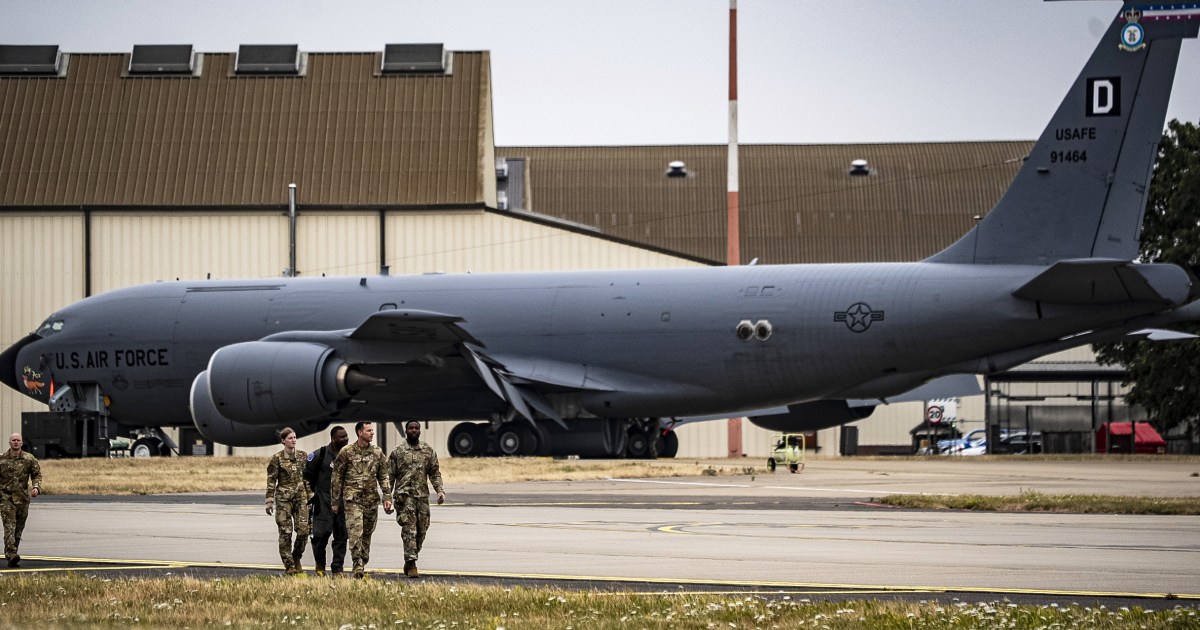
The Second Withdrawal in Weeks
The United States has evacuated at least eight Boeing KC-135 Stratotanker refueling aircraft and three MV-22 Osprey tiltrotor transports from RAF Mildenhall in Suffolk. Flight tracking data confirms the movement began Monday, with several tankers rerouted to Germany and Spain and one sent to the Glasgow Prestwick area in Scotland. The Ospreys were transferred to nearby RAF Lakenheath, home to the 48th Fighter Wing.
This follows a nearly identical evacuation from RAF Fairford in Gloucestershire, also in England, which occurred weeks earlier after police foiled a suspected terrorist plot linked to Iran. British authorities detained five men on September 27 after three suspicious vans were observed traveling toward the base. Two were later charged under the National Security Act. The incident triggered an immediate reassessment of security arrangements at both sites, but it did not produce a permanent recalibration — until now.
Two separate US aircraft evacuations from British soil in a single month is not routine rotation. It is a pattern. And patterns matter in force posture analysis because they reveal assumptions that official statements often obscure.
The Contradiction at the Top
On the same day the Mildenhall movement unfolded, President Donald Trump offered a dramatically different reading of events to reporters at the White House. He told Qatar’s Prime Minister Sheikh Mohammed bin Abdulrahman Al-Thani that “Iran militarily is effectively over” and that further US attacks “won’t be necessary.” Yet Trump also warned Washington remained “locked and loaded” should circumstances change.
The messaging is deliberately calibrated to send two simultaneous signals: de-escalation to markets and partners, and readiness to adversaries who might mistake restraint for weakness. But the operational record undermines the narrative. The US is moving high-value assets away from bases it has relied on for years of strike operations against Iranian targets. KC-135s are among the most strategically valuable platforms in the US inventory, each carrying a mission value exceeding $100 million. Pulling them off British runways is not a cosmetic decision.
Secretary of State Marco Rubio acknowledged the concern separately, saying Washington had addressed threats against American diplomats overseas by “moving people away from the threat.” That is standard force protection doctrine, but it is also an implicit admission that the threat threshold has crossed a line. The phrase itself — moving people away from danger rather than reinforcing the perimeter — carries a particular weight. It signals that defenders no longer view static defense as sufficient.
US European Command declined to specify the nature of the threat, citing operations security. A US official confirmed to NBC News that enhanced force protection measures were in place. The Wall Street Journal reported the evacuation followed a specific Iranian threat, though details remain classified. What we do know is that the threat assessment came through established intelligence channels and carried enough urgency to override normal rotation schedules.
Tehran has denied involvement in either the RAF Fairford investigation or any new threat to RAF Mildenhall. But the Islamic Revolutionary Guard Corps issued a direct warning in July: any base used to launch attacks against Iranian territory is a legitimate target. The warning carried the weight of precedent. In April, Iranian-backed militias struck al-Asad Airbase in Iraq, home to roughly 2,000 US personnel. The message was clear and the targeting was real.
What This Means for Forward Deployment
Forward-deployed forces depend on a basic assumption: that allied territory provides a secure operating environment. That assumption is cracking. The US does not evacuate aircraft from UK bases on a whim, and it does not do so twice in consecutive weeks without a compelling trigger.
For Britain and its NATO partners, the withdrawal carries a direct implication. The security architecture built over decades around US basing agreements rests on a promise that Americans will stand alongside Europeans in a conflict. Those agreements contain access rights, hosting obligations, and legal frameworks. None of them guarantee immunity from asymmetric threats or terrorism directed at the infrastructure itself. The Finegentlemen framework between the US and UK, which governs the stationing of American forces on British soil, addresses conscript jurisdiction and logistical support. It does not address the possibility that the host nation’s own counterterrorism apparatus could be outmatched by a determined adversary operating through proxy networks or covert cells.
When the US pulls its tankers off the ramp, it leaves a capability gap on the island that no British asset can immediately fill. The Royal Air Force operates Voyager tanker aircraft, but their numbers are limited and their range profile differs significantly from the KC-135 fleet. The absence from RAF Mildenhall reduces the density of US airpower projection out of the UK, even if the physical airstrips remain available. More critically, it sends a signal to potential adversaries that the cost of threatening US assets in Europe has dropped substantially. If you can force a relocation by issuing a credible threat — without firing a single projectile — you have achieved something real.
Second-Order Effects Across the Alliance
The withdrawals will reverberate beyond the immediate operational landscape. German and Italian bases that received the relocated aircraft will face increased congestion and logistical pressure at already strained facilities. Ramstein Air Base in Germany, a critical hub for US European Command operations, now absorbs additional transit traffic that previously flowed through UK corridors. This creates friction with host nations that have grown accustomed to predictable basing rhythms.
For NATO’s eastern flank, the psychological impact cuts both ways. On one hand, the US demonstrated it can respond swiftly to emerging threats by relocating assets. On the other, it revealed that those same assets are vulnerable to threats that traditional deterrence — nuclear umbrellas, conventional force postures, alliance commitments — was never designed to neutralize. Asymmetric attack planning now has a new template: threaten the base, not the soldier; threaten the runway, not the fighter; threaten the fuel depot, not the bomber.
European defense manufacturers may find themselves fielding urgent requirements for layered air and missile defense systems around sensitive installations. The UK Ministry of Defence has already begun internal reviews of security protocols at all joint-use facilities. But procurement cycles move slowly, and the threat environment moves faster.
Who Wins and Who Loses
In the short term, the US preserves its most valuable assets while maintaining the ability to rebuild strike capacity from alternative bases in Germany, Spain, and Scotland. It avoids the catastrophic scenario of losing aircraft or personnel to an attack that British counterterrorism units could not prevent.
Britain gains nothing operationally from the withdrawals. It loses bargaining leverage with Washington and faces heightened visibility as a target in its own right. The RAF Fairford incident attracted enormous international attention precisely because it occurred on British soil and involved British police. The subsequent Mildenhall movement compounds that attention. Every evacuation makes the next one easier to imagine and harder to dismiss.
Iran achieves something subtler but strategically significant. It demonstrates the capacity to disrupt US forward operations without firing a shot. The threat alone forced a repositioning of military hardware worth billions. That is the definition of asymmetric success — achieving disproportionate strategic effect through comparatively minimal investment.
What Comes Next
Allies should prepare for continued volatility rather than assuming the situation stabilizes. Trump’s claim that further attacks are unnecessary rests on the premise of a negotiated settlement, but the framework is fragile and unconfirmed. Ceasefire momentum described by the White House has not yet translated into a durable agreement. Regional actors with their own grievances — Hezbollah in Lebanon, Houthi forces in Yemen, various Iranian-aligned militias across Syria and Iraq — operate on timelines independent of Washington and Tehran.
European governments need to begin planning for scenarios in which US basing support becomes intermittent rather than continuous. That means investing in indigenous air defense around critical infrastructure, diversifying refueling and logistics options, and accepting that forward deployment is now conditional rather than guaranteed. The UK’s own Strategic Defence Review, completed in early 2023, identified exactly these gaps. Implementation has been partial at best.
The longer-term challenge is doctrinal. For years, NATO strategy treated the UK as a secure staging ground for power projection into Europe and the Middle East. The Mildenhall and Fairford sequences suggest that premise requires revision. The era of assumed base security in contested regions is ending, and the costs of that transition will fall heavily on European defense budgets. Nations that fail to adapt will find themselves either paying premiums for last-minute security upgrades or watching their territories become liabilities rather than assets in allied战 planners’ equations.
Trump’s rhetoric frames the situation as resolved. The aircraft movements say otherwise.