US Shuffles Marines From Korea to Iran Front
Washington's cancellation of joint amphibious drills reveals a strategic pivot that leaves Seoul filling a growing reassurance gap. As Trump prioritizes the Middle East and courtes Kim Jong-un, Korea must choose between accelerating defense spending or accepting a diminished alliance.
A Strategic Shift, Not a Scheduling Conflict
When the United States formally notified South Korea in June that it could not deploy forces for this year’s Ssangyong amphibious exercise, the reason was not a budget shortfall or a logistical snag. It was the Iran war. The cancellation, confirmed by Seoul on Monday, is a blunt indicator that Washington is treating the Middle East as the primary theater of military attention—and the Korean Peninsula as a secondary concern.
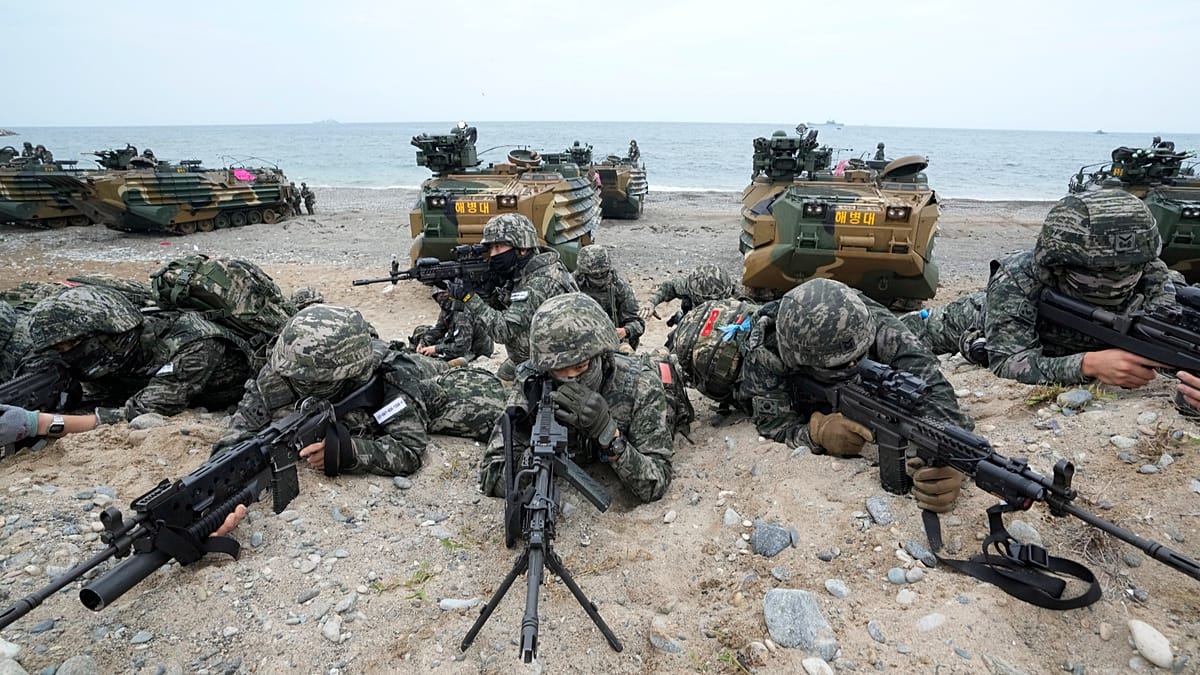
The Ssangyong drills, held biennially, involve both nations’ marine forces rehearsing amphibious landings with warships, aircraft, and ground troops. Their absence next month leaves a conspicuous gap in combined‑operations readiness. But the real story lies in the context: just last week, President Donald Trump ordered a drastic reduction of the annual Ulchi Freedom Shield training exercise, cutting it from 11 days to five. Trump justified the cut by citing high costs and labeling the large‑scale drills as an “inappropriate and hostile” signal to North Korea—a remark that underscored his intent to revive the personal rapport he built with Kim Jong‑un during his first term.
The Calculus Behind the Pullback
Trump’s moves are consistent with a broader prioritization of the Middle East. With US Marine Corps units already strained by deployments tied to the Iran conflict, pulling assets from the Korean theater is a force‑management decision that sends a clear message: Washington’s military attention is elsewhere. The administration’s rhetoric about “getting along” with Kim is equally telling. Trump repeated that Pyongyang now possesses 57 “very powerful” nuclear weapons, a figure far below Seoul’s own estimate of 80–120 warheads. Whether the president is underestimating the threat or deliberately downplaying it, the effect is the same: he is signaling that the US will not anchor its deterrence posture on the Korean Peninsula.
For Seoul, the implications are stark. The US–South Korea alliance has long rested on the promise of extended deterrence—the guarantee that American forces would defend the South against aggression. When joint exercises are scaled back and regular rotations of marines are paused, that promise acquires a conditional quality. The reassurance gap is not merely rhetorical; it is material. Every cancelled drill is a tangible reduction in combined‑arms proficiency, and every day without a visible US marine presence is a day in which North Korea can rehearse its own contingency plans without interference.
Who Wins, Who Loses
The immediate winner is Donald Trump. He has secured a political narrative that he is reducing costly overseas engagements while pursuing a diplomatic opening with Kim. The cost savings from shrinking Ulchi Freedom Shield are real, and the perceived de‑escalation may buy him leverage in the Middle East. For the North Korean regime, the US pullback offers a strategic windfall: it validates Pyongyang’s long‑held suspicion that American commitments are fickle and that nuclear weapons are the only reliable insurance. Kim’s acceleration of the nuclear program after the failed 2019 Hanoi summit was a direct response to perceived US unreliability; this year’s drill cancellations reinforce that lesson.
The loser is South Korea. Seoul faces a binary choice: invest heavily in its own defense capabilities to compensate for the diminished US presence, or accept a lower threshold of American reassurance and hope that Trump’s diplomatic outreach to Kim yields stability. The former path requires billions in new spending, likely directed toward indigenous missile systems, submarine fleets, and air‑defense networks. The latter path risks a security deficit that could embolden Pyongyang and unsettle allies across the region. Neither option is comfortable, and both carry political costs.
What Happens Next
Seoul and Washington are consulting on whether to resume the Ssangyong exercise, but no details have been offered. Given the ongoing constraints on US Marine Corps deployments, any resumed drill will likely be smaller in scale and shorter in duration. The Pentagon has declined to comment on Seoul’s announcement, which itself is a signal: the administration is not急于 to explain a policy that may be adjusted further as the Iran situation evolves.
For South Korea, the most consequential development will not be the cancellation of a single exercise, but the precedent it sets. If the US can unilaterally scale back core alliance activities in response to another theater, then the durability of the Korean commitment is no longer a given. Japanese and Australian observers are watching closely. A recalibration of US forces in East Asia could ripple through the entire Indo‑Pacific security architecture.
Seoul’s government will likely respond with a dual track: public reaffirmations of alliance solidarity coupled with accelerated procurement and defense‑industry initiatives. In July, South Korea announced a $3.7 billion increase in defense spending for the next fiscal year, with a focus on asymmetric capabilities and joint‑force modernization. The Ssangyong cancellation will only intensify those plans.
The Broader Implication
The cancellation of joint marine drills is not an isolated incident; it is a symptom of a wider strategic rebalancing. Washington is confronting multiple crises simultaneously, and the Middle East has emerged as the priority. That does not mean the Korean alliance is abandoned, but it does mean that the traditional pillars of deterrence—visible US force posture, regular combined training, and unequivocal rhetorical commitment—are being whittled away.
For South Korea, the question is no longer whether the US will honor its treaty obligations, but how much of its security budget must be diverted to replace capabilities that were once guaranteed. The alliance remains vital, but its value is now subject to the same competitive pressures that drive all great‑power partnerships: interest, capacity, and political will. When those factors diverge, as they are doing now, the weaker partner must adapt—or risk being left behind.
The coming months will test whether Seoul can bridge the reassurance gap with money and technology, or whether it will have to rely on diplomacy and deterrence by denial alone. Either path requires a level of strategic autonomy that Seoul has never fully embraced. The Iran war may be far from the Korean Peninsula, but its shadow is already lengthening across it.