Venus's Clouds May Not Be What We Thought
A 2025 reanalysis of 1978 data suggests Venus's clouds may contain far more water and iron salts than the classic concentrated sulfuric acid model allows—reshaping the science of runaway greenhouse planets.
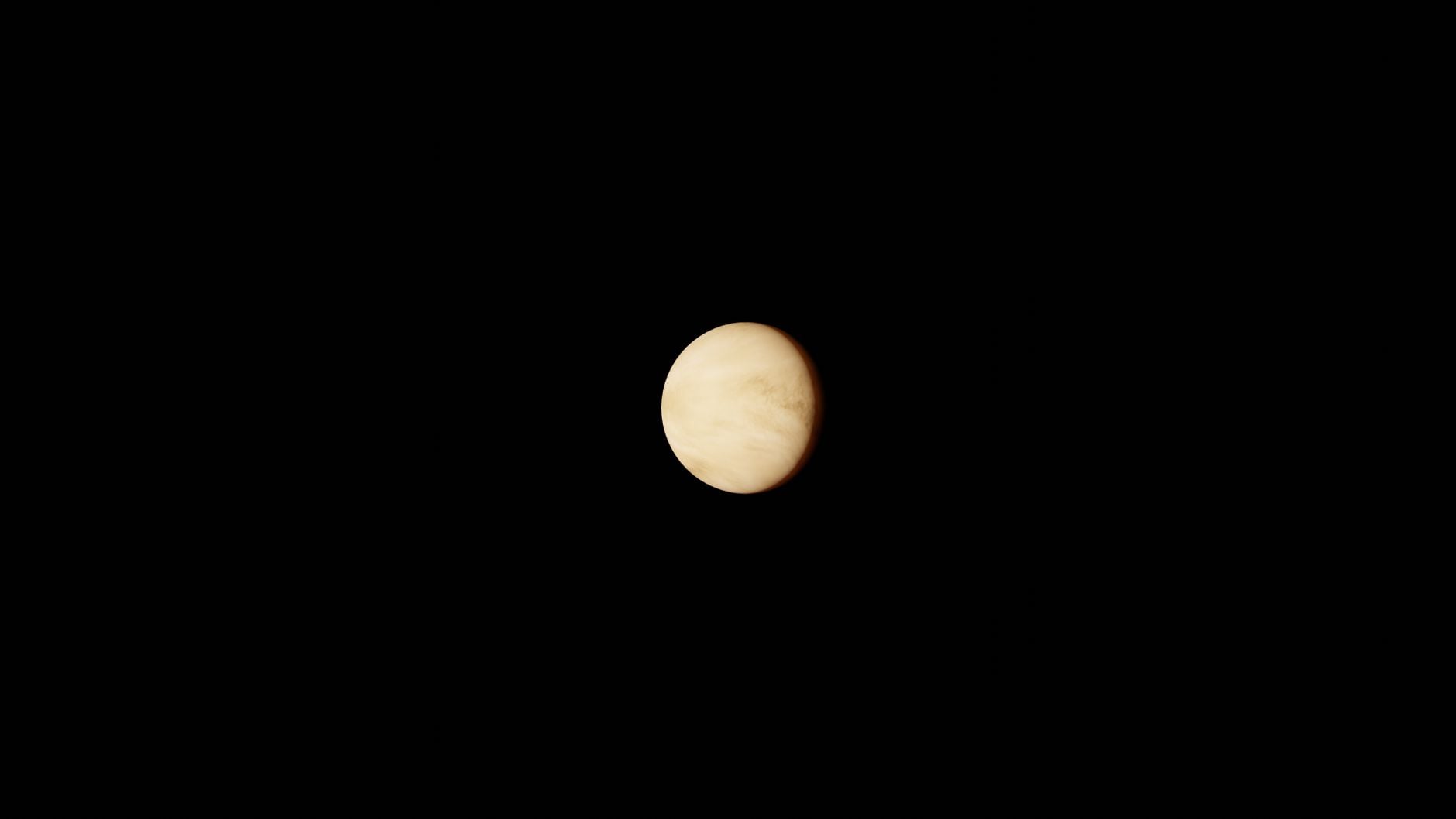
A 1978 accident is rewriting Venus
For nearly half a century, scientists have described Venus’s cloud deck as droplets of concentrated sulfuric acid floating in a carbon-dioxide atmosphere. The image is simple, stubborn, and embedded in every textbook on planetary atmospheres.
A 2025 paper asked whether an accidental experiment recorded during NASA’s Pioneer Venus Large Probe descent actually captured something far more complex.
The result, published in the Journal of Geophysical Research: Planets, assigns roughly 62 percent of the trapped aerosol mass to water and 16 percent to ferric sulfate — compounds that do not fit neatly inside the classical acid-droplet picture.
This is not a claim that Venus hides lakes in its skies. It is a claim that most of the water in those clouds is locked inside hydrated minerals, released only when the probe’s own instruments baked the sample during descent.
The unintended experiment
The Pioneer Venus Multiprobe launched four atmospheric probes on December 9, 1978. The Large Probe descended through the dayside equatorial clouds and carried a neutral mass spectrometer and a gas chromatograph. Neither instrument was designed to analyze solid aerosol particles. Their job was to sample gases.
As the probe crossed the middle and lower cloud layers, aerosols apparently entered the gas-sampling plumbing. The mass spectrometer inlet clogged temporarily around 51 to 48 kilometers altitude. The gas chromatograph collected material as well.
Then Venus provided its own oven. The probe kept descending into a thickening, heating atmosphere, and the chromatograph performed programmed heating steps. Material retained in the lines evaporated or decomposed and released compounds that the instruments recorded.
The original teams noticed odd behavior. Rakesh Mogul’s group reframed it. They treated the sequence as an improvised thermal analysis — the same principle behind modern evolved-gas experiments, where a researcher heats a sample and identifies what escapes at each temperature.
Water released in steps
The reanalysis did not find a single spike in water vapor. It found a pattern.
Water emerged in distinct peaks near 35, 80, 185, 242, 276 and 414 degrees Celsius. Sulfur dioxide, oxygen, sulfur trioxide and metal-bearing signals appeared alongside them in their own sequences.
The 185-degree peak aligns with products expected when sulfuric acid and less stable hydrates decompose. The largest water peak, near 414 degrees, coincided with signals the team linked to the breakdown of heat-resistant hydrated ferric sulfates and related minerals.
A possible magnesium sulfate signal also appeared, though old mass spectra often overlap at the same nominal mass. The ferric sulfate reconstruction draws on several mutually consistent products, but it remains an interpretation — not a grain of material imaged under a modern microscope.
The argument is pattern-based: a simple sample of concentrated sulfuric acid cannot easily reproduce the full sequence of temperature-ordered releases.
What the percentages actually mean
The reconstructed bulk composition assigns 62 ± 8 percent of aerosol mass to water. But 59 of those percentage points came from high-temperature release attributed to metal sulfates and other hydrates. Intermediate hydrates contributed about 3.3 percent. The free liquid or solution-phase share was estimated at just 0.2 ± 0.1 percent.
Hydrates are compounds whose crystal structures incorporate water molecules. Gypsum is a familiar terrestrial example. Heating drives that water off as vapor even though the mineral never flows, splashes or behaves like liquid water.
The 62 percent figure also carries a narrower denominator than headlines might imply. It describes the reconstructed composition of aerosols captured over a short interval during one descent, based on compounds that produced detectable gases. It does not mean that 60 percent of Venus’s atmosphere is water.
The authors call these percentages maximum values because some aerosol constituents may not have decomposed into identifiable products. Undetected refractory material would increase total particle mass and reduce the percentage assigned to measured components.
In practical terms, the reconstruction yields about 4.2 milligrams of water per cubic meter of cloud, within roughly 6.8 milligrams per cubic meter of inferred aerosol material. The proposal is about sparse suspended particles, not a hidden ocean.
The classic model survives, barely
The sulfuric acid model did not arise from habit. Cloud refractive properties, atmospheric chemistry, remote spectroscopy and measurements by multiple probes have all been consistent with droplets dominated by sulfuric acid and water.
A 2021 analysis in Nature Astronomy used that standard composition to estimate a water activity near 0.004 in Venus’s clouds. Water activity measures how much water is available for chemical or biological processes, not simply how many water molecules a sample contains. That value sits far below the approximately 0.585 lower limit known for terrestrial organisms.
The new paper does not eliminate sulfuric acid. It assigns the acid 22 ± 4 percent of the reconstructed bulk aerosol. The more volatile material released during the inlet clog was itself estimated to contain 86 ± 17 percent sulfuric acid.
What changes is the proposed remainder. Instead of treating cloud particles as an acid-and-water solution alone, the reinterpretation adds ferric sulfate, possible magnesium sulfate and other hydrated material.
If those components are genuinely widespread, models of particle density, acidity, water activity, cloud formation and ultraviolet absorption may need recalibration.
The probe may have changed what it caught
The largest uncertainty is inseparable from the discovery. Pioneer Venus did not deliberately collect a particle, seal it at cloud temperature and analyze its original structure. Aerosols entered plumbing, clogged an inlet, experienced changing pressure and heat, and probably evaporated, concentrated, precipitated and reacted before all their products were measured.
Mogul and colleagues explicitly state that many of the hydrates likely formed after capture, as aerosol material thermally evaporated inside the inlet. The incoming particles could still have supplied the water, sulfates and metals needed to create those compounds. But the measurement does not prove that identical crystals floated intact through the clouds.
There is only one Large Probe trajectory in the calculation. Venus’s atmosphere circulates rapidly and contains several cloud layers with different particle sizes. One accidental sample cannot establish how the proposed composition varies with altitude, latitude, local time or season.
These limitations do not erase the temperature-ordered signals. They define the question a future mission must answer: did the instrument reveal a neglected reservoir present in the clouds, or did its unusual plumbing and descent transform a smaller amount of water and salt into a misleadingly large reconstruction?
Hydrated salts and the UV absorber
Iron-bearing compounds are especially relevant because an unidentified substance absorbs ultraviolet sunlight in the Venusian clouds. Ferric sulfate could contribute to that absorption, and the team compared its projected iron loading, about 0.3 ± 0.1 milligrams per cubic meter, with earlier Soviet probe measurements and found them broadly compatible.
Cosmic dust and micrometeorites provide a plausible delivery route for the iron and magnesium. Concentrated acid could alter the grains as they pass through the clouds. The route is plausible, but the paper does not trace an individual cloud grain back to a meteorite.
The proposal therefore joins several puzzles rather than solving them at once: cloud composition, delivery of rocky material, ultraviolet absorption and possible chemical energy. That is scientifically useful precisely because each connection creates a test.
The decisive experiment must return
Archive work can recover a measurement that an original team did not know it had made. It cannot give the 1978 instruments capabilities they lacked. The clean test requires a new probe that collects individual particles at known altitudes, controls their temperature and then measures water, acid, salts and metals without allowing the sample to transform unnoticed.
NASA’s DAVINCI mission will measure atmospheric gases and structure during descent and obtain images below the clouds. It should provide far better environmental context, though it is not a particle-return mission or a full aerosol mineralogy laboratory.
A purpose-built sampler could distinguish the cloud layers. It could test whether any bound water and iron are widespread, confined to larger lower-cloud particles or variable enough that Pioneer Venus encountered an unusual patch.
Concentrated sulfuric acid remains part of the evidence, not an old model cleanly overturned. The 2025 study offers a serious alternative interpretation of one probe’s records: Venus’s aerosols may contain a much larger reservoir of chemically bound water and altered salts than scientists have allowed. Confirming it will require a spacecraft sent to do deliberately what Pioneer Venus may have done by accident.