What 800,000 Catholics in Paris Reveals About the Faith Resurgence Europe Ignores
Eight hundred thousand people streamed through secular Paris for Pope Leo's Mass—a number that dwarfed registration lists and exposed the disconnect between Europe's secular establishment and a quiet religious revival.
The Unexpected River
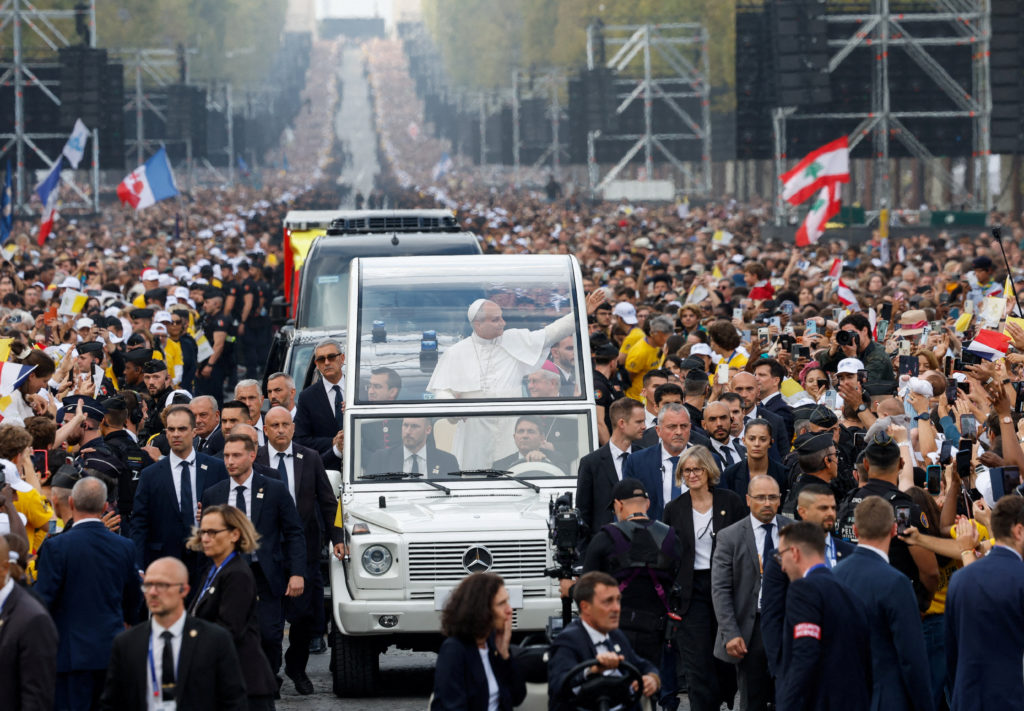
Eight hundred thousand people showed up. Not eight hundred thousand who had registered, signed petitions, or queued for permits. Eight hundred thousand who simply decided, in a city that has not been notably pious for two centuries, to fill the Champs-Élysées and spill across the Place de la Concorde on a Saturday morning.
Two hundred thousand were unaccounted for—beyond the numbers that organizers, police, and the Vatican had estimated. The discrepancy matters. It is the difference between a managed event and a spontaneous eruption, between an institution counting its regulars and a movement discovering it has far more members than anyone realized.
Pope Leo XIV did not merely greet a crowd that day. He was met by one.
The crowd gathered from early morning, arriving on foot from the 15th and 17th arrondissements, from banlieue neighborhoods with no particular Catholic identity, from Lyon and Lille by high-speed rail. Station agents reported commuters heading west who told them they had never walked the Champs-Élysées before. Border police at Gare du Nord noted an unusual number of visitors whose hotel bookings did not match any major conference or trade show. The energy was not merely organizational—it was generative, pulling people from places that had not produced something like this in living memory.
The Secular Blind Spot
France’s establishment has built its self-image on a particular story: that the country moved past religion, that laïcité triumphed over the Church, that the secular republic won. The 1905 law separating church and state is treated not as legislation but as theological doctrine—that modernity and faith are mutually exclusive, and that France is now fully, permanently beyond that particular temptation.
Saturday’s turnout should give that narrative pause.
The numbers echo something the French political class prefers not to discuss. Adult baptisms in France have tripled since 2016, reaching 13,000 this year. The same pattern appears in secular Spain. These are not mass conversions, not even marginal blips against the long decline—513,000 baptisms in 1980 versus 186,000 in 2024—but they are directional. Something is moving upward where everyone assumed only one trajectory existed.
The secular establishment treats these statistics as anomalies. But look closer and a pattern emerges that resists the simple dismissal. The adult baptisms are not concentrated in immigrant communities, which would make them a demographic footnote. They are happening across the hexagon—in suburban towns, in small cities, in the working-class quarters of Paris where the Church has long been considered irrelevant. The convert demographics resemble those of the United States: educated, middle-class, often young professionals searching for something the competitive individualism of late capitalism does not provide.
Who Shows Up When the Pope Comes
The crowds were not exclusively Catholic. They were not even predominantly Catholic, by some estimates. Thierry Chen, a non-Catholic entrepreneur from the 11th arrondissement, described seeing “people of really different races, really different nations” united by what he called “a common belief in humankind.” He had come on a whim after his neighbor invited him. He stayed for three hours.
Sylvane Le Goff, raised Catholic but not practicing, brought her grandchildren not for doctrine but for “his message of peace and unity.” She lived in the 20th arrondissement and had not set foot in a church since her own first communion thirty years earlier. What moved her, she said, was the sheer visibility of belonging—the sense that thousands of strangers were participating in something larger than themselves.
This is the demographic that European politicians rarely account for. The idea that faith in France is dying assumes that only practicing Catholics matter. It ignores the grandfather who wants his grandchildren to know something about their heritage. It ignores the secular humanist who finds the ritual moving. It ignores the convert who discovered the Church precisely because it offered something the secular order did not—meaning, community, transcendence.
What also went unreported was the role of social media in driving attendance. Young Catholics across France organized carpooling networks, shared real-time transit updates, and posted invitations in community groups with little institutional coordination. The digital infrastructure of faith has adapted to a post-institutional world in ways that traditional sociological surveys have not yet captured.
Pope Leo, an American pope presiding over a Church with growing strength in the Global South, seemed to understand this. He spoke of letting faith “overflow” so that those you meet “may be refreshed and their thirst satisfied.” The language was not sectarian. It was an invitation rather than an enclosure.
The Ground Beneath the Stage
The choice of venue was itself a provocation. The Place de la Concorde—where Louis XVI and Marie-Antoinette were executed, where the Republic celebrates its anniversaries, where the 2024 Olympics staged breakdancing and skateboarding—is not a conventional Catholic space. Using it for Mass was a claim that the square belonged as much to faith as to the secular republic.
Critics objected on strict secularist grounds. The Invalides, where Benedict XVI addressed 240,000 people in 2008, would have been more appropriate, they argued. But the Invalides is a military complex, a monument to French state power. The Place de la Concorde is where the people gather. The choice revealed a subtle shift: the Church no longer accepts being confined to spaces that do not challenge the secular order.
There was also a practical dimension. The Vatican had requested a venue that could accommodate the expected crowd. When diocesan estimates fell short of the projected turnout, expanding to the Concorde was the only option. What began as a contingency decision became a statement of presence.
What the Numbers Don’t Show
Eight hundred thousand is a large crowd. It is smaller than the 1998 and 2018 World Cup celebrations on the same avenue, but those were sporting events, not moments of collective meaning-making. The comparison reveals something important: France can still mobilize for shared experience. The infrastructure for awe has not disappeared; it was simply waiting for the right occasion.
The youth vigil the previous evening drew 80,000 people to the national stadium. Leo, speaking off the cuff in French, told them they were “the saints of France.” The applause was raucous. This is not the demographic profile that secularization theory predicts. It is not even the profile that cautious optimism would predict.
What the attendance figures miss is the emotional texture of the day. People wept. Not the quiet weeping of private grief but the communal, almost collective release that comes when a society that has been told for decades that it has outgrown certain depths is suddenly given permission to feel them. Strangers embraced. The Eucharist was distributed under conditions of such overwhelming demand that altar servers and ushers worked for nearly three hours after the liturgy formally concluded. Some people stood in line twice—once for Communion and once, they said later, just to stand in the place where it had been offered.
The Second-Order Effects
The consequences of this turnout will extend well beyond the immediate aftermath. Already, seminary applications in France are being discussed in conversations that three years ago would have been unthinkable. Diocesan leaders who had resigned themselves to managed decline are recalibrating their assumptions about available resources and willing participants. The Archdiocese of Paris announced it would fast-track renovations on three churches that had been slated for closure, citing “demographic developments that require updated pastoral planning.”
Political respondents have been conspicuously quiet. The Élysée issued no statement. The Ministry of Interior, which coordinated security, declined to elaborate on the crowd estimate discrepancy. In the National Assembly, where secularist orthodoxy carries significant cultural capital, no prominent figure challenged the narrative that France is irrevocably post-religious—and no figure stepped forward to claim the event as evidence to the contrary. The silence is itself informative.
The Uncomfortable Question
If faith is resurging among young people, among converts, among the nominally secular who find themselves moved by ritual and message, then the secular establishment faces an awkward reality: it has been predicting the disappearance of religion for decades and has been wrong.
This is not a victory speech for the Church. Baptisms remain far below 1980 levels. The trend over the long arc is still downward. But the slope may be flattening, and in places bucking entirely. The question for Europe’s secular leaders is whether they will continue treating these developments as statistical noise or recognize them as signals.
The deeper implication is one of capability. The 800,000 who filled Paris were not merely celebrating a pope. They were enacting a form of communal life—spontaneous, large-scale, emotionally genuine—that the secular order has struggled to replicate in any equivalent form. France has shown it can fill the streets for politics, for sport, for protest. But those mobilizations are typically adversarial or competitive. They organize around opposition or achievement. The convergence on the Place de la Concorde organized around something quieter and harder to manufacture: shared reverence.
That may be the most striking fact of all. Not the number itself, but what the number demonstrates about a society that was supposed to have exhausted its capacity for collective wonder—and, according to Saturday morning, had not.