Why the Cyber Dimension Changes Everything in the Trilateral Drill
The Japan-US-ROK Freedom Edge exercise has added a cyber domain for the first time, signaling a qualitative shift in trilateral deterrence — and drawing sharp retaliation from Pyongyang.
A Quiet Upgrade With a Loud Aftermath
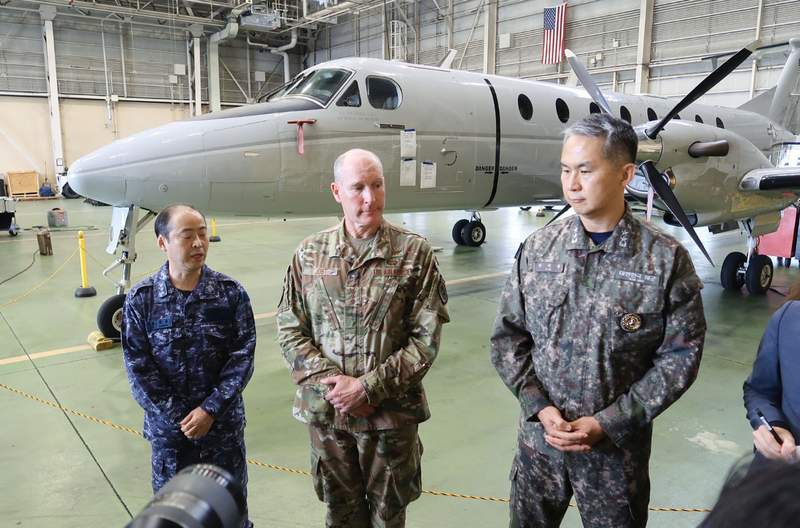
Japan, the United States, and South Korea launched their annual trilateral exercise, Freedom Edge, in the East China Sea on September 7. The drills run through September 11. On paper, nothing dramatic has changed — Yost, the commander of US Forces Japan, confirmed the scope and scale remain identical to previous years. But one inclusion shifts the entire calculus: for the first time, the exercise formally incorporates a cyber domain alongside maritime and air operations.
The move drew an immediate and fiery response from North Korea, which condemned the exercise as an expression of hostile policy and warned it would respond with its strongest possible stance if the Trump administration continued its adversarial posture. That reaction is worth parsing. Pyongyang rarely issues such blunt warnings about routine trilateral drills unless something in them cuts closer to home than usual.
The exercise was announced with deliberate understatement. Press briefings emphasized continuity, running times, and participant counts. But defense analysts who reviewed the revised exercise framework noted that the cyber component was not an add-on — it was a structural change. For the first time, cyber operators will be embedded within the trilateral command structure, sharing real-time situational awareness with naval and air commanders in a way that has never been tested before.
Why Cyber Matters Here
The inclusion of cyber operations in a combined arms exercise is not merely symbolic. It signals that Washington, Tokyo, and Seoul now treat the electromagnetic and informational battlespace as an integrated theater, equal in weight to the skies and seas above them.
For decades, each of the three allies has conducted its own cyber capabilities in isolation. The US has CYBERCOM, which operates globally with significant resources. Japan’s Self-Defense Forces established a Cyber Defense Command in 2022, a relatively late entrant into institutionalized military cyber operations. South Korea operates under its own Military Cyber Command, which has grown substantially since its inception but has historically coordinated bilaterally with Washington rather than multilaterally.
None of these institutions existed in a coordinated fashion when the trilateral security architecture was first conceived after the 2010 Yeonpyeong bombardment. Back then, cyber was not even on the table. Today, it is central to how these three nations envision collective defense.
Freedom Edge’s cyber component is a practical test of what that coordination looks like in practice — shared threat intelligence, cross-border incident response protocols, and the ability to synchronize defensive and offensive cyber operations with kinetic strikes. That interoperability is precisely what makes it dangerous to adversaries, because it transforms three separate cyber postures into a single operational picture.
Beijing is already watching. China’s own cyber commands have grown enormously since the establishment of the Strategic Support Force in 2015, but they have never had to plan for a scenario where three well-funded Western-aligned militaries operate a unified cyber defense posture over the East China Sea — waters where Chinese naval and civilian vessels operate in dense proximity and where undersea infrastructure is increasingly critical to both regional commerce and military communications.
Pyongyang’s Specific Vulnerability
North Korea’s response is unusually sharp for a drill of this type. The regime has endured decades of US-ROK joint exercises with relative stoicism, treating them as background noise in a long-running confrontation. Its latest warning appears aimed specifically at the expanded scope of Freedom Edge rather than the exercise itself.
Pyongyang understands better than any regional actor what a tri-nation cyber coordination capability means for it. North Korea’s command-and-control systems, its nuclear and missile launch architectures, and its financial networks all depend on communications infrastructure that a synchronized cyber operation could disrupt. The regime’s reliance on legacy systems and isolated networks creates a paradox: the more it secrets its operations, the more brittle those systems become.
Western intelligence assessments have long noted that North Korea’s missile command infrastructure depends on aging Soviet-era communications equipment and poorly maintained fiber-optic links. A coordinated cyber disruption during a crisis could blind launch authorities or degrade their ability to communicate orders — a scenario that is precisely what Freedom Edge is designed to explore.
The exercise is occurring under the Trump administration, which has maintained a hardline posture toward North Korea despite its otherwise transactional approach to foreign policy. The regime’s reference to continued hostility suggests it sees no relief on the horizon and is preparing its domestic audience for escalation. Kim Jong Un’s recent speeches have emphasized self-reliance and military readiness, language that typically precedes tangible actions rather than serving as empty rhetoric.
The Japan Factor
Tokyo’s participation carries particular weight. Japan’s Cyber Defense Command, established only four years ago, is still building institutional capacity and has yet to conduct large-scale multinational cyber operations. Having Japanese assets operating alongside US and South Korean cyber units in a live exercise represents a significant maturation step — one that Beijing will note carefully and one that signals Japan’s willingness to move beyond its traditionally defensive posture.
Japan’s legal framework for cyber operations has also evolved. The 2023 defense guidelines expanded the circumstances under which the Self-Defense Forces can conduct offensive cyber operations, and Freedom Edge is the first opportunity to test those authorities in a trilateral context. That shift from doctrine to practice is significant.
The exercise also takes place in Japan’s strategic backyard. The East China Sea is already a flashpoint over the Senkaku Islands and Chinese maritime expansion. Adding a cyber dimension to operations in those waters raises the possibility that future exercises will test scenarios involving undersea cable disruption, GPS jamming, or coordinated electronic warfare alongside traditional naval presence.
Undersea infrastructure is particularly relevant. The East China Sea carries some of the world’s busiest undersea cable routes, connecting Japan and South Korea to Southeast Asia and beyond. Disrupting those cables — whether through cyber means or physical attack — would have immediate economic and military consequences. The fact that this scenario is now being considered in a trilateral exercise marks a notable evolution.
Second-Order Effects
The implications of Freedom Edge extend beyond the immediate participants. Other regional actors are recalibrating. Taiwan is closely watching how effectively the three allies can coordinate cyber operations, given that the island faces similar vulnerabilities and could benefit from interoperable systems. Australia, a key US partner, has expressed interest in similar trilateral arrangements extending to the southern half of the region.
Within the alliance itself, the cyber dimension creates new friction points. Japan and South Korea still have unresolved historical disputes that occasionally surface in security discussions. Integrating cyber operations requires a level of trust and information sharing that goes beyond what has been typical. The fact that these three nations are pursuing this integration despite political disagreements underscores how seriously they view the evolving threat environment.
China’s response to Freedom Edge is likely to be measured but pointed. Beijing has historically responded to increased allied military activity with its own exercises and infrastructure buildout. Expect accelerated construction of militarized features in the South China Sea and increased cyber reconnaissance operations directed at US and Japanese military networks in the coming months.
What Comes Next
The immediate next step is straightforward: Freedom Edge concludes on September 11, but the interagency protocols it stress-tests will linger in planning documents across all three capitals. The real question is whether the trilateral will institutionalize the cyber component as a standing feature of future exercises or treat it as a one-time expansion. Given the current trajectory, institutionalization is the more likely outcome.
For Pyongyang, the harder question is what comes next. The regime’s threat of a strong response needs to materialize in some form to maintain credibility, but the options are limited. Cyber retaliation against Japanese or American infrastructure is possible but risky — it could trigger the very coordinated response the drill is designed to prepare for. More likely, North Korea will continue its familiar pattern of verbal escalation followed by measured action, using the exercise as justification for further military posturing while avoiding anything that could provoke a full-trilateral strike scenario.
Beijing, meanwhile, faces a different calculus. Japan-US-ROK coordination has historically been weakest on cyber issues precisely because China is the primary target of such operations. Expect Chinese maritime and cyber activities in the East China Sea to become more assertive in coming months — a sign not of panic but of adaptation to a new operational reality.
The drill’s public statements were careful and restrained. That restraint is the point. The message is not shouted; it is built into the structure of what the three allies now do together. Freedom Edge may end on September 11, but the shift it represents is enduring. The cyber dimension has arrived, and no one in the region is returning it.