Why Japan Is Watching the Roman Telescope Launch So Closely
NASA launched the Roman Space Telescope on August 30, but the story isn't just about the optics or the dark-energy mission. Japanese media's unusually prominent coverage signals a shift: Asian institutions are moving from participants to co-leaders in the next generation of deep-space observation.
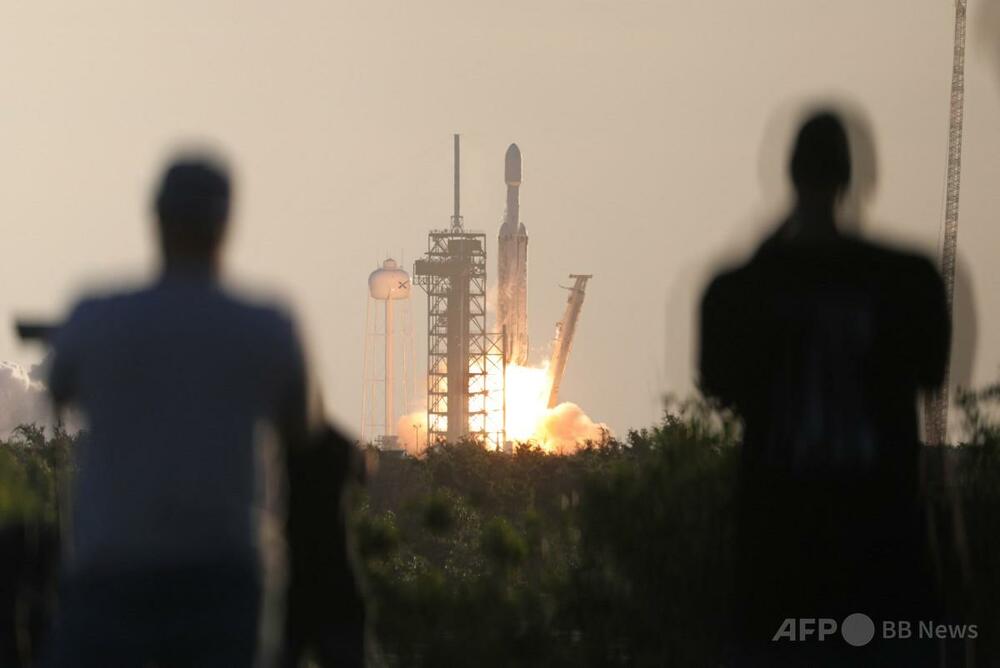
The launch was routine. The attention wasn’t.
NASA’s Roman Space Telescope lifted off from Cape Canaveral on August 30 aboard a SpaceX Falcon Heavy, arriving at its Lagrange-2 station roughly 100 days later. The hardware itself is not newsworthy for anyone who has followed Hubble or the James Webb Space Telescope — another massive mirror, another deep-parking orbit, another multi-billion-dollar survey mission.
What makes this moment more interesting is who is watching it closely.
AFPBB News, Jiji Press, and other major Japanese outlets ran prominent coverage of the launch ahead of what would have been routine wire absorption in English-language media. The headline language alone — 史上最大級の「宇宙地図」作成へ, or “toward creating one of the largest cosmic maps in history” — signals that Japanese newsrooms are framing this as a story for their audience first, not as a re-publishing opportunity.
That framing matters. It reflects a structural shift in how space science is being done, and who is doing it.
Japan already has a seat at the table
Roman is not a solo NASA project. Japan’s participation goes well beyond symbolic contribution. JAXA, the Japan Aerospace Exploration Agency, supplied the Focal Plane Module — the instrument housing the detectors that actually convert incoming photons into data. That is not a peripheral component. It is the heart of the telescope’s imaging capability, the part that determines resolution, sensitivity, and ultimately whether the mission delivers on its promise to map dark energy and dark matter across billions of light-years.
This is part of a broader pattern. Japan’s involvement in space science has matured from component supplier to mission-critical partner. The XRISM X-ray observatory, launched in 2023 in collaboration with NASA, returned its first data less than a year later and is already producing results on galaxy-cluster plasmas that no single agency could have generated alone. The Hitomi predecessor, Astro-E2, had a famously painful first decade. Japan learned from that. Roman is a different kind of partnership — one where JAXA’s technical contribution carries real weight in how the mission is designed and operated.
The Korean Academy of Science and Technology, meanwhile, has been quietly positioning itself in the same space. While South Korea has not yet contributed hardware to Roman, its indigenous astronomical infrastructure — including the KMTNet observatory network in Chile, South Africa, and Hawaii — provides ground-based follow-up capability that complements Roman’s sky surveys. The exoplanet transit data KMTNet collects feeds directly into the kind of multi-wavelength analysis Roman will require.
China, for its own part, has been building its own next-generation space observatories. The Einstein Probe, launched in 2024, is already detecting X-ray transients. China’s planned Xuntian telescope, expected to launch in the coming years, will share similarities with Roman in its wide-field survey approach. That parallel is not coincidental — it reflects a recognition that the era of singular Western-dominated space astronomy is ending.
Why exoplanets are the real prize
Roman’s exoplanet count will dwarf anything we have seen before. The mission is designed to discover thousands of exoplanets using gravitational microlensing — a technique that detects planets by the way their gravity bends light from background stars. This is fundamentally different from the transit method that has dominated recent headlines. Microlensing is sensitive to planets at greater orbital distances, including Earth-mass worlds in or near the habitable zone of their host stars. Transit surveys miss most of those. Roman will find them.
The numbers are striking. Roman is expected to characterize tens of thousands of supernovae and thousands of exoplanets. Combined with JWST’s atmospheric spectroscopy on select targets, this creates a pipeline: Roman finds the candidates, JWST measures their atmospheres. It is a division of labor that neither telescope could achieve alone, and one that now includes Japanese and Korean ground-based partners providing the ground truth.
What comes next depends on whether the Focal Plane Module performs as designed. The detectors must handle the radiation environment at L2, maintain thermal stability across a wide field of view, and process data fast enough to handle Roman’s unprecedented survey cadence. If they do, the resulting cosmic map will constrain the equation of state of dark energy to within a few percent — enough to distinguish between a cosmological constant and more exotic models that predict a changing dark-energy density over cosmic time.
If they don’t, the mission still returns valuable data, but the precision on dark energy drops and the exoplanet yield falls short of projections. Either way, the partnership model that produced this mission — NASA hardware, JAXA detectors, European contributions to the optics and ground support — will be the template for whatever comes next.
The signal in the coverage
Japanese media coverage of Roman is not simply about a NASA launch. It is about a telescope in which Japan has built a critical piece of hardware, whose science will use instruments and data pipelines Japanese teams helped design, and whose results will be shared through a collaboration framework that gives Japanese astronomers early access to data and genuine influence over observation scheduling.
That is a meaningful change from the decades when Japan’s role in large space missions was largely that of a hardware vendor operating at the margins. Roman places Japanese engineering at the center of a NASA flagship. The AFPBB headline’s emphasis on 史上最大級 — “one of the largest in history” — is not just promotional language. It is an acknowledgment that the map Roman will produce is a collaborative product, and that Japan is no longer on the periphery.
The same logic applies to the exoplanet science. When Roman discovers a new population of distant, Earth-mass planets through microlensing, the follow-up observations will come from telescopes across three continents — including Chile and Hawaii, where Korea and Japan respectively operate key facilities. The data will flow through multiple institutions before reaching the public.
That is the new model. Not a single agency deploying a telescope and owning the results. A distributed network, coordinated across governments and disciplines, producing science that no single country could generate alone.
Roman is the first flagship mission built explicitly for that era. Japan’s unusually attentive coverage of its launch is both a reflection of that reality and an argument for paying closer attention to what comes next.