Why Marvell's Drop Matters More Than Its Earnings Beat
Marvell beat estimates and raised guidance, yet its stock fell 8%. The lesson isn't about one missed number — it's about how hard the market is willing to discount the AI chip demand story right now.
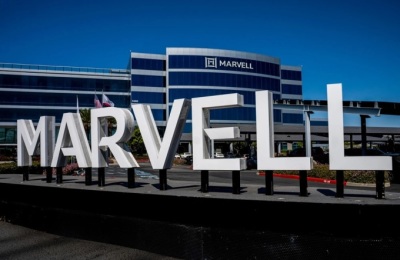
The drop was the story.
Marvell Technology posted a quarter that would have been a triumph in any other market. Revenue guidance for fiscal 2027 jumped to $12 billion from $11.5 billion — a roughly 45 percent increase driven by data-center demand. Fiscal 2028 estimates climbed to $18 billion from $16.5 billion. Five analysts raised their price targets afterward. The median target sat at $275, implying nearly 14 percent upside from the prior close.
And yet the stock fell 8.05 percent in morning trading, dropping to $222.02 on August 28. The reason had nothing to do with the numbers that came in and everything to do with the numbers the market was waiting for.
What happened that morning was a master class in forward-looking pricing. Marvell’s reported earnings exceeded consensus. Its adjusted earnings per share came in above estimates. The company painted a picture of accelerating demand across its custom-silicon and networking businesses. By every traditional metric of an earnings report, this was a win. But the market does not reward companies for beating expectations that were set too low. It rewards them for exceeding the expectations that were set by the most optimistic version of the future — and Marvell simply hadn’t done that.
The Google contract that wasn’t enough.
Last week, Marvell announced it would supply custom AI semiconductors to Google under a deal valued at up to $120 billion in revenue through fiscal 2033. Google also became a major shareholder. On paper, this should have sent the stock higher. Instead, it sold off because of when that revenue actually arrives.
CEO Matt Murphy made the timeline clear during the earnings call: Google-related custom-chip revenue would partially appear in Marvell’s outlook through fiscal 2028, but meaningful contribution starts in fiscal 2029. That is a full five years from the deal’s announcement. The gap between headline value and cash-flow reality is enormous, and the market punished Marvell for it.
Morgan Stanley analysts put it bluntly. They said the Google contract had lifted expectations to a level where the guidance — even upgraded — barely cleared the bar. In their view, the deal’s revenue contribution was already baked into Marvell’s existing outlook to some degree. What was left to surprise on had largely disappeared.
The subtlety here matters. This isn’t a case where a company missed on a contract’s magnitude. The $120 billion figure is real and significant. The issue is one of concentration risk and competitive positioning. Google is not the only hyperscaler racing to build custom silicon, and Marvell’s relationship with one cloud giant does not guarantee dominance across the sector. Amazon and Microsoft are pursuing parallel strategies through their own chip designs and partnerships. The market is quietly recalibrating its assumptions about how much of the custom-silicon opportunity Marvell can realistically capture over the next decade.
A valuation built on future cash flows.
Marvell’s stock has nearly tripled this year. It is now trading at a 12-month forward P/E of 58.41 times, nearly double Broadcom’s 32.15. The multiple assumes that AI infrastructure demand will continue expanding at a pace that justifies paying an extraordinary price today for revenue that may not fully materialize until the latter half of the decade.
Melius Research acknowledged the short-term picture was not dramatically better than expected, but argued that combining the Google deal, Marvell’s Microsoft relationship, and growth in its AI-connected segments could push earnings per share toward $20 by the end of the decade. Whether that number is achievable depends entirely on whether custom silicon orders from Google and other cloud giants convert into shipping volume on schedule.
The risk with forward multiples this elevated is that they leave no room for sequence error. If Google’s custom-chip program slips by even a year, if the first-generation product encounters yield challenges, if another customer pauses its roadmap — the entire valuation structure wobbles. This is what makes the current environment so unforgiving for Marvell shareholders. The stock is priced as if execution will be flawless across multiple products, multiple customers, and multiple years.
The second-order lesson.
This episode reveals something important about how the AI chip trade is being repriced right now. The narrative has been simple for over a year: big tech is building custom silicon to reduce dependence on NVIDIA, and the companies supplying those chips are the new infrastructure winners. Marvell, alongside Broadcom, has been treated as a direct beneficiary of that structural shift.
But when a company reports strong results and still gets hammered, the market is sending a signal. It is not questioning whether AI demand exists. It is questioning whether the current pricing of that demand leaves enough margin for error. A $120 billion contract sounds enormous until you realize most of it sits five years out and competes with every other hyperscaler pursuing the same strategy. Amazon, Microsoft, and Google are all building their own silicon roadmaps. Marvell’s customers are also its potential competitors.
There is a deeper tension at play that deserves attention. Custom silicon is, by definition, designed to reduce dependence on any single supplier. That means Google’s success with Marvell’s chips could eventually lead Google to bring more design work in-house or diversify its supplier base. The same logic applies to every other hyperscaler. The very customers driving Marvell’s growth have a structural incentive to diminish their reliance on it over time. This is not a near-term concern, but it is a boundary condition that sophisticated investors are increasingly factoring into their models.
The broader market implication is that the AI infrastructure trade is moving from a conviction phase into a scrutiny phase. When sentiment is this strong, stories command premium valuations. When the next earnings report merely confirms the story without accelerating it, those premiums get trimmed. Marvell’s 8 percent drop is not an anomaly. It is a preview of the friction that will characterize this sector going forward.
What happens next.
Analysts remain broadly constructive. The upgraded guidance and multiple target raises suggest Wall Street has not lost faith. But the 8 percent drop on an earnings beat is a reminder that sentiment around AI infrastructure names is fragile. Any delay in Google’s custom-chip timeline, any sign that hyperscaler demand flattens, or any competitive pressure from Broadcom could compress Marvell’s premium valuation quickly.
The stock is priced for execution without friction. The market has moved beyond asking whether the AI boom is real and started asking whether individual companies can deliver on timelines that were set against an even more optimistic version of that boom. Marvell’s fall is not a signal that the story is over. It is a signal that the story has gotten crowded, and the margin for disappointment has shrunk to near zero.
For investors, the practical takeaway is straightforward: the earnings beat was not the point. The point was the gap between what the Google contract promised on paper and what the market had already priced in. When that gap closes, even positively, the trade can move against you — sometimes by 8 percent before the opening bell. The AI chip sector has entered a phase where beating expectations is no longer sufficient. Companies must reframe the terms of the conversation entirely, and Marvell’s latest report showed that the market had already moved past the terms it offered.