Why NASA Should Retrieve the Moon's Forgotten Trash
Apollo astronauts left 96 waste bags on the Moon. A new proposal argues retrieving one isn't cleanup—it's the most ambitious planetary protection experiment ever proposed.
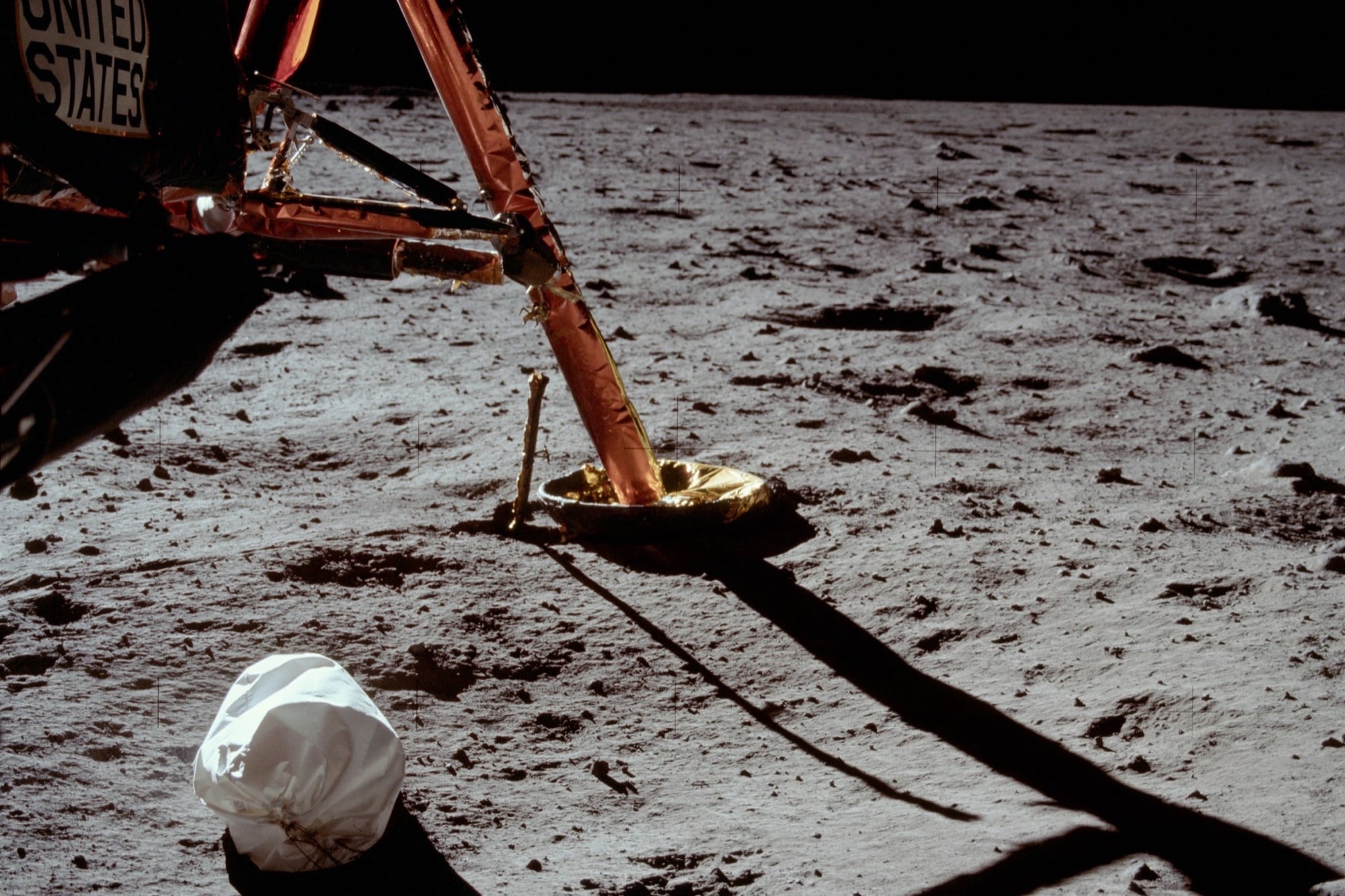
The oldest active experiment on the Moon wasn’t designed by any scientist.
It was dumped there as trash.
Across six Apollo landings between 1969 and 1972, astronauts stowed their refuse in jettison bags and kicked them beneath the descent stages of their lunar modules before climbing back into orbit. The commonly cited total is 96 bags—containing urine, feces, vomit, food wrappers, empty water containers, wipes, and equipment the crews no longer needed to carry home. The oldest have sat at Tranquility Base for 57 years, exposed to full lunar radiation, vacuum, and the brutal thermal cycling of a 29.5-day day-night rhythm.
Nobody installed sensors on them. Nobody monitors them. They are, as one researcher put it, the strangest experiment in astrobiology that nobody designed.
Now a proposal has surfaced that could change how the world views those forgotten sacks. Retrieving one—not to clean up the lunar landscape, but to test whether any Earth microbes survived half a century of extraterrestrial abuse—would answer questions that go far beyond the Apollo era. It would reshape the rules humanity carries into the Moon’s future.
The number 96 hides a messier reality
That figure has traveled through pop-science accounts as if it were a neat NASA inventory: 96 identical bags of human waste. It is not. Apollo garbage came in at least two forms, and the mission records use different names for each.
Inside the cabin, astronauts sealed individual fecal and emesis bags—small collection devices treated with a germicidal liquid based on phenol compounds, mixed in to inactivate microbes and suppress gas production. Those inner packages went into outer bags. The waste system had an adhesive rim and was more engineered than the phrase “plastic bag” suggests, though not more dignified.
Outside the cabin, larger nylon jettison sacks—roughly 101 centimeters long and 70 centimeters wide when empty, expanding to the size of an eight-year-old child once stuffed in the cramped ascent module—gathered the smaller waste bags alongside food wrappers, empty containers, and anything else the crew could leave behind. One large sack went out at the start of every moonwalk. On every landing except Apollo 11, a second followed near the end, bundled with the portable life-support backpacks. The later missions sometimes used empty sacks to contain dust on spacesuit legs during rest breaks.
That white bundle visible beneath Eagle in Neil Armstrong’s first surface photograph is a mixed refuse sack, not a transparent label for a single bowel movement. And it means a returned “bag” could hold several layers of material with entirely different biological histories—outer fabric bathed in sunlight, inner contents sheltered from direct exposure.
Why the trash came off the rocket
The lunar module was a mass-limited flying machine with no installed toilet. Every pound left on the surface meant two astronauts could climb out of the descent stage and back to orbit. Waste served no function at 384,000 kilometers away. It also posed a contamination risk inside a closed cabin, which is why the germicide treatment was standard procedure.
Astronauts pushed the filled sacks down the ladder and usually kicked them beneath the descent stage—out of the direct path of the ascent engine’s exhaust but still fully exposed to the lunar environment.
That placement turned out to be the experiment’s first variable. Being tucked under a spacecraft structure changes everything: shielding from direct solar UV, reduced thermal cycling, a layer of regolith on the underside. The difference between a bag lying flat on the surface and one pressed against a metal bulkhead could decide whether any cell inside survives at all.
What the models say—and don’t say
In 2019, Andrew Schuerger and colleagues published a study in the journal Astrobiology modeling microbial contamination across dozens of spacecraft that landed or crashed on the Moon. Their forecast for exposed surfaces was grim: a single lunation of UV and vacuum should sterilize them. Deeply embedded microbes might persist longer, but the model predicted all hardware from the 1959–1976 era would be free of viable Earth organisms by 2030.
The same paper placed Apollo’s nylon jettison bags at the top of its recovery priority list.
There is no contradiction. A robotic lander’s surface carries a thin, uniform microbial load. An Apollo waste bag started with a rich and varied population—human skin flora, oral bacteria, gut microbes—trapped inside multiple layers of packaging, some treated with biocide, some shaded by the lander’s own structure. The model’s assumption of uniform exposure does not apply here.
A returned bag would test the model at its most plausible point of failure. Finding nothing viable would set a hard upper bound on survival under real lunar conditions. Finding even a handful of living cells—after contamination has been convincingly excluded—would show the models missed something: a protective combination of material, geometry, or microbial state that deserves re-examination.
The Surveyor 3 ghost
Any retrieval proposal carries a cautionary precedent. In November 1969, Apollo 12 astronauts walked to the Surveyor 3 lander, cut away its television camera, and brought it home after it had spent roughly 31 months on the lunar surface. Laboratory workers later recovered Streptococcus mitis, a bacterium associated with the human mouth and respiratory tract, from the camera assembly.
The result was presented as evidence that terrestrial microbes could survive on the Moon. Later scrutiny of photographs and handling procedures made accidental contamination during the return journey the more persuasive explanation. NASA’s planetary-protection history retains both sides of the episode: a reminder that a positive result means nothing without an airtight chain of custody.
A modern retrieval would need to sample the bag’s exterior before opening it, include sterile blanks, seal the material at the lunar site, and record the microbes associated with every suit, tool, and spacecraft surface touched during recovery. Genetic sequencing could help trace a contaminant, but DNA alone cannot reconstruct every handling error. The chain of custody would be part of the experiment.
Why now
The Moon is about to get busy.
NASA’s Artemis program plans to return astronauts to the lunar south pole, where cold traps preserve water ice and organic chemistry. Crewed landers, rovers, suits, and habitats will shed cells and biological molecules continuously. New terrestrial material will mix with whatever ancient traces remain, making it harder to distinguish natural from introduced.
The Apollo waste bags represent a simpler event: known humans, known materials, known landing dates, and decades of exposure with no later visitors. Their contents were treated with germicide. Their exact inventory is imperfect. But those flaws are documented parts of the sample, not reasons to ignore it.
Even a completely sterile bag would carry data. Investigators could measure DNA fragmentation, protein degradation, lipid oxidation, and chemical changes in the nylon itself. They could compare sun-facing and shaded layers, map radiation damage gradients, and ask whether different biological signatures disappear at different rates. Dead material still keeps records.
The boundary condition
The most likely result is not a revived bacterium. It is a boundary—how thoroughly the Moon erased viability, what molecular traces endured, and how much protection a few layers of nylon, plastic, and dried waste supplied.
Five-seven years of lunar exposure is a long time. But it is also the longest continuous record we have of Earth life sitting on another world without intervention. That record is degrading. Every passing year brings more radiation dose, more thermal fatigue, more ultraviolet damage. A retrieval does not need to find life to matter. It needs to arrive before the last readable signal vanishes.
The experiment is already running. It just never had an instrument panel.