Why SpaceX's First Orbital Starship Flight Matters Beyond Space
Starship's first orbital flight came with engine trouble and an early landing, but the real story is what it means for launch economics and the race between Blue Origin and Rocket Lab.
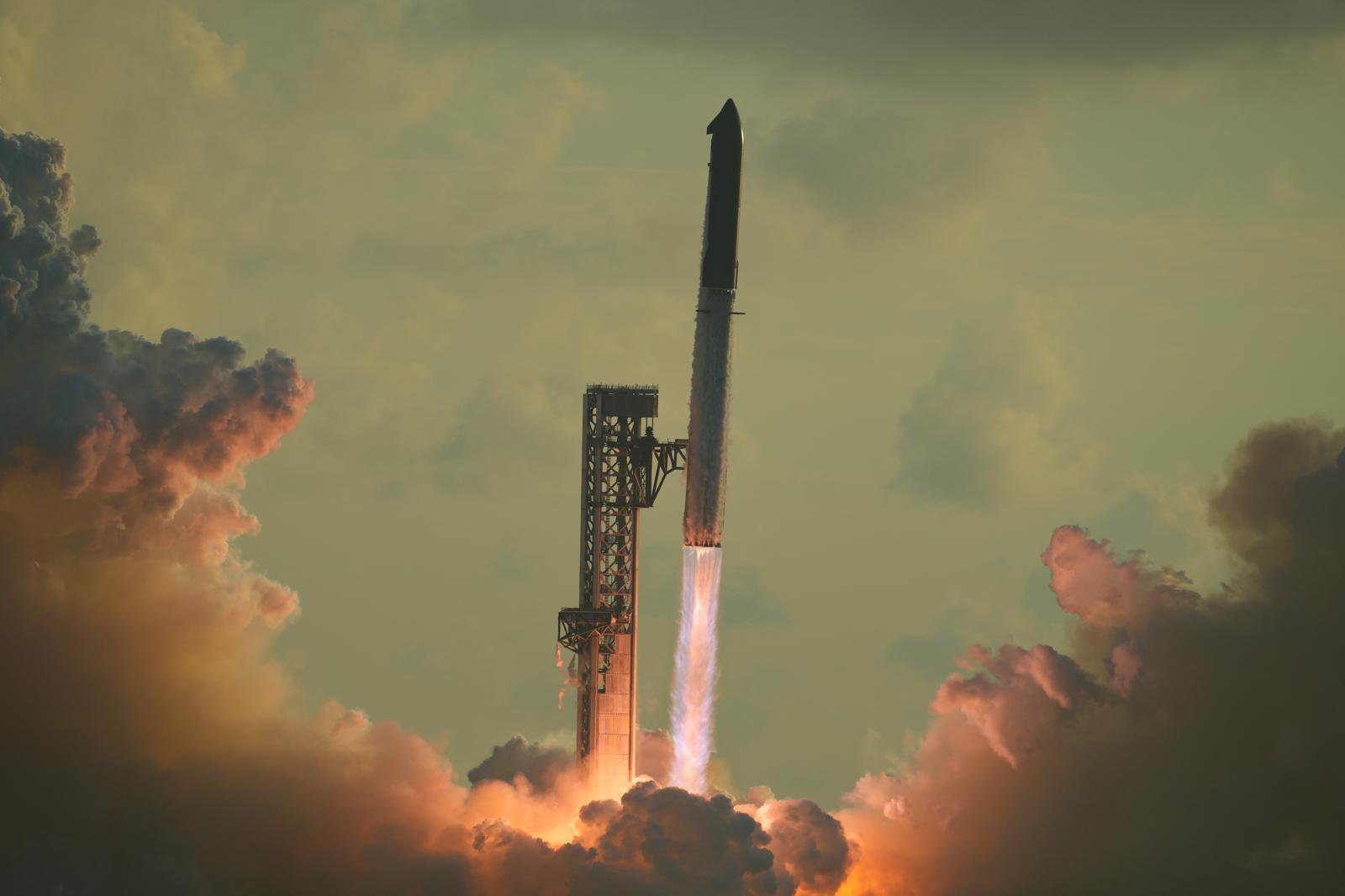
The Milestone That Wasn’t Clean
SpaceX’s Starship reached orbit for the first time on September 28, and the flight was anything but smooth. One of the 33 Raptor engines on the Super Heavy booster shut down shortly after liftoff. Telemetry suggested a fuel line issue, though SpaceX has not released a detailed post-flight analysis. The decision to continue was immediate—those 32 remaining engines had to compensate for the lost thrust, and they did so by firing longer during the ascent phase, which increased structural loads across the vehicle and left less margin for the upper stage.
Then, after stage separation, one of Starship’s three upper-stage Raptors shut down early. This was the more consequential failure. Without that engine, the remaining two had to burn longer to reach orbital velocity, consuming propellant that would have been reserved for the return profile. SpaceX compensated by extending the burn, successfully inserting the upper stage into a 275-kilometer orbit, and deploying 26 next-generation Starlink satellites—the first time actual operational hardware left the pad rather than a test mass or ballast.
Then came the abort. The original plan called for ten hours and six orbits to gather a comprehensive data set before attempting a controlled splashdown off the coast of Hawaii. SpaceX made the call to return after three hours and fewer than two orbits. The decision likely reflected caution after the upper-stage engine failure—a single point of redundancy lost in a vehicle that had already revealed vulnerabilities in its propulsion system. The spacecraft re-entered over the northern Pacific and landed in the water well short of its intended target.
The New York Times called it a major milestone. Reuters wondered whether the engine troubles would derail SpaceX’s goal of wrapping up test flights by year and moving to routine operations. Both read the story right. Neither followed it far enough.
The Economics That Change Now
Before this flight, Starship existed as a proposition: a vehicle that could theoretically carry 150 tonnes to orbit in fully reusable configuration, at a cost per kilogram that no existing rocket could match. After this flight, Starship has demonstrated that it can reach orbit with operational hardware in its payload bay. The 26 Starlink satellites prove the vehicle can deploy a meaningful payload to a useful trajectory. That distinction matters more than the engine failures suggest, because it changes how anyone who buys launch time thinks about price.
SpaceX’s publicly stated target for Starship is a fraction of a percent of current heavy-lift costs per kilogram. A fully reusable Falcon Heavy launches at roughly $1,500 to $2,000 per kilogram to low Earth orbit. Starship, if it achieves its design goals, would drive that number below $100 per kilogram—potentially an order of magnitude lower. Whether that target is achievable remains unproven. The early engine failures are a reminder that full reusability involves problems that only reveal themselves in flight, particularly when you are flying a booster that lands itself vertically after a launch that required 32 engines instead of 33.
But the direction of travel is now established. Competitors cannot pretend the possibility does not exist. Pricing models built around the assumption that heavy-lift launch will remain expensive for the foreseeable future now have to account for a vehicle that could collapse that entire cost structure.
Blue Origin’s New Glenn, which has been stuck in rehearsal for years, now faces a timeline that is hostile rather than patient. New Glenn was designed to compete in the heavy-lift market with a partially reusable first stage and a price point estimated between $50 million and $70 million per launch. Starship, even at half the performance SpaceX promises and with reuse rates that have not yet been proven, will undercut that number by a factor that makes the business case for New Glenn difficult to sustain. Jeff Bezos has repeatedly stated that New Glenn will not enter service until at least 2027. That gap is now wider than it looked last quarter, and the longer it stretches, the more customers who were considering New Glenn will reconsider.
Rocket Lab, which operates the smaller Neutron rocket in development, occupies a different niche. Neutron is aimed at the medium-lift segment, not the super-heavy market Starship dominates. But Rocket Lab’s existing Electron launcher is already under pressure from Falcon 9’s rising cadence and falling prices. Starship’s entry into any market below its full payload envelope will accelerate that pressure. The question for Rocket Lab is not whether Starship targets its customers directly—it will not, at least not initially—but whether the whole launch market compresses around it. When the cheapest way to put anything in orbit becomes dramatically cheaper, every pricing tier below it adjusts downward. Neutron’s value proposition depends on being the right size for customers who cannot fill a Starship. If Starship can deliver small payloads economically through rideshare or dedicated launches, that cushion disappears.
The Pentagon Calculus
The U.S. Department of Defense is one of SpaceX’s largest commercial customers, and Starship’s first orbital flight carries direct implications for defense logistics that go well beyond the usual satellite deployment contracts. The Pentagon has been exploring heavy-lift launch options for years, particularly for national security payloads that are too large or too numerous for existing rockets. The National Reconnaissance Office has signaled interest in launching larger, more capable satellites that require heavier lift vehicles. Starship’s payload volume is qualitatively different from anything currently in the commercial or government inventory. A single Starship could deploy an entire constellation segment in one launch rather than requiring dozens of individual flights.
An orbital flight that carried actual Starlink satellites, even test-flight hardware, demonstrates a pathway to rapid deployment of large constellation segments. The military applications are obvious and well-documented. The same vehicle that delivers commercial broadband can deliver military communications, surveillance, and potentially cargo to orbit on demand. That flexibility is valuable. The Strategic Commands have talked for years about the need for responsive space launch—the ability to replace a lost or degraded satellite within days rather than months. Starship is the only vehicle in development that approaches that capability.
The engine failures this flight experienced are a reminder that demand without reliability is just hope. The Pentagon does not buy potential. It buys demonstrated capability. SpaceX will need to fly again and fly cleanly before defense contracts shift from exploration agreements to operational commitments. But the trajectory is now clear enough that budget planners are already adjusting their assumptions about what space launch capacity will look like in the next five years.
SpaceX has publicly stated intentions to use Starship for lunar cargo under NASA’s Artemis program. The early return from this flight complicates the timeline for orbital refueling tests, which are a prerequisite for lunar operations. If refueling cannot be demonstrated this year, the Artemis timeline—which has already slipped more than once—slides further. The Pentagon watches those dates closely. A delay in lunar logistics affects not just NASA’s schedule but the broader defense posture that depends on space dominance.
What Happens Next
SpaceX will fly again. That is the pattern with this vehicle. Each attempt extracts information that the next attempt uses. The early landing was the conservative choice; it protected hardware and data. The engine failures are fixable. The upper-stage engine issue, in particular, is the kind of problem that becomes obvious only when you fly the full stack to orbit for the first time. You do not learn about fluid dynamics in separated combustion cycles by running simulations. You learn by flying, and then you fix what breaks.
What does not reset is the competitive position. Starship has crossed the threshold from prototype to operational vehicle. The market has repriced accordingly. Wall Street reacted positively, as Korean financial media noted, and not only because of the orbital achievement but because the revenue pathway from satellite deployment to cargo logistics just became more concrete. SpaceX’s stock moved on the strength of a flight that most analysts would classify as partial success, and that movement reflects a market that understands the difference between a clean milestone and a decisive one.
Blue Origin will accelerate. That is predictable. But acceleration does not close a gap that opened today. Rocket Lab will defend its niche aggressively. Every other launcher in the world—Ariane 6, H3, Angara, Long March variants—now faces a benchmark that redefines what heavy lift means. None of them can match the payload capacity or the reusability profile that Starship is demonstrating. Some will survive by serving markets Starship does not target. Most will not.
The 14th attempt worked. The 15th will likely work better. The economics of space, which have been static for decades, are shifting. That is the story the engine failures do not erase. The failures are data. The orbit is the headline. And the headline is changing everything.