How Windows Is Rewiring GPU Memory for the AI PC Era
Microsoft is testing a Windows feature that lets users customize how much unified memory gets dedicated to the GPU — a quiet but consequential shift for AI PCs. Japanese coverage is surfacing the first concrete details before Western desks catch up.
The memory war is moving to the OS layer
A Windows Insider build currently circulating in Microsoft’s Experimental Channel contains a setting that, if it ships, quietly changes how personal computers allocate memory for graphics and AI workloads. The feature first surfaced in posts by a X user known as Xeno, who identified configuration options on Build 29648.1000 under the Future Platforms ring. ITmedia’s PC USER desk has since provided the most detailed breakdown available in any language, and what emerges is a signal worth tracking: Microsoft is effectively giving users — and perhaps OEMs — a dial for Dedicated GPU Memory allocation within Unified Memory systems.
This is not a dramatic announcement. There was no keynote, no press release. But the implication is significant for anyone watching the AI PC market, where memory architecture is becoming the hidden battleground between Intel, AMD, and NVIDIA.
How Windows currently partitions memory
To understand why this setting matters, it helps to trace how Windows categorizes system memory today. There are three buckets: CPU Reserved Memory, Shared GPU Memory, and Dedicated GPU Memory.
Dedicated GPU Memory is the portion the GPU can claim as its own. On a discrete graphics card, that is the VRAM physically soldered to the board. On integrated graphics — the kind found in most AI PC chips today — a slice of the system’s main RAM is reserved and treated as Dedicated GPU Memory for screen compositing and other GPU tasks.
After that reservation is made, Windows splits the remaining memory roughly in half. One half goes to CPU Reserved Memory, the other to Shared GPU Memory. The Shared pool is the flexible zone: both the CPU and GPU draw from it as needed, and the OS shifts allocation dynamically depending on what each workload demands. That fifty-fifty split is not an accident — it is a stability rule baked into Windows to ensure the CPU side never starves.
The experiment in Build 29648
What Xeno spotted in the Experimental Channel appears to be a UI element that lets a user adjust how much of that Unified Memory pool gets designated as Dedicated GPU Memory instead of flowing into the Shared pool. The numbers in the screenshot suggest a straightforward reclassification: increase the Dedicated GPU allocation, and the remainder gets divided again between CPU Reserved and Shared GPU Memory according to Windows’ existing half-and-half rule.
It is, in effect, a software-level version of what AMD already offers in hardware on its Ryzen AI Max+ APU through a feature called Variable Graphics Memory, or VGM.
AMD’s VGM lets you take a system with, say, 128 gigabytes of Unified Memory and reassign 96 of those gigabytes as Dedicated GPU Memory. The remaining 32 gigabytes split evenly: 16 for the CPU, 16 for the Shared GPU pool. That is an enormous shift for AI workloads, which are notoriously hungry for GPU-accessible memory when loading large language models or running diffusion pipelines.
Windows appears to be building something analogous directly into the operating system — not as a chip-specific feature tied to one vendor’s silicon, but as a platform capability. That distinction matters.
Why this timing is notable
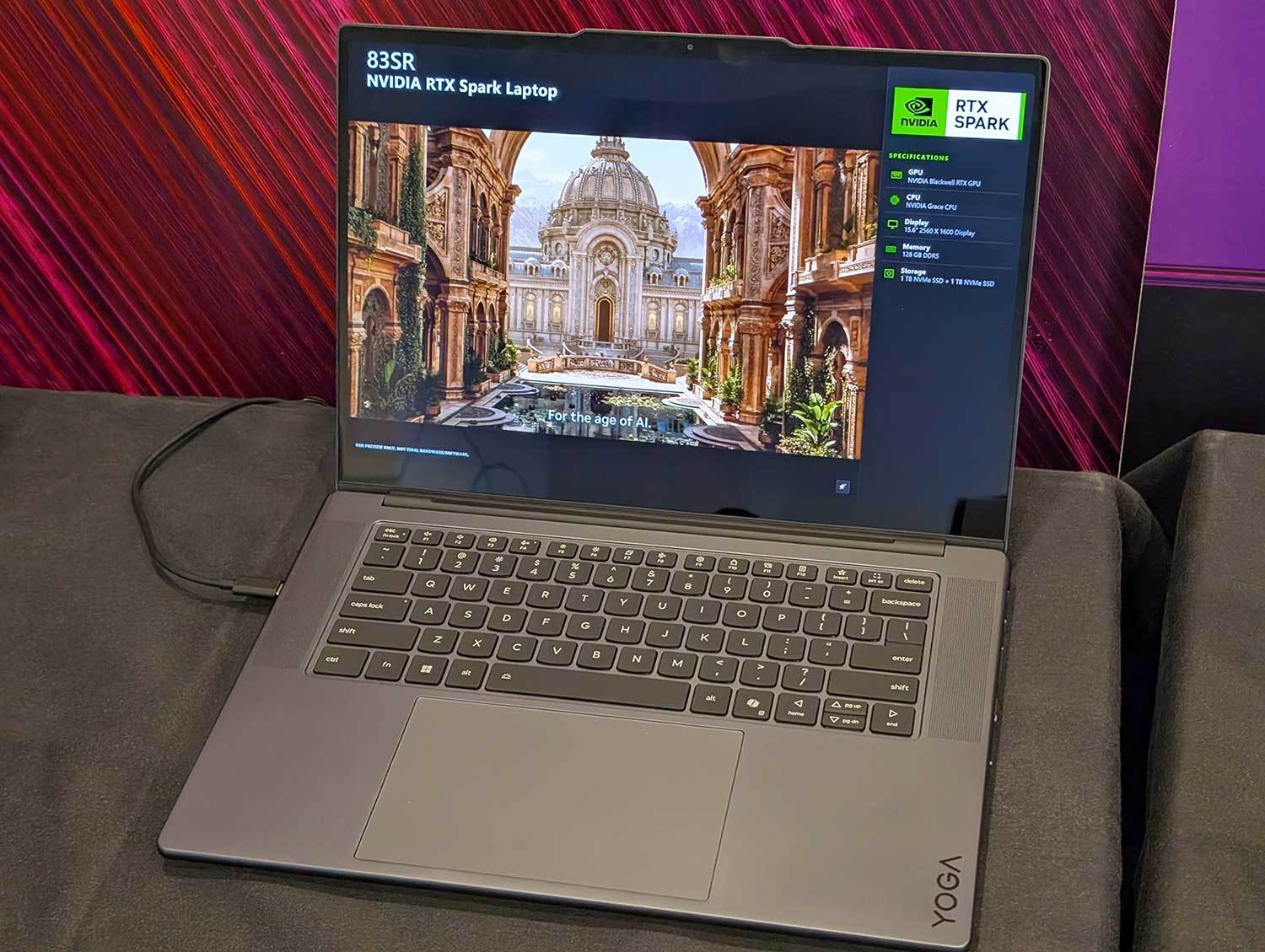
The setting surfaced alongside reports that NVIDIA is preparing an RTX Spark ecosystem — a lineup aimed at bringing more capable GPU compute to the consumer and prosumer PC space. While Western coverage has focused on hardware announcements and speculative pricing, the Japanese-language press is looking at the software plumbing first. That is a useful reminder: a new GPU line is only as useful as the OS can actually assign it the memory it needs.
Currently, many AI PC users hit a wall not because their GPU lacks performance, but because the system allocates too little VRAM-equivalent memory to the graphics side. Integrated GPUs share system RAM, and the default Windows split often leaves AI models undersized or forced into slower shared memory. The new Windows setting, if finalized, would let OEMs and advanced users push more memory toward the GPU without touching physical hardware.
For laptop makers designing thin AI-focused machines with integrated graphics, this could change the calculus. Instead of stuffing a system with excessive RAM and hoping the default split works, they could ship a configuration tool pre-set to favor the GPU, matching the machine’s intended workload.
Who wins and who loses
The winners are fairly clear. Users running local AI models — whether that is a Llama variant, a Stable Diffusion pipeline, or a RAG application on a workstation — gain a path to more GPU memory without opening the case. OEMs that have been constrained by Windows’ rigid memory split gain flexibility in their firmware and BIOS menus. AMD, which already supports VGM, now has a Microsoft-backed counterpart that could work across a wider range of silicon, including future Intel and NVIDIA integrated designs.
The loser, if there is one, is the assumption that unified memory in Windows is a solved problem. The fact that this setting is still in an Experimental Channel build suggests Microsoft has not yet finalized the UX, the safety guards, or the interaction with drivers from multiple GPU vendors. There will likely be adjustments before this lands in a stable release.
What to watch next
The key question is whether this setting ships with any guardrails. Letting users reassign memory freely is powerful, but it also opens the door to misconfiguration — a user pushing too much memory to the GPU could destabilize the desktop experience or even cause the system to fail to boot into a graphical environment. Microsoft will need to balance freedom against the possibility of a brick-prone settings menu.
Another open question is how this interacts with NVIDIA’s upcoming RTX Spark hardware. If RTX Spark is positioned as a consumer and prosumer AI compute platform, the ability to allocate more unified memory to its GPU side could be a competitive differentiator against AMD’s current VGM implementation. We may see OEMs ship machines with these settings pre-tuned before Microsoft even makes the feature widely available.
The Windows Insider build in question is Build 29648.1000, in the Future Platforms ring. That ring is not for casual testing — it is where Microsoft puts features it is still figuring out. Treat the setting as real but unfinished. The direction is what counts.
The bigger picture
This is one of those stories that looks small until you zoom out. For years, GPU memory has been a hardware problem: buy more VRAM, buy a better card. As AI workloads move onto the PC, that framing breaks down. Unified memory architectures make GPU memory a software problem — a matter of how the OS decides to divide what is already there.
Microsoft is now treating that division as adjustable. That is a recognition that the old Windows memory model was built for a different era, one before every laptop needed to run neural networks alongside the desktop compositor. The RTX Spark ecosystem, the VGM feature on AMD chips, and this Windows setting are all pieces of the same transition: the operating system is becoming part of the AI PC’s hardware design.