Xi Is Building a BRICS AI Belt and Road
China is packaging open-source AI models, talent training, and digital infrastructure into a single offering for BRICS nations — a quiet bid to carve out an alternative to US-led AI governance before Xi meets Trump.
The Open-Source Play Nobody Is Talking About
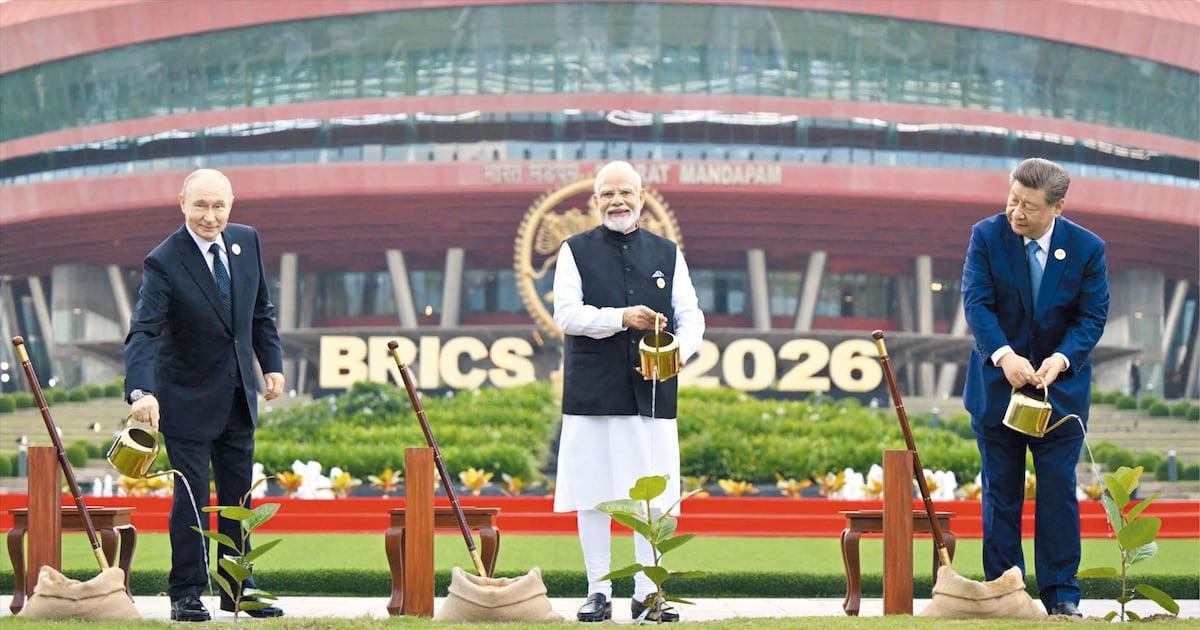
While the world watches the US-China trajectory ahead of Xi Jinping’s scheduled meeting with Donald Trump on September 24, a quieter structural shift is taking shape at the BRICS summit in New Delhi. Xi announced that China will build an “AI open-source zone” for BRICS member states — a package deal covering large language model development, AI talent training, smart factory construction, and technical standard-setting. The announcement landed with almost no splash outside specialist circles. It should not have.
What Xi is proposing is the AI equivalent of China’s Belt and Road Initiative: a bundled export of technology, standards, and human capital designed to lock developing countries into a Chinese-led ecosystem before Western alternatives become affordable or accessible. The strategy is elegant because it sidesteps the one bottleneck that has plagued China’s AI ambitions — chip sanctions.
The Real Weapon: Open Weights, Not Closed Models
China’s opening gambit rests on a class of models that Western capitals largely dismissed as insufficiently competitive. DeepSeek and Alibaba’s Qwen are open-weights models — developers can download the model parameters, fine-tune them on local languages, adapt them to domestic industries, and redeploy without paying licensing fees or routing data through San Francisco or Seattle servers. This is fundamentally different from the closed-API model dominant in the US, where every inference flows through controlled infrastructure and every usage term is dictated by American providers.
For a country like Indonesia, Nigeria, or Brazil — nations with strong languages, specific regulatory environments, and limited domestic AI R&D capacity — the math is simple. Building a competitive proprietary model from scratch requires billions in compute and data. Fine-tuning an open-weights Chinese model costs a fraction of that. The question is not whether the model is state-of-the-art on every benchmark; it is whether it is good enough, cheap enough, and sovereign enough to matter.
The answer, increasingly, is yes.
Standards Are the Real Export
The most consequential part of Xi’s announcement is not the models themselves but the technical standards he promised to help build alongside them. Smart factories, LLM deployment frameworks, AI education curricula — all of these require interoperability standards, and whoever sets those standards early owns the architecture for decades. This is the same logic that underpinned China’s 5G rollout across the Global South: once a country adopts Chinese telecommunications standards, replacing them later is prohibitively expensive.
China is reinforcing this through the World AI Cooperation Organization (WAICO), a government-to-government body established in Shanghai in July with 29 signatory countries. Xi explicitly invited BRICS members to join. WAICO covers AI development, application, and governance — a deliberate framing that positions China not just as a model supplier but as a rule-maker in a space where Western institutions currently dominate.
The timing is calculated. China is positioning itself as the default AI partner for nations that do not want to choose between American technological dominance and complete digital isolation. For countries caught in the middle — and that describes most of the Global South — the offer is difficult to refuse.
The US Response Is Narrow
Washington’s counter-strategy, embodied in the Pax Silica framework launched in December with South Korea, Japan, Australia, the UK, Singapore, and Israel, is a supply-chain alliance. It covers critical minerals, energy, semiconductors, data centers, and AI models — but only among trusted partners. It is exclusive by design. The implicit message to the rest of the world is that if you are not in the club, you do not get access to the best hardware or the newest models.
That message has the unintended consequence of pushing excluded countries toward Beijing. Pax Silica does not offer an alternative ecosystem; it offers exclusion. China’s open-source zone offers the opposite: inclusion on Chinese terms. The competition is no longer just about which model is more capable. It is about which model architecture becomes the default for an entire generation of developers in the developing world.
India Is the Fault Line
The obvious obstacle to China’s vision is India, BRICS’s largest member and the one country in the grouping with its own serious AI ambitions. Indian leaders have consistently treated BRICS as a platform for strategic autonomy rather than anti-Western alignment. New Delhi maintains significant security and economic ties with Washington and has repeatedly resisted efforts to turn the grouping into a cohesive geopolitical bloc.
Xi’s visit to New Delhi — his first in seven years — was widely read as an attempt to reset the relationship after months of diplomatic friction. Whether that reset can absorb the structural tension between two countries that see BRICS as serving completely different purposes remains an open question. India benefits from Chinese open-source models in the short term; it fears Chinese standard-setting dominance in the long term. That contradiction will define New Delhi’s posture inside any BRICS AI framework.
Other members are equally misaligned. Iran pursues a confrontational stance toward the US. The UAE maintains close American security ties. The grouping’s diverse geopolitics make a unified anti-Western AI bloc unlikely, even as individual members may quietly adopt Chinese technology.
What Happens Next
China holds the BRICS presidency next year and has already announced plans to host the 19th summit and a BRICS services trade forum. That gives Beijing a full calendar to institutionalize the open-source AI zone — moving from announcement to working groups, to pilot projects, to binding standards. The window is narrow. If China can establish even a handful of flagship deployments in key member states before Western alternatives adapt, the lock-in effect will be substantial.
The Trump-Xi meeting on September 24 will dominate headlines. But the more durable contest is happening in parallel: a race to define which AI ecosystem developing countries inherit, and whether that inheritance comes with open-ended dependence on American infrastructure or structured dependence on Chinese standards. The open-source zone is China’s answer to that race — and it is a move that redefines what AI competition actually looks like when the prize is not just the models but the rules that govern them.
The question for policymakers in Washington, London, and Tokyo is not whether China will lose this argument on technical merit alone. It is whether they have a credible offer for countries that do not want to be locked into anyone’s system — including their own.