Xiaomi's Privacy Screen and 8500mAh Battery Signal a New Android Arms Race
Xiaomi's new Pro Max packs a voyeur-proof display, dual 200MP cameras, and an 8500mAh battery — features that press harder on the premium smartphone market than any single spec alone. The question is whether China-built excess can shift the balance against Apple and Samsung.
Xiaomi is betting that the next flagships won’t be won on speed alone.
The Xiaomi 18 Pro Max announced in Beijing on September 23 does three things at once that no single competitor is currently matching. It pairs dual 200-megapixel cameras with a privacy display that blocks side-view reading when tilted, an 8500mAh battery, and a Snapdragon 8 Elite Extreme Gen 6 — the first phone anywhere to carry Qualcomm’s newest extreme-tier chip. The smaller 18 Pro does nearly all of the same, scaled down to a 6.4-inch screen and a still-huge 7000mAh cell. Both will run globally; neither has a date yet. Japan is not mentioned.
Taken individually, each spec looks like ambition. Combined, they look like a strategy.
The privacy screen is the real move
The angled privacy display is the detail most English-language coverage will glide past. It is also the one that matters most for how the phone is used in public.
Commute culture across East Asia — crowded trains, narrow sidewalks, packed cafés — makes screen glancing a daily hazard. A display that turns opaque when viewed from the side is not a gimmick. It is a utility. More importantly, it is a differentiator that does not require the buyer to adopt a new app, a new OS, or a new ecosystem. It is baked into the glass.
Apple does not offer anything comparable on the iPhone. Samsung’s privacy options remain software-level. Other Chinese brands have experimented with privacy filters, but none have folded the feature into a flagship display at this resolution and brightness level. Xiaomi is turning a once-niche accessory into a baseline expectation.
If this display ships as advertised at 4000 nits peak brightness, the privacy layer will have to be thin enough to preserve that luminance — which means the manufacturing hurdle is real. That is exactly why it is impressive if it works.
The battery is an embarrassment of riches
An 8500mAh cell in a phone that weighs 235 grams is not just large. It is structurally disruptive to the category.
Samsung’s largest battery this generation sits in the 5000mAh range. Apple’s numbers are not published, but estimates place iPhone 17 Pro Max capacity somewhere near 4800mAh. Xiaomi’s 18 Pro Max holds roughly double.
The implication is not merely longer battery life. It is a change in the conversation around what a flagship phone should prioritize. For years, the premium segment chased thinner bodies, lighter materials, and faster chargers. Xiaomi is pushing in the opposite direction: bigger cells, faster 100W charging, and 50W wireless — all while keeping the phone under 8.5 millimetres thick.
That ratio is unusual. It suggests Xiaomi has either solved a thermal or structural problem that other manufacturers have accepted as unavoidable, or it has re-prioritized what users will tolerate in a phone. Either way, it raises the bar for anyone trying to compete on endurance at the top end.
Dual 200MP sensors change the telephoto calculus
Most flagships offer one high-resolution sensor and compromise on the telephoto. Xiaomi is installing 200MP on both the main wide and the 3.2x telephoto. The telephoto sensor is a 1/1.56-inch unit, which is large for a periscope-style lens and enables tele-macro photography.
The practical effect is that Xiaomi is targeting the same photography crowd that currently gravitates toward Samsung’s 10x optical zoom or Vivo’s periscope setups — but at a wider focal range and with higher resolution across the board. Whether the image processing pipeline can match the sensor specs is the open question. The raw numbers, though, set a new reference point for the category.
The AI button is a hardware commitment
Qualcomm’s new chips include an on-device NPU bump, and Xiaomi is giving the phone a dedicated AI button on the left edge. The button can trigger screenshots, recordings, and custom workflows — and can be remapped to toggle the privacy display.
This mirrors a move that Apple is expected to make on the iPhone 17 series with its new Capture button, but it arrives six months earlier and with more functional flexibility. The hardware-level shortcut signals that Xiaomi wants the 18 Pro Max to feel like a tool, not a slab.
The transparent special edition is theater — and that is fine
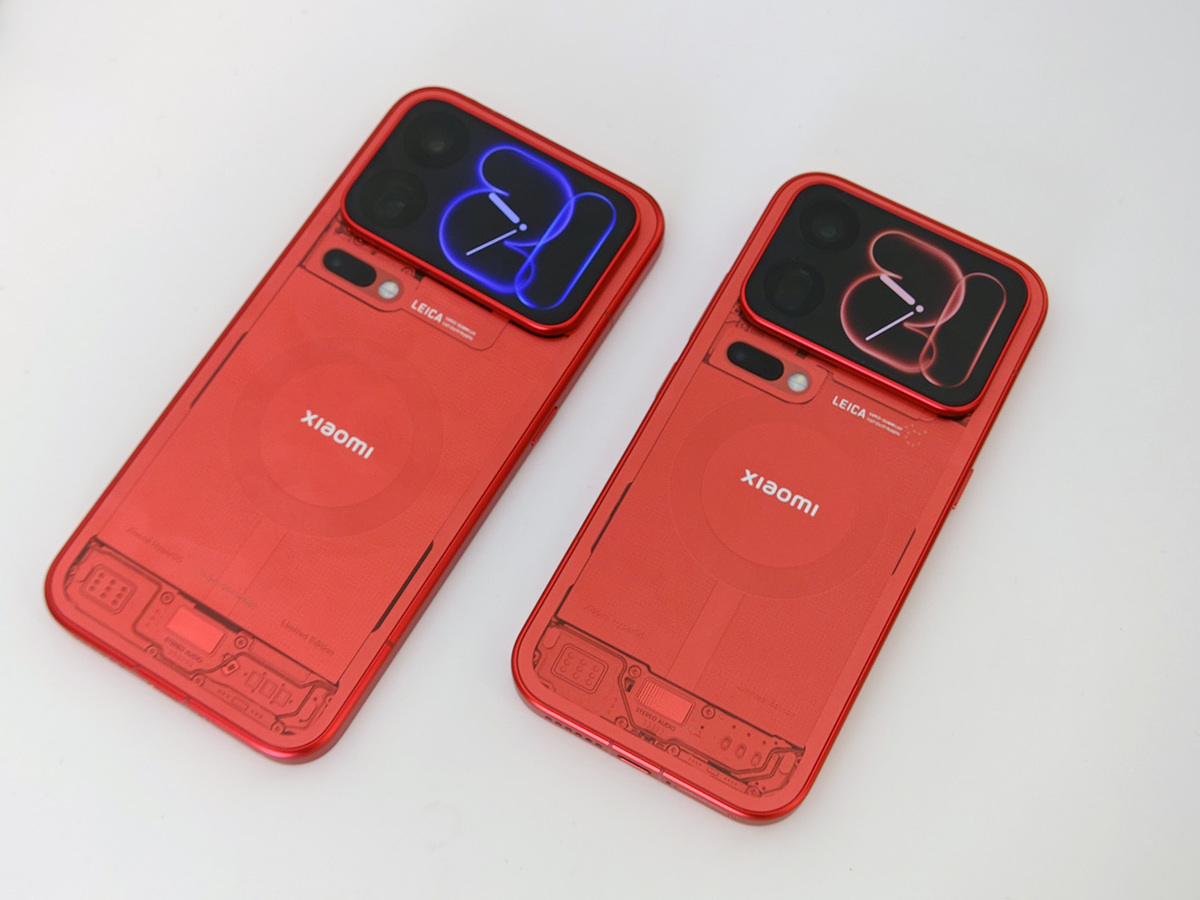
Xiaomi also announced a translucent red special edition of the 18 Pro with 16GB of RAM and 1TB of storage, priced at 9999 yuan. It is a $23,600 yen premium over the standard variant, and it exists primarily to generate social media attention. The real products are the standard blue, pink, black, and white models at 5999 to 6999 yuan.
But the transparent edition matters narratively. It tells buyers that Xiaomi can make unusual hardware at scale — a signal that reinforces the brand’s push beyond the value-segment image it carried for years.
What this means for Samsung and Apple
The immediate pressure falls on Samsung. The Galaxy S series competes directly with Xiaomi’s Pro line in Asia, and Samsung currently leads on display technology and camera processing. A privacy display on a phone with more than double the battery capacity and a dual 200MP setup changes the framing of that comparison. Samsung will need to respond with hardware, not just software tweaks.
Apple faces a different problem. The iPhone is not sold on battery capacity or camera megapixels. It is sold on ecosystem lock-in and perceived reliability. Xiaomi’s specs do not threaten the iPhone’s core value proposition — but they do widen the gap in pure hardware ambition. In markets where phone upgrades are driven by spec sheets rather than brand loyalty, that gap accelerates.
The global timing question
Xiaomi confirmed a global rollout but gave no date. Japan was not mentioned. Historically, Xiaomi launches in China first, then rolls out to Europe and India, with Japan entering later or not at all. If the 18 Pro Max follows that pattern, global buyers should expect a winter announcement at the earliest.
The real test will come when the phones ship and the privacy display, battery longevity, and dual 200MP camera system are evaluated independently. The specs are bold. Confidence comes from verification.