Xiaomi's IFA Play: Why Samsung and LG Are Losing the Ecosystem War
At its first IFA 2026, Xiaomi displayed not a phone but a strategy: connecting cars, homes, and robots through one AI layer. The question for Samsung and LG is whether they can compete when lock-in now belongs to whoever controls the platform.
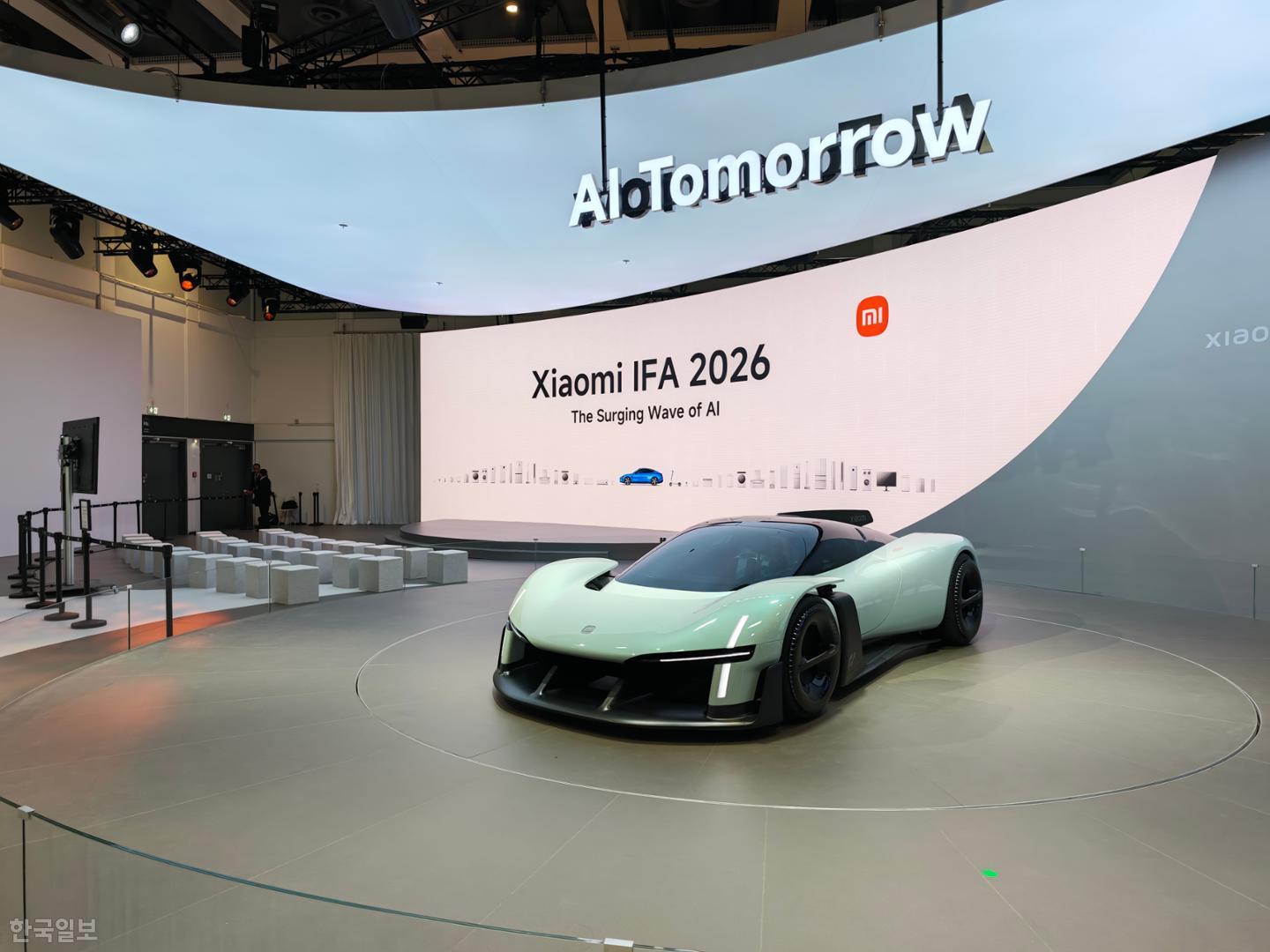
Xiaomi forgot its phone at IFA. That was the point.
Walk into the Xiaomi booth at Messe Berlin and the first thing you notice is an absence. The company that built its global reputation on smartphones has pushed its phones to the back of the room. In the front sits a green electric concept car—the Vision GT—designed in collaboration with Sony’s Gran Turismo racing game. Beside it, a humanoid robot called CyberOne. Surrounding both, a fully staged smart bedroom where lights, climate, curtains, and a TV respond to a single voice command.
This is not a company announcing products. This is a company announcing a strategy.
Xiaomi’s first appearance at IFA 2026 was deliberate theater. The booth covered more than 3,300 square meters with 380 products, all threaded together under a single concept Xiaomi calls “person × car × home.” The message to European buyers—most of whom have never owned a Xiaomi device outside of budget earbuds or a phone—is unambiguous: we are no longer a smartphone company that dabbles in appliances. We are an AI-powered platform company, and everything you touch, drive, and live in runs through the same system.
The lock-in is not the device. It is the habit.
Consumer technology lock-in has always worked through friction, not force. You own an iPhone; your apps, photos, and subscriptions live in Apple’s walled garden. Switching costs climb until you stay. But a walled garden only locks you into one category. If your phone is Apple, your fridge is Samsung, and your car is Volkswagen, you carry three separate apps, three separate accounts, and three separate friction points.
Xiaomi’s play is to remove those walls—or at least make them invisible. A user comes home from work. The car tells the house someone is arriving. Lights adjust. The refrigerator orders groceries because its sensors detected a gap. The robot vacuum starts cleaning because the occupant’s watch recorded less movement than usual. All of this runs through HyperOS, Xiaomi’s operating system, powered by its own large-language model MiMo and, increasingly, its custom Xingling semiconductor.
The product experience is seamless. The competitive implication is far more aggressive: whoever controls the AI glue between car, home, and personal device owns the relationship with the consumer. The hardware becomes the delivery mechanism; the software experience is the moat.
Samsung and LG are still selling islands.
Samsung and LG dominate Korean home appliances. They also make phones and, in Samsung’s case, semiconductors. But their product divisions operate largely as separate empires. A Samsung phone user does not automatically get a richer experience from a Samsung refrigerator. A LG car owner (or prospective EV buyer) gains no meaningful integration with a LG washing machine.
That fragmentation is a structural advantage for Xiaomi. The Chinese company has spent years building HyperOS as a single connectivity layer across categories that competitors treat as business units. When Xiaomi rolls out a new AI feature, it lands across phones, TVs, vacuums, and cars simultaneously. When Samsung introduces AI capabilities, they typically announce them per-division, with varying timelines and feature parity.
The result is not a product-gap problem. It is a platform-gap problem. And platform gaps widen faster than hardware gaps because every new generation of AI makes the previous generation’s experience look incremental.
What IFA reveals about who is setting the frame.
Xiaomi chose to lead with a concept car at a consumer electronics show. That is a status move. It signals that the company considers the automobile—traditionally the domain of Detroit, Stuttgart, and increasingly Shanghai—to be a natural extension of its ecosystem, not a separate venture. The Vision GT will not ship. It is a signpost, not a product.
Similarly, the CyberOne humanoid robot is not yet a household appliance. It is an assertion that Xiaomi sees AI agents entering physical space, and it wants to be the company that controls the relationship between those agents and the devices they manipulate.
For Samsung and LG, the spectacle at Xiaomi’s booth is a mirror reflecting a strategic vulnerability. Neither Korean giant is presenting a unified “person × car × home” narrative at IFA. Their shows are still organized by product category: TVs here, phones there, appliances somewhere else. That organizational reality shapes what visitors take away.
The Korean market is the proving ground.
Xiaomi’s expansion into Korea is the sharpest edge of this competition. The company already sells phones and tablets there, but it is moving aggressively into robot vacuums and now eyes refrigerators and air conditioners. The product story is easy to tell. The distribution story is harder.
Samsung and LG built their dominance in Korea through decades of dealer networks, installation teams, and after-sales service operations. Xiaomi has none of that infrastructure. Reports indicate the company plans to open more direct Xiaomi Stores and lean harder on online sales channels. That approach works for small appliances and accessories. It struggles with bulky items that require installation and long-term maintenance—exactly the category where Samsung and LG margins are highest.
So the near-term question is practical: Can Xiaomi build a service network fast enough to convert ecosystem enthusiasm into sales? The long-term question is strategic: Once it does, will Samsung and LG be able to respond without cannibalizing the margins their traditional model generates?
The chip war inside the ecosystem war.
Xiaomi also used IFA to showcase its Xingling AI chip and announced an AI accelerator called O100 that will ship next year. This matters beyond marketing. Custom silicon allows a company to optimize the latency and cost of running its LLM locally on devices—phones, vacuums, cars—without routing every inference through a cloud server. Local AI is faster, cheaper at scale, and more private. Those are exactly the features that make a locked-in ecosystem feel frictionless rather than forced.
Samsung has its own exynos line and continues investing in AI chips. LG’s semiconductor exposure is far narrower. The gap here is not yet decisive, but it tracks with the broader pattern: Xiaomi is building vertically, from chip to OS to cloud model to physical product. Samsung is building horizontally, across categories that do not yet talk to each other.
Who wins, who loses, and what happens next.
Xiaomi wins if its ecosystem stickiness outpaces its distribution gaps. Even a partial lock-in in Korea and Europe would let the company command higher lifetime value per user than any single-product competitor. Samsung and LG lose margin share on appliances first, then face harder choices about whether to open their platforms or dig in and protect installed-service revenue.
The immediate next moves are visible. Xiaomi will push HyperOS integrations harder and likely announce concrete product launches in refrigerators and EVs within the next 12 months. Samsung and LG will respond with their own cross-category AI promises, though execution will reveal whether their organizational structures can deliver what Xiaomi’s already operates as one stack.
The deeper shift is cultural. For decades, consumer tech competition was measured in megapixels, screen brightness, and battery life. IFA 2026 made clear that the metric has changed. The winner will be the company whose AI makes the consumer feel least responsible for managing their own devices.
That is a harder bar to measure and a much wider moat to defend.