Zelenskyy's €70 Billion Bet Forces EU's Strategic Autonomy Into
Ukraine's record funding request exposes the gap between European defense ambition and actual spending. The €70 billion ask will test whether Brussels can finally replace Washington as Kyiv's primary patron.
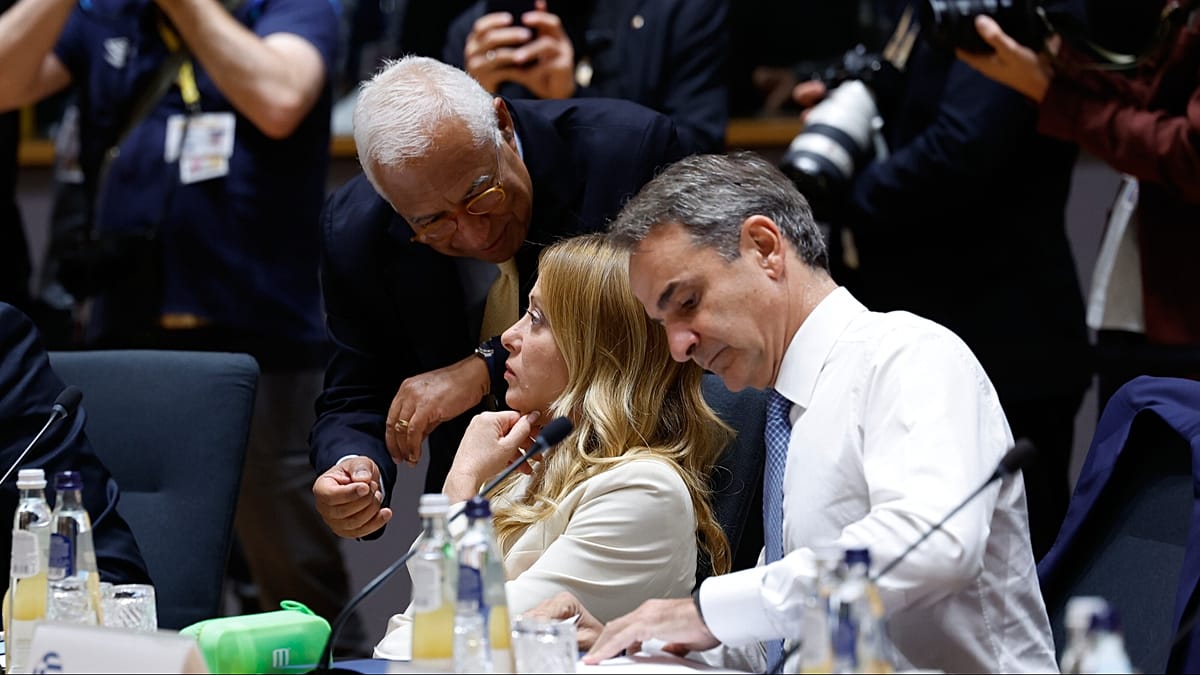
Zelenskyy’s €70 Billion Bet Forces EU’s Strategic Autonomy Into Budget Reality
When Volodymyr Zelenskyy stood before EU leaders in Brussels on Friday and asked for €70 billion in additional support for 2027, he was doing more than supplementing a war budget. He was handing Europe a bill for something it has been debating in theory for over a decade: what it actually costs to be strategically autonomous from the United States.
The number alone is staggering. €70 billion next year on top of the €90 billion loan already approved to cover 2026 and 2027. That brings the total EU commitment to roughly €160 billion across two years, with Kyiv telling Brussels it will need another €155 billion just for 2027. The war is not winding down. It is expensive.
What makes this moment distinctive is the timing. Donald Trump has spent months suggesting that American support for Ukraine is conditional, transactional, and nearing its end. He called Kyiv’s strikes on Russian oil refineries a “disgrace” and told Newsmax that dealing with Zelenskyy is harder than dealing with Putin. The diesel deal struck between the US and Russia — an arrangement Zelenskyy said Kyiv was not consulted about — signals that Washington may be carving out its own side agreements while Europe is expected to foot the bill.
That is the pivot Zelenskyy is banking on. He made it explicit during his press conference. “I defend the interests of Ukraine and the Ukrainian people exclusively,” he said. “We were attacked, occupied, and our people were killed. It is only logical that we have the right to defend ourselves.” He also pressed the EU for anti-ballistic missiles during the period of whatever US-Russia energy deal emerges, noting bluntly that he had not received any.
Europeans heard him. Ursula von der Leyen endorsed the €70 billion estimate and admitted it had been “hard to predict” what the war would cost when the original funding package was agreed. But she also made clear the EU would not cover it alone. A share, she said, should come from other Western allies — a polite way of acknowledging that America remains the heavy lender at the table, even as its political will appears to fray.
The real story here is not the money itself but what it forces Europe to confront. Strategic autonomy has been a slogan since France first pushed it two decades ago. It became a watchword after Trump’s first term, when the possibility of an isolated America became real. It has been discussed in white papers, summits, and working groups. It has never been put to a vote with a price tag attached.
Now it has. €70 billion is not a hypothetical. It is a line item that will have to be found somewhere — in the EU budget, in borrowed money, in redirected spending, or in new revenue mechanisms that no member state currently wants to create.
Sweden’s Prime Minister Ulf Kristersson made that clear on the second day of the summit. His country will not accept a 60 percent increase in its national contribution to the EU budget. “You cannot ask a few number of countries providing some 70 percent of the support for Ukraine and 40 percent of the money to the EU budget to just increase that amount again,” he said. The message was unmistakable: the countries most willing to finance Ukraine’s defense are also the ones most resistant to financing the EU’s broader budgetary commitments.
The split is not new but it has sharpened. Denmark, Poland, and Italy pushed for migration language in the summit conclusions that implicitly targeted Spain’s regularization of 600,000 undocumented migrants. Czech Prime Minister Andrej Babis went further, accusing Pedro Sánchez of seeking to “replace” Spaniards with migrants to stay in power. Macron called it a “bad debate” and warned that ideological divisions were making the bloc “ineffective.” The summit ran past its scheduled end time, a rare sign of how contentious the agenda had become.
Meanwhile, on the economic side, Friedrich Merz announced that leaders had given the Commission a mandate to build new trade defense tools aimed at global imbalances — undervalued currencies, high subsidies, leveraging capacities. A Franco-German proposal would introduce a mechanism activated by reversed qualified majority, a significant shift in how EU decisions are made. Merz also confirmed a second informal leaders’ retreat at Alden Biesen castle in February 2027, focused on competitiveness.
Germany and France also struck a deal on the 2035 combustion-engine ban, easing the outright prohibition in exchange for tougher “Made in Europe” rules on public procurement. Cars would still need to cut CO₂ emissions by 90 percent by 2035, but the remaining 10 percent would no longer need to be offset through carbon credits. The agreement opened the door for the UK, Norway, and Switzerland to participate in the rule — a signal that Europe wants to build a sphere of influence without fully closing itself off.
Merz insisted the deal was not a blueprint for other sectors and that he did not want the EU to move toward protectionism. Whether that holds as the new trade defense toolbox takes shape remains unclear.
What is clear is that the Ukraine funding gap is the defining problem of this summit. The €70 billion ask arrived at a moment when the US is retreating from its traditional role as guarantor of European security and China is accelerating its industrial competition. The EU has neither the unified budget nor the unified political will to fill the vacuum alone.
Zelenskyy’s remarks were pointed. “Twenty million people will come to Europe” if Russia achieves its aims, he warned, drawing a direct link between Ukrainian defense and European demographic and security futures. He also accused Putin of testing NATO through hybrid warfare across the continent — drones, arson, sabotage — and suggested the Kremlin does not see Ukraine as a legitimate nation.
The question for Europe is whether it believes him enough to pay the price. The summit produced no budget deal. It produced promises to explore options. It produced a trade toolbox in principle. And it produced a €70 billion gap that no one has yet offered to close.
If the EU wants strategic autonomy to mean anything beyond rhetoric, it will have to find that money. Not in 2028. Not after the next summit. Now.