The $100 Oil Shock Is Already Reshaping Global Policy — Starting in Asia
WTI crude just破 100 dollars a barrel for the first time in four months, triggered by Iran conflict escalation and Hormuz Strait disruptions. The implications reach far beyond gas prices — into central bank strategy, election calculus, and Asian household budgets.
The Line That Matters Now Is $100
WTI crude crossed $100 a barrel on September 10 for the first time since May. It touched $100.88 intraday before settling at $100.25 — up 4.37 percent. Brent, the global reference price, followed into the $105 range. The catalyst was not speculation but geography: the Hormuz Strait, through which roughly 21 million barrels of oil flow each day, is once again a chokepoint under threat.
The trigger is a renewed US-Iran military exchange. Both sides have been trading strikes. Shipping through the Strait has experienced disruptions. The market is pricing in a scenario that traders tried to dismiss only weeks ago — that this conflict will not be brief.
What Western Desks Missed First
Chosun Ilbo reported the breakout in its early morning Seoul edition before most Western financial desks had fully digested the supply-risk implications. That timing tells you something important about how oil information flows today: the first clear signal often comes from Asian exchanges and newspapers, not New York or London. Hormuz is an Asian chokepoint. Asian refineries — in China, South Korea, Japan — are the first to feel the logistics squeeze. By the time Wall Street re-prices the risk, Asian importers are already hedging at worse levels.
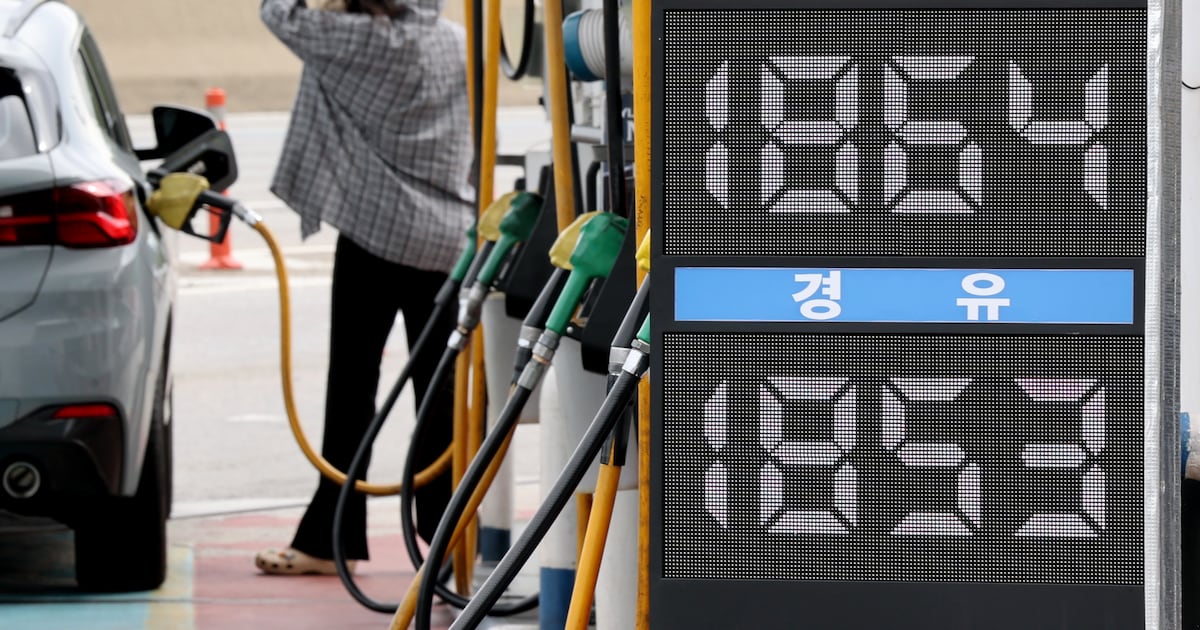
South Korea, a country that imports virtually all its oil, sees pump prices move within hours of any Hormuz disruption headline. On September 10, photos published from a Seoul gas station showed queues forming — a visual that travelled faster than any commentary on supply curves.
The ECB Is Already Moving
The European Central Bank gave itself no choice. On the same day WTI broke $100, the ECB raised its key rate by 25 basis points to 2.5 percent. The decision was framed as inflation control, but the underlying pressure came directly from energy. Eurozone producers faced steep cost inputs. The August US producer price index — up 5.4 percent year-on-year, ahead of July’s 4.8 percent — reinforced the message that inflation is back on track, not retreat.
The ECB’s move signals a central bank watching its mandate get squeezed from two directions: sticky services inflation and now a renewed energy shock. Rate cuts that policymakers had been quietly forecasting are gone. The question is whether the ECB can sustain tightening without pushing growth into contraction — a tension already visible in German and French equity weakness, with the DAX down 0.6 percent and CAC 40 down 1.3 percent.
Trump’s Election Math Gets Complicated
Donald Trump told reporters that oil prices would likely fall only after November’s midterms. That is not a forecast. It is a political boundary. It says the administration sees no benefit from lower energy prices before the vote and may be willing to tolerate higher prices in the short term.
But Trump’s own closest aides have privately suggested the war could continue through the end of his term. That contradiction — price relief promised for November, conflict escalation possible through 2028 — is the kind of signal that makes markets nervous. Investors do not price certainty. They price probability distributions. And the range of outcomes has just widened significantly.
Who Wins and Who Loses
Who wins: US shale producers with existing capacity, particularly Permian Basin operators who can ramp without major new capital. Naval defense contractors. Countries with strategic oil reserves — the US, China, Japan — that can draw on stored supply while spot prices spike.
Who loses: Every economy that imports more oil than it produces. That is most of Asia. South Korea, Japan, India, Taiwan — all of them face transport cost increases, petrochemical margin compression, and consumer price pressure that central banks cannot easily offset without hurting growth. Europe loses twice: energy costs rise and growth slows.
The US is the only major economy that could emerge net-positive if domestic production expands fast enough. But even the US faces a paradox: higher oil prices dampen consumer spending at the pump, which weakens the very economy that the Federal Reserve would need to keep stable if inflation runs hot.
What Comes Next
The most important number to watch is not $100. It is what happens at $110. At that level, demand destruction becomes real — refineries cut runs, airlines reduce capacity, shipping companies impose fuel surcharges. At $100, the market is still in the “shock and hedge” phase. At $110, it enters the “recession pricing” phase.
Hormuz is the variable. If the Strait reopens — even partially — prices could retreat sharply. If both sides escalate and mining or missile activity disrupts terminal operations in the UAE or Saudi Arabia, the supply curve shifts left almost overnight. The difference between those two scenarios is measured in tens of billions of dollars in global GDP.
Asian markets reacted on September 10 with broad declines — Japan excepted, where yen weakness partially offset energy costs. European markets sold off harder. US futures were down before the bell. The pattern is familiar: every oil shock since 2022 has moved through Asia first, then Europe, then the US.
The next four weeks will determine whether this is a contained geopolitical premium or the start of a sustained higher-for-longer energy regime. Central banks have already begun adjusting. Elections are about to get more expensive. And consumers in Seoul, Tokyo, Mumbai, and Los Angeles are about to find out what $100 oil feels like at the pump.