Adult T. rex Trackway Rewrites What We Know About Dinosaur Behavior
Paleontologists have found the first fossilized footprints from a full-grown Tyrannosaurus rex, revealing how these giants moved and why tracks are rarer than their bones.
Bones Lie. Tracks Tell the Truth.
For decades, paleontologists have built our understanding of Tyrannosaurus rex from skeletons. Skulls. Vertebrae. Finger bones. The most complete specimens tell us about bite force, growth rates, and what these animals looked like standing still.
But they reveal almost nothing about how T. rex moved through the world.
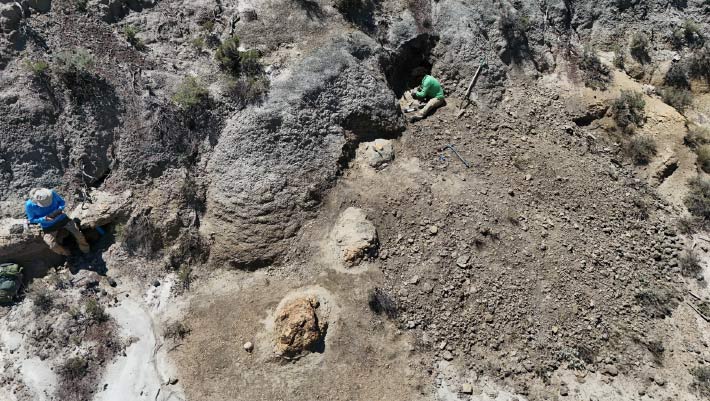
That changes now. A team led by Dr. Tyler Lyson of the Denver Museum of Nature & Science has published the first fossilized trackway confidently attributed to an adult Tyrannosaurus rex—a 7-meter sequence of four massive three-toed prints captured in mud that hardened 66.5 million years ago in what is now southwestern North Dakota.
The discovery matters because it fills a gap that skeletons cannot. “Bones tell us an enormous amount about these animals, but footprints capture a moment of behavior,” Lyson said. “With a trackway, we can actually follow an animal as it moved across the landscape. That is incredibly rare for T. rex.”
The Speed of a Titan
Here is what the trackway reveals: this particular T. rex was walking at roughly 1.5 to 2 meters per second—about 3.4 to 4.5 miles per hour. Its stride measured approximately 4 meters between footfalls. That pace is consistent with other large theropod trackways, suggesting adult tyrannosaurs moved more slowly than their pop-culture reputation implies.
The prints themselves are enormous—each around 1 meter long, or roughly 3.3 feet. Combined with their shape, the narrow angle between toe impressions, and the abundance of T. rex bones already extracted from surrounding rock, the researchers concluded the trackmaker was a fully grown individual. This is critical. Previous tyrannosaur tracks from New Mexico and Montana were isolated footprints, never part of a continuous trackway. And earlier trackways attributed to tyrannosaurs in Canada and Wyoming were made by smaller animals—younger T. rex or related species—not adults.
Why Adult Tracks Are Rarer Than Adult Bones
The finding is rarer than it sounds. Hell Creek Formation has yielded hundreds of T. rex specimens, including some of the most complete skeletons ever found. Yet trackways from adults are essentially nonexistent in the fossil record.
There are several reasons. First, not all terrain preserves footprints. An adult T. rex—easily weighing several tons—would sink into soft, muddy sediment. If that sediment didn’t rapidly harden or get buried, the tracks would collapse. Second, erosion has to strip away surrounding rock to expose them, a process that rarely captures multiple consecutive steps in alignment. Third, and perhaps most importantly, adult tyrannosaurs may have lived in different microhabitats than younger individuals, or their behaviors may have taken them away from the floodplain environments where tracks fossilize best.
The Hell Creek prints preserve in an unusual way: as calcium-carbonate-cemented sandstone casts formed inside the original depressions. Over millions of years, erosion removed the softer surrounding mudstone, leaving the harder casts exposed. The result is a series of massive but heavily fractured impressions—limited in fine anatomical detail but invaluable for what they reveal about locomotion.
A Teacher’s Discovery
The trackway was found in 2025 by Kent Hups, a high school teacher in Northglenn, Colorado, working in the badlands of southwestern North Dakota. Hups is not a professional paleontologist. He recognized the prints, documented them, and brought them to scientists.
“As a teacher, I’m always telling my students that science starts with curiosity, passion and careful observation,” Hups said. “I never imagined that could lead me to a discovery like this.”
That quote is worth sitting with. The fossil record is incomplete not because we lack sites to explore but because we lack eyes willing to notice. This trackway might never have been found by conventionally trained professionals scanning for bones. It required someone looking at the ground instead of digging into it.
What Comes Next
The findings appear in the Journal of Vertebrate Paleontology, published September 8, 2026. The paper’s lead author is Peter L. Falkingham, with co-authors including Lyson and Hups.
Beyond the immediate data—stride length, estimated speed, trackmaker size—the discovery opens questions. How common were adult T. rex trackways? Were adults more solitary than juveniles, leaving fewer overlapping trails? Did they move differently across varied terrain, or was this walking pace typical regardless of environment?
Researchers will now re-examine existing Hell Creek track sites with fresh eyes, asking whether isolated large theropod prints might belong to adult tyrannosaurs rather than smaller relatives. They will compare this trackway’s speed estimates against biomechanical models derived from skeletal anatomy to test whether bones and tracks tell the same story.
And they will keep looking.
The Point
We spend centuries reconstructing dinosaurs from fragments of bone. But bones are silent. They don’t tell us how an animal walked, how fast, whether it paused to rest, or whether it moved alone or in company.
This trackway does. It captures a moment—literally frozen in stone—of a creature 12 tons of muscle and bone stepping through mud on the last days of the Cretaceous. It happened just before the asteroid hit. That animal was alive when the sky burned.
Finding its footprints is extraordinary because it gives us something skulls never can: evidence of behavior. The skeleton tells us what T. rex was. The trackway tells us what T. rex did.
Both matter. But only one lets us watch it move.