The Nuclear Clock Arms Race Has Begun
First operational thorium-229 nuclear clocks built simultaneously in Vienna and Beijing signal a new era in precision timing—and a silent geopolitical competition over the technology that could redefine navigation, fundamental physics, and national security.
A Clock That Ticks on Nuclei, Not Electrons
The last time a new class of atomic clock was demonstrated in the lab, it rewrote how we define the second and upgraded the GPS infrastructure underneath it. Now, a nuclear clock has crossed the same threshold—only this one does not rely on the spin-flip of an electron. It relies on the nucleus itself.
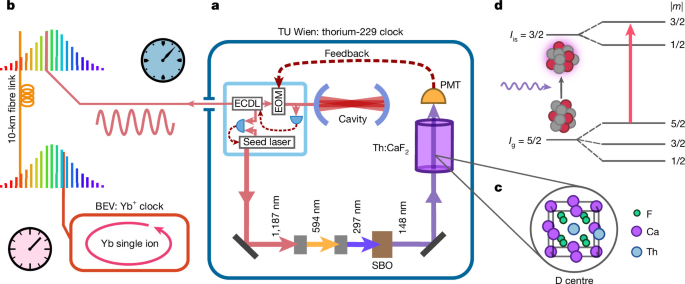
A team in Vienna has published what appears to be the first operational thorium-229 optical nuclear clock with a closed feedback loop, stabilizing a laser directly to the 8.4 eV nuclear transition in a doped CaF2 crystal. The system runs for days at a time, reaching fractional frequency instabilities in the low 10^-14 range within a single continuous run. The transition frequency sits at roughly 2.02 × 10^15 Hz—over ten thousand times higher than the microwave transitions that anchor today’s cesium fountains.
Two labs, working independently, have converged on the same milestone within the same twelve months. The second, in Beijing, reported a competing demonstration at nearly the same time. That simultaneity is not incidental.
Why the Nucleus Changes Everything
The difference between an atomic clock and a nuclear clock is not semantic. Electrons orbit the nucleus and are exposed to electromagnetic noise— stray fields, thermal fluctuations, blackbody radiation shifts. Nuclei sit inside the atom, shielded by those same electrons, and interact far more weakly with external perturbations. For thorium-229, the isomeric state sits at an unusually low excitation energy of about 8.4 eV, which means the transition can be driven by a vacuum-ultraviolet laser at 148 nm—a wavelength that, while demanding, is now commercially available.
The resonance quality factor of the bare nucleus approaches 10^19. Doping microgram quantities of 229Th into a crystal host sacrifices some of that perfection but gains orders of magnitude in signal-to-noise ratio. Instead of trapping a single ion, the Vienna experiment interrogates roughly 10^13 nuclei in a solid-state target. Absorption spectroscopy replaces fluorescence detection, yielding three orders of magnitude more signal photons per second.
The feedback loop works by locking a high-finesse cavity-stabilized laser to the nuclear transition with a Pound-Drever-Hall scheme. The error signal comes from modulating the interrogation frequency across the absorption line and measuring the differential signal with a photomultiplier tube. A single correction step takes about a second. At an integration time of thirty minutes, the nuclear feedback barely perturbs the short-term stability inherited from the cavity—already at the 10^-15 level. At twenty seconds, the laser locks to the nucleus much faster, at the cost of degraded short-term performance. That trade-off is not a limitation. It is a design choice that opens a door to dark matter searches.
The Dark Matter Window That Just Opened
The most immediate scientific payoff of a nuclear clock is not better timekeeping. It is a new detector for physics beyond the Standard Model.
The 229Th isomer’s low energy arises from a near-cancellation between the mega-electronvolt-scale Coulomb repulsion and the strong nuclear binding energy. That accidental degeneracy makes the transition frequency exquisitely sensitive to small variations in the fine-structure constant alpha, the QCD scale parameter Lambda_QCD, and quark masses. Pass an ultralight scalar boson—a candidate for dark matter—through the crystal, and the transition frequency should oscillate at a rate set by the boson’s mass.
The Vienna team searched for exactly that signal in twenty-three hours of data taken at a twenty-second integration time. They looked for periodic modulations in the ratio of the 229Th transition frequency to that of a Yb+ single-ion clock, converted through a beat note measured on a frequency comb. No signal was claimed, but the bounds placed on the coupling of scalar bosons to electromagnetic and strong interactions already rival or surpass what the best atomic clocks can achieve—despite the nuclear clock not yet matching their fractional instability.
This is the critical asymmetry. Atomic clocks are approaching the 10^-19 uncertainty frontier. Nuclear clocks are currently sitting around 10^-15 to 10^-14. Yet for certain dark matter couplings, the nuclear transition’s sensitivity exceeds that of any atomic system by orders of magnitude. The two experiments probe different parameter spaces. Together, they close a widening net.
Two Capitals, One Milestone
The Vienna result is significant on its own merits. The coincidence of a simultaneous Beijing demonstration adds a dimension that goes beyond physics.
Navigation is the first casualty of any timing disruption. GPS, Galileo, BeiDou—all depend on satellites carrying atomic clocks whose drift compounds into meter-scale position errors over a day. A network of nuclear clocks on the ground would provide an independent reference frame, immune to the electromagnetic vulnerabilities that afflict conventional oscillators. In a contested environment, that independence is strategic.
China has invested heavily in quantum sensing and precision measurement as part of its broader technology sovereignty agenda. The Beijing nuclear clock team operates within a system that treats fundamental measurement capabilities as dual-use infrastructure. The same apparatus that searches for dark matter also measures gravitational redshift at the centimeter level—enabling new geodesy networks that track subsidence, groundwater depletion, and magma movement without a single gravimeter in the field.
Austria’s contribution came through a collaboration spanning TU Wien, the Institute for Quantum Optics and Quantum Information, and the Austrian Federal Office of Metrology and Surveying. The Yb+ reference clock they beat against sits at BEV, linked through a Doppler-compensated fiber span. The infrastructure is distributed, civilian, and open. That openness is both a strength and a vulnerability. China’s parallel effort runs through a more centralized academic-military ecosystem that accelerates deployment but obscures verification.
The Immediate Friction
The Vienna clock is not yet a practical replacement for cesium or optical lattice standards. Reproducibility between experimental runs is limited to about 5 × 10^-13, primarily because realigning the laser changes where the beam hits the crystal. The beam is half a millimeter wide; the crystal is three millimeters across. Local strains from inhomogeneous doping shift the line center by up to 1.7 kHz between positions—more than ten times the statistical spread. The team has identified the problem and proposed a fix: constrain the optical path to a reproducible volume and grow more homogeneous crystals. Neither step is trivial. Crystal growth with uniform thorium doping at the microgram-per-gram level is still experimental. Strain mapping at the sub-millimeter scale requires interferometric techniques that add complexity to an already demanding VUV laser system.
The 148 nm continuous-wave laser that drives the clock remains a bottleneck. Generating that wavelength requires frequency-quadrupling a 1,187 nm diode laser through a nonlinear crystal, a process that is power-limited and thermally sensitive. The Vienna system delivered 65 picowatts at the detector after the crystal—enough for absorption spectroscopy, not enough for a field-deployable oscillator.
What Comes Next
Three developments will determine whether nuclear clocks move from laboratory curiosities to infrastructure. First, solid-state hosting materials need to improve. The CaF2 route works, but alternatives—LiSrAlF6, fluorides with lower phonon cutoffs, even thin films—may reduce strain-induced frequency shifts and extend coherence times. Second, the 148 nm laser system must be miniaturized and stabilized against vibration and temperature. The current lab setup fills an optical table; a deployment-ready version would need to fit on a rack, then a ship, then a satellite. Third, the feedback architecture needs to mature. Twenty-second lock times are useful for dark matter searches. A operational time standard requires lock times measured in hours, with the cavity doing the heavy lifting in between nuclear corrections.
The geopolitical dimension is simpler to forecast than the technical one. Whoever builds the first network of nuclear clocks—ground-based, airborne, or orbital—controls a reference frame that no adversary can spoof through electromagnetic warfare. That network will also detect gravitational waves in the milliHertz band, complementing LISA, and map Earth’s geoid with centimeter precision. All of that flows from a crystal doped with a few micrograms of thorium.
The clock is ticking. The question is who holds the stopwatch.