Alito's Climate Recusal Leaves the Supreme Court Stranded at 4-4
Justice Alito's belated recusal from a pivotal climate-tort case shifts the Supreme Court to a possible 4-4 split, exposing how indirect fossil fuel stock holdings create conflicts of interest the Court's ethics rules were never designed to catch.
The Recusal Nobody Could Force Until Monday
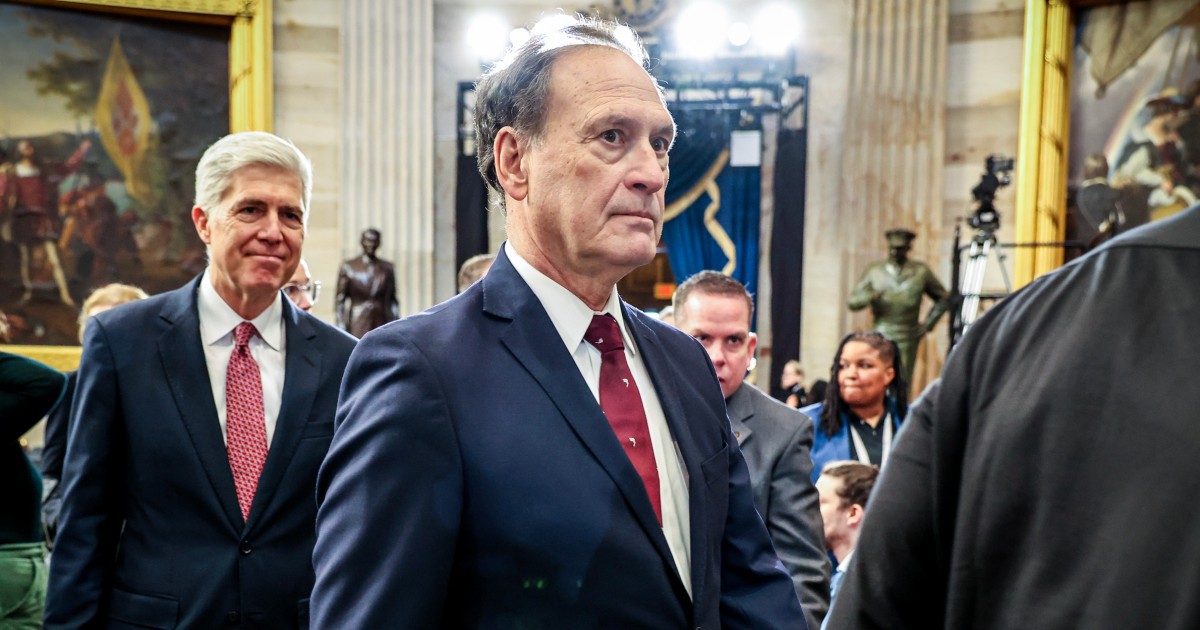
Justice Samuel Alito will not participate in Boulder v. ExxonMobil and Suncor Energy, the climate-damages case the Supreme Court hears oral arguments on next week. The announcement came via a terse letter to counsel: “Justice Alito has determined that he will not continue to participate in this case.” No explanation. No timeline. No acknowledgment of the months of pressure that preceded it.
The non-obvious detail is not that Alito recused. It’s how long it took and why it was so hard to get him to do it. Earlier in 2023, when the Court denied the oil companies’ appeal in this very case, Alito stepped aside and the Court’s spokeswoman told NBC News his absence was “inadvertent” and that “his recusal is not required” because he had “no financial interest in any party” involved. The ethical standard the Court applied was narrow: does the justice own stock in the named litigants? Exxon and Suncor — no. Case closed, keep arguing.
Monday’s letter implicitly abandons that standard. Alito’s financial disclosures show holdings in ConocoPhillips and Phillips 66, plus five other energy-sector firms. Neither company is a party in the Colorado case. But both are defendants in parallel climate-tort suits across the country, and both disclosed to shareholders earlier this year that the Boulder litigation model poses material financial risk. The logic that finally forced the recusal is therefore indirect: if the Court strikes down the Colorado lawsuit on broad grounds, ConocoPhillips and Phillips 66 inherit a shield. Alito’s portfolio benefits. The conflict is real, but it lives in a gray zone the Court’s code of conduct doesn’t cleanly address.
What a 4-4 Split Actually Does
With the Court’s conservative 6-3 majority reduced to 8 sitting justices, Alito’s absence opens the door to a 4-4 deadlock. A 4-4 is not a neutral outcome. No majority opinion issues, which means no binding national precedent. The lower-court decision — here, whatever the Colorado Supreme Court has already ruled in favor of the city and county of Boulder — stands by operation of law, but only for that case. Every other state court where a municipality or county has brought a similar claim against a fossil fuel company keeps grinding forward without a Supreme Court rule to end the fight.
For the oil and gas industry, that was never the goal. The strategic play is a clean, sweeping ruling that preempts state-level tort litigation nationwide, potentially preserving billions in avoided damages. A 4-4 forecloses that. The industry is left with a fragmented patchwork: win in Texas, lose in Colorado, draw in California. Legal uncertainty persists, and with it, the cost of litigating each case on its own merits. For plaintiffs and the municipalities they represent, the silver lining is thin. No national shield means no certainty, either. They still have to prove damages in every forum where they sue, every year, under a moving target of appellate review.
The practical upshot: climate tort law stays a state-by-state contest, which is slower, more expensive, and harder to coordinate than a single federal framework would be. The delay itself is a form of outcome.
The Pressure Valve Is Public, Not Institutional
Consumer Watchdog, a consumer-protection advocacy group, is the organization that publicly connected the dots between Alito’s ConocoPhillips and Phillips 66 holdings and the shareholder-risk disclosures those companies filed this spring. Organizing director Alexandra Nagy called the recusal “the right decision, and one he should have made from the start.” That phrasing matters. The Court’s internal ethics machinery — the Judicial Conference, the Committee on Codes of Conduct, the informal tradition of self-policing — did not flag the indirect conflict. An outside advocacy group did. The justice then wavered, his spokeswoman initially telling NBC there was “no need” to step aside. Only sustained public pressure produced the letter.
That sequence tells you something uncomfortable about how judicial ethics actually function at the top of the American system. The rules exist. The disclosures are public. The conflict is, in principle, identifiable from the documents. But the enforcement mechanism is essentially reactive: someone from outside has to point at the portfolio and say this one matters. Without that external nudge, the Court’s own institutional culture defaults to the narrowest reading of disqualification — you are not a party, therefore you can sit — regardless of who in the defendant’s corporate family would stand to gain. The architecture assumes judges police themselves. The evidence suggests they largely don’t, until they have to.
The Kagan Gambit and the Vote-Engineering Game
Even as Alito stepped aside, a parallel push emerged from the Court’s conservative flank: several commentators and some legal scholars have argued that Justice Elena Kagan should recuse over a climate-change chapter that was included in, and later quietly removed from, a reference manual for judges. Kagan wrote the foreword. She recently told lawmakers she never read the chapter. The question is whether a foreword author’s involvement in a document that contained a contested climate section constitutes a financial or ideological conflict in a climate-tort case. Almost certainly not. But the strategic value of the argument is not in its legal merit. It is in the arithmetic. Remove Kagan, and the Court drops to 7 sitting justices with a plausible 3-4 split, guaranteeing a deadlock regardless of how the eight-justice deliberation goes.
Both flanks are now working to engineer the vote count around the case. That is a rare and telling dynamic. In most Supreme Court dockets, recusal fights are quiet, institutional, and boring. In this one, they are public, partisan, and aimed squarely at the outcome. The case has become a proxy war over who gets to set the national floor for climate liability, and the number of judges in the box is the battleground.
What Happens Next Week, and After
Oral arguments proceed with eight justices. The Colorado case asks whether a municipality can use tort law to recover damages from fossil fuel companies for the specific, localized impacts of carbon emissions — a theory of “public nuisance plus property rights” that would, if it survives, hand local governments a new legal weapon against the energy sector. The oil companies argue that climate regulation belongs exclusively to Congress and the executive branch, and that state tort law is an end-run around that allocation.
If the Court splits 4-4, the Colorado ruling stands in Colorado and the broader question bounces back to the circuit courts to be decided piecemeal. If a majority forms — a long shot, given the ideological alignment of the remaining eight — the ruling will reshape the entire landscape of municipal climate litigation, a landscape that includes pending cases in New York, Massachusetts, and at least three other states.
Either way, Alito’s recusal did not resolve the conflict of interest question. It merely made it visible. The deeper problem is structural: the Court’s financial disclosure rules allow justices to hold open-end portfolios that can create diffuse, indirect stakes in virtually any major corporate litigation. The recusal was the right fix for this case. The fact that it required an external advocacy group to force it is the part that should worry anyone who thinks the American judiciary is a self-correcting institution. Right now, it is a reactive one, and the reaction came late.
The fossil fuel industry’s dream of a single national verdict shielding it from state-level climate damages has, for now, been pushed back. The dream of a 4-4 stalemate that delays that shield indefinitely is very much alive. And at the center of it all sits a justice who, until Monday, insisted he had nothing to see in the way of seeing a case his stock portfolio would pay off on.