AMD's Desktop Share Surge Hides a 20% Price Collapse
Desktop CPU shipments cratered 20% in Q2 as part prices surged, but AMD grabbed its largest-ever market share at 30.7%. The server shift has major implications for Korean memory makers balancing new gains against looming inventory risk.
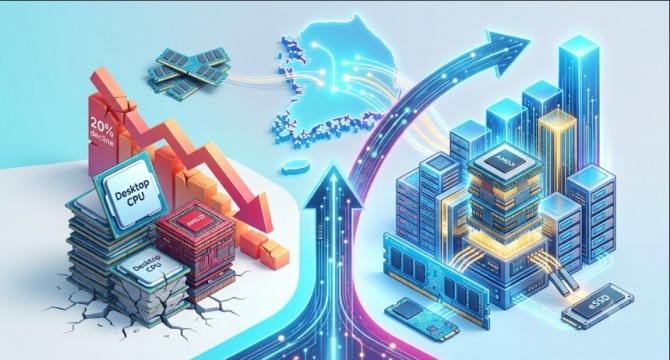
A Market Split in Two
The global x86 CPU market did not shrink in the second quarter of 2026. It split into two worlds with almost nothing in common.
Desktop shipments fell more than 20 percent from a year earlier. Server and laptop orders rose enough to push overall x86 volume up by over 10 percent quarter over quarter. AMD, caught in the middle of both trajectories, posted a 30.7 percent share by shipment volume—the first time it has ever led the market at that level.
The headline number sounds like a victory. The context underneath it tells a different story. AMD is winning a market where desktop volume is evaporating and server volume is the only thing growing. That distinction matters more than the raw percentage, especially for the Korean companies that supply the chips and memory sitting inside them.
Why the Desktop Collapsed
The drop was not caused by a single shortage or a single choice. It was the compounding result of three separate pressures hitting at once.
High-performance graphics card supply remained constrained. Motherboard, SSD, and DRAM module prices rose. Assembled system costs climbed accordingly. At the same time, many buyers who wanted high-end machines had already bought them in 2025, pulling forward demand that would normally spread across the year.
Both Intel and AMD shipped fewer desktop CPUs. Intel’s decline was steeper, which is why AMD’s desktop share rose to 34.9 percent from 33.2 percent in the prior quarter. When the pie shrinks, the piece that shrinks the least looks bigger, even if the overall outcome is worse for everyone.
Mercury Research analyst Dean McCallum noted that continued expansion of data center processor supply is what is driving market growth. That explanation fits the server side perfectly. It does not explain why anyone should be excited about desktop sales falling 20 percent.
The Server Shift Is Not New. It Is Just Deepening.
Server CPU shipments grew nearly 20 percent year over year in Q2. AMD’s share in that segment sat at 34.5 percent. In the pure core server space—EPYC versus Xeon, excluding edge and communications chips—AMD hit 46.4 percent. Intel remains larger in absolute volume, but the distance between the two has narrowed to something close.
This is not a surprise to anyone watching the sector. What changed this quarter is the speed at which the gap closed while the desktop market burned. AMD is executing well on both fronts. The danger for the broader industry is that it is doubling down on the segment where growth exists and letting the segment where brand loyalty once mattered contract without a fallback.
What This Means for Korean Memory Makers
Samsung Electronics and SK Hynix are benefiting from the server tilt. High-core-count processors require more memory channels per socket. Each channel typically carries a DDR5 RDIMM. Enterprise SSD demand rises alongside it. The architecture of modern server platforms is increasingly memory-heavy compared with the compact desktop builds that dominated the last decade.
Large-area FC-BGA substrate makers such as Daedeok Electronic and Samsung Electro-Mechanics also stand to gain. High-end server platforms demand more expensive packaging than consumer desktop boards. The revenue per unit climbs even as total unit volume may not keep pace.
This is the upside. The downside is equally concrete.
Prolonged weakness in desktop set sales risks dragging consumer DRAM and NAND flash inventory correction longer than expected. Consumer memory sits in a different revenue bucket than server memory. A firm like SK Hynix can absorb some mix shift. It cannot absorb a prolonged one without pressuring margins on the consumer side.
Global enterprise data center capital expenditure delays remain another variable. Mercury Research’s report assumes continued deployment. If macroeconomic uncertainty causes large customers to push spending into later quarters, the server growth story softens faster than the desktop recovery strengthens.
Who Wins and Who Loses
AMD wins in the short term by capturing share in both declining and growing segments. Its positioning across mobile, server, and desktop gives it flexibility Intel currently lacks. But share gains measured in shrinking desktop volume are not the same as gains measured in expanding server volume. The market should track those numbers separately going forward.
Intel loses the most visibly. Its desktop decline outpaced AMD’s. Its core server position slipped below 54 percent. It has been expanding mobile processor supply by millions of units, but mobile share growth of 8.4 percentage points year over year for AMD—reaching 28.9 percent—shows the competitive pressure is real and accelerating across all three segments simultaneously.
Korean memory producers occupy an ambiguous position. They benefit from server mix but are exposed to desktop weakness through consumer memory exposure. Their ability to pivot production between server and consumer DRAM over the next few quarters will determine whether this market split improves or worsens their earnings trajectory.
What Comes Next
The second half of 2026 will likely turn on two questions: whether data center processor volumes expand as expected around the fourth quarter, and whether desktop replacement demand recovers at all.
For Korean suppliers, the implication is clear. Diversifying the product mix toward server-oriented memory and packaging remains the right strategic direction. But relying on server demand alone to offset persistent desktop weakness introduces its own risk—if enterprise CAPEX slows, there is no offsetting consumer volume to fall back on. The market is no longer protected by the traditional buffer of steady desktop sales.
AMD’s record share is real. The market behind it is narrower than the headline suggests. Everyone watching this sector should pay attention to what happens when the server wave flattens and the desktop wave does not return.