Apple's Foldable Surrender Opens the Door for Korea and China
Apple's decision to walk away from foldables ceded the form-factor frontier to Samsung and Chinese rivals. Now that it has relented and launched the iPhone Duo, the premium smartphone market faces a three-way war it never had before.
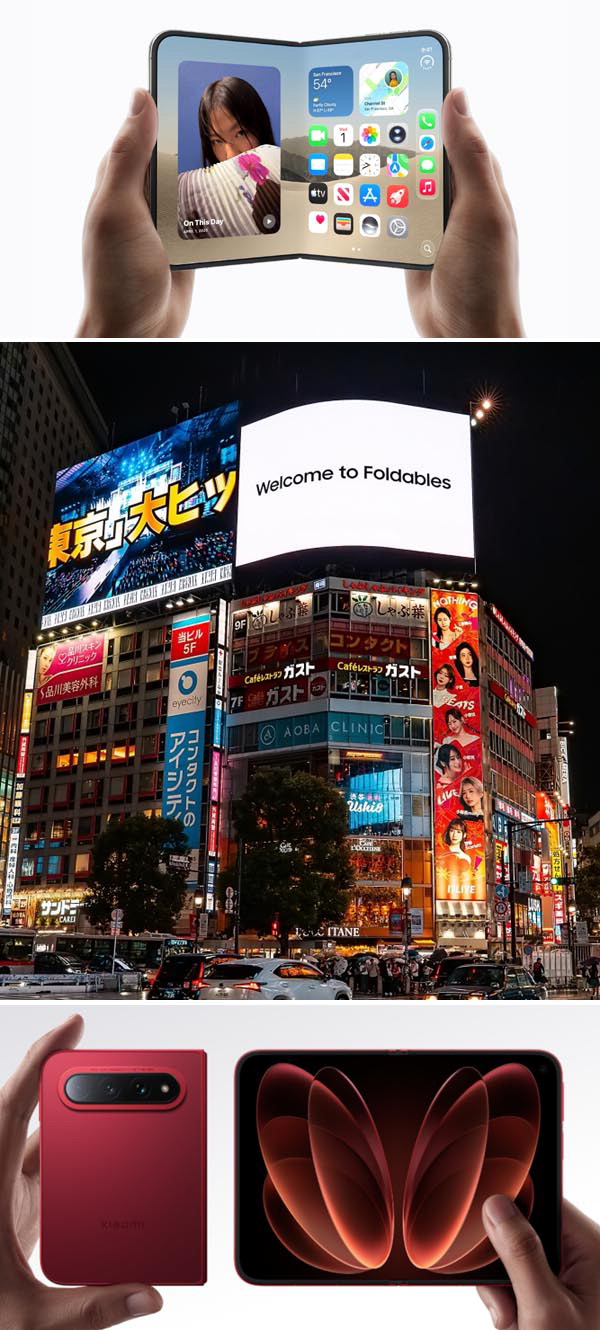
Apple folded first. Then it unfolded.
Apple’s original stance on foldables was famously dismissive. Executives called the form factor a gimmick, a solution in search of a problem that would only degrade reliability and inflate prices. The company held firm while Samsung spent years refining crease reduction, hinge engineering, and software adaptation. By the time the Galaxy Z Fold series reached its fifth generation, foldables had moved from novelty to a credible premium segment — and Apple had ceded the entire battlefield.
That surrender lasted until September 9, 2026, when Apple finally introduced the iPhone Duo at its Cupertino event. The device folds to 5.4 inches and opens to 7.6 inches, weighing 254 grams with a titanium frame and a dedicated vapor chamber for thermal management. It starts at $1,999 — squarely above Samsung’s Galaxy Z Fold8 at roughly $1,800, and aimed directly at the same user: people who want a phone that also functions as a small tablet.
The timing matters less than the reversal. Apple’s late entry does not reset the competitive landscape. It confirms it.
Who already won
Samsung has been shipping foldable phones since 2019. The Z Fold8, launched in July 2026, weighs 201 grams — 53 grams lighter than the iPhone Duo. Samsung is currently running a global outdoor advertising campaign called “Welcome to Foldables” across Seoul, Tokyo, London, and three other landmark cities. The messaging is understated but pointed: “Ultra Thin.” “The world’s most lightweight fold.” “Built to outlast.”
Those are not generic slogans. They are calibrated responses to Apple’s hardware specifications.
Samsung’s dominance in foldables extends beyond marketing. The company controls its own display production through Samsung Display, which reportedly supplies the foldable panels for the iPhone Duo. This creates a structural paradox: Apple’s first foldable depends on the very company it is now trying to displace in the premium smartphone segment. Samsung Display profits from Apple’s entry while Samsung Electronics profits from defending its installed base.
For now, that arrangement benefits Samsung on both sides of the ledger.
The Chinese flank
While Apple and Samsung spar over the same form factor, Chinese manufacturers are pursuing different strategies — and building supply chains that could matter far beyond the foldable category.
Xiaomi launched the Xiaomi 18 Fold on the same day as the iPhone Duo announcement. It features the company’s self-developed Xring O3 processor, LPDDR6 memory from China’s CXMT, and a display estimated to be domestically produced. Xiaomi CEO Lei Jun called it the most premium phone the company has ever made, the result of two years of planning and 20 months of research and development. Xiaomi has no plans to sell the device in Korea.
The supply chain story is the more interesting one. Xiaomi is constructing a foldable phone — from chip to screen — without relying on Korean or American components. Whether this self-reliance can scale to volume production and long-term yield remains an open question. But the direction is unmistakable.
Huawei, meanwhile, is pursuing a different geometry entirely. Its Mate XT2 tri-fold — a phone that folds twice — went on sale on September 12, 2026, as the successor to the original Mate XT launched in 2024. Tri-fold devices are mechanically far more complex than single-fold phones, and Huawei is the only company shipping them at scale. US export restrictions limit Huawei’s global reach, but the Mate XT2 establishes a design direction that neither Apple nor Samsung has matched.
What changes — and what doesn’t
Counterpoint Research’s Liz Lee noted that Apple’s choice of screen size and aspect ratio mirrors the Galaxy Z Fold8 closely, signaling that Apple is targeting Samsung’s established premium user base rather than exploring new form factors. The strategy is familiar Apple: arrive late, refine the experience, leverage ecosystem lock-in, and price at the top.
But the ecosystem advantage is weaker in foldables than in any other iPhone category. Samsung’s One UI has years of fold-specific optimization — app stretching, multitasking layouts, hinge-aware sensors — ahead of iOS’s foldable adaptations. Apple will need to close that gap while Samsung continues shipping updated hardware every twelve months.
The revenue math also favors Samsung. Apple’s $1,999 entry price positions the iPhone Duo above Samsung’s base Fold8 but below the Fold8 Ultra. Apple is capturing users who would otherwise spend more on a Samsung device, not users who would have bought a standard iPhone. That is a zero-sum shift within the premium tier, not an expansion of the overall market.
The real loser is the innovation cycle
The most consequential outcome of Apple’s belated entry is not which company sells more phones. It is what happens to the pace of form-factor innovation.
Before 2026, the foldable category had one serious non-Chinese competitor shaping its trajectory. Apple’s participation raises the bar for display quality, software integration, and build precision — but it also raises the cost of competing. Smaller players cannot match Apple’s marketing budget or distribution reach. The category is converging on a single dominant form factor (the book-style fold) while tri-folds and rollables remain niche experiments.
Apple’s arrival legitimizes foldables for the mainstream market. That will bring millions of new users into the category. But it will also accelerate consolidation around the players with the deepest pockets and the longest supply chains.
Samsung still leads. Huawei is mapping a different path. Xiaomi is building an alternative supply chain. Apple is catching up.
The three-kingdom war is now open. And the kingdom Apple surrendered first — the one where innovation happens before the giants arrive — remains the one it will struggle longest to reclaim.