Apple's iPhone Duo Is Here — Samsung's Foldable Reign Just Met Its Match
Apple launched its first foldable, the iPhone Duo, bringing screen crease tech, Apple Pencil support, and an under-display camera to a market Samsung has dominated. The question is whether these innovations are enough to claw away Samsung's first-mover advantage.
Apple’s Bet on the Foldable Phone
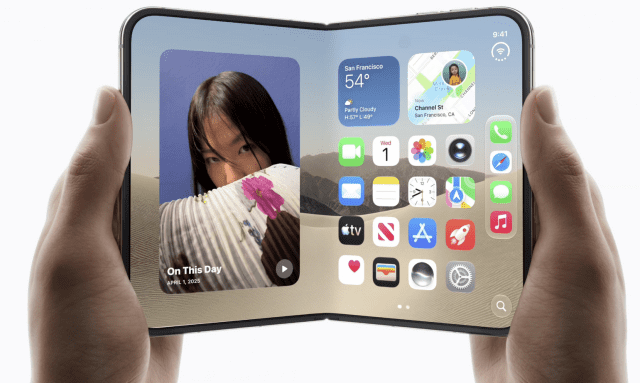
Apple finally unveiled its first foldable device, the iPhone Duo, at a launch event in Cupertino on September 9. It is a book-style clamshell with a 7.6-inch OLED internal screen and a 5.4-inch OLED cover display — a form factor Samsung has been refining since the original Galaxy Fold launched years ago.
The device is not just Apple entering a category. It is Apple attempting to define what a foldable should be for people who have not yet bought one. The specifications are designed to answer the specific complaints that have kept foldable sales concentrated among early adopters in South Korea, China, and parts of Europe: visible creases, fragile screens, and awkward cameras that punch holes in the display.
The Crease Problem, or How Apple Refused to Ignore It
The most visible concern with any foldable is the crease — the faint ridge that forms where the screen bends. Samsung has reduced it over successive generations. Apple is claiming a different approach.
The company says it applied nano-texture technology directly to the display panel. Nano-texture is a matte, micro-etched surface treatment Apple has used on some Mac displays to reduce glare. On the iPhone Duo, it is intended to scatter light in a way that makes the crease less visible under normal lighting. Apple also introduced a cover layer with a scratch-resistant coating and a polymer material it claims is up to 40 percent stronger than previous foldable cover materials.
Perhaps more technically significant is the decision to use ultrathin glass — UTG — on both the top and bottom of the panel. In most current foldables, UTG is applied only to the upper side, while the lower support layer relies on plastic film. Replacing that film with UTG should increase overall panel stiffness and durability. Whether this translates into real-world longevity remains to be seen, but it is the kind of detail-oriented engineering the company is known for.
The hinge is another area where Apple invested heavily. It contains more than 100 precision parts and uses AI-assisted alignment during manufacturing. According to the company, Apple struggled most with the hinge during production — a common bottleneck in foldable design. A hinge that opens and closes smoothly is critical, and one that stays aligned over thousands of cycles is rarer still.
The Under-Display Camera, and Why It Matters More Than It Sounds
On the software side, Apple is tackling a different user experience problem: the notch and the punch-hole. The iPhone Duo is the first iPhone to feature an under-display camera, which Apple calls the “FaceTime camera.” When inactive, the camera hole is not visible on the screen. When you are video calling with the device fully open or standing upright, the camera activates and the hole becomes apparent.
For a company that has spent years obsessing over display quality and minimal bezels, this is a natural move. Punch-hole cameras have been standard on Samsung’s foldables and most Android flagships for years. Apple is now catching up, but it is doing so on a device that is already a generation behind in the foldable category. Whether users notice the difference once the camera is active remains an open question.
Apple Pencil Support, and the Tablet Kill Strategy
Perhaps the most striking feature announced is that Apple will support the Apple Pencil on both the inner and outer displays of the iPhone Duo by the end of the year. The company is not using a traditional digitizer layer — instead, it is using a battery-powered Apple Pencil with USB-C connectivity.
Samsung has explicitly chosen not to support S Pen on its Galaxy Z Fold series, citing thickness constraints and low customer demand. Apple’s decision to support stylus input without adding bulk could attract a segment of users who want tablet-like note-taking and drawing capabilities in a phone-sized package.
This is also consistent with reports that Apple originally envisioned the Duo as a replacement for the iPad Mini — a compact tablet that folds into a phone form factor. The Pencil support gives that vision a more concrete shape.
Camera Specs That Signal Intent
The rear camera setup includes a 48-megapixel main sensor and a 48-megapixel ultrawide. The main camera features a built-in 2x telephoto lens, a variable aperture, and sensor-shift optical image stabilization — a technology Apple has favored for years because it stabilizes the sensor rather than the lens group, which requires more complex mechanics.
Samsung and other Android manufacturers tend to use lens-shift stabilization. Apple is sticking with its preferred approach. For most consumers, the difference will be negligible. For photographers, it could matter.
What This Means for Samsung
Samsung has led the foldable market since 2019. It holds an estimated majority share globally and has refined its hinge, display, and software integration over five generations. The iPhone Duo is Apple’s first serious challenge to that dominance.
The competition will play out on three fronts. First, display quality — Apple’s crease-reduction claims and dual-UTG approach may close the gap, but real-world reviews will determine whether Samsung’s latest foldable screens remain superior. Second, hinge durability — Apple admitted the hinge was the hardest component to perfect. If it holds up, Apple gains credibility; if it fails, the backlash will be swift. Third, ecosystem lock-in — Apple’s integration with the Pencil, iOS, and its existing hardware lineup gives it an advantage Samsung cannot easily replicate.
Korean media has already framed the announcement as a head-to-head confrontation, and the reaction from Korean consumers suggests intense comparison shopping between the two devices. Samsung’s Galaxy Z Fold series has been the default premium foldable in Korea for years. Apple’s entry changes that equation.
Who Wins and Who Loses
Apple wins if the Duo convinces foldable skeptics that the category is worth adopting. The crease reduction, Pencil support, and UDC are features designed for people who have heard about foldables but never bought one. If those features land well, Apple could capture a significant share of first-time foldable buyers.
Samsung wins if the Duo fails to meet expectations on durability or pricing. The iPhone Duo is expected to launch in Korea on September 23 at a starting price of 329,000 won. If that price feels too high relative to the Galaxy Z Fold’s offerings, or if early reviews reveal durability issues, Samsung’s lead will hold.
Consumers win regardless. Apple entering the category means more investment in foldable technology from both sides, which should accelerate improvements in hinges, screens, and battery life for everyone.
What Happens Next
The immediate test will be the hands-on reviews. Apple’s claims about crease reduction and hinge durability need independent verification. The UDC’s performance in real lighting conditions is another unknown. And the Apple Pencil support on a phone-sized device could either become a defining feature or a niche novelty.
If the iPhone Duo performs well, expect Apple to follow up with more foldable designs — possibly a larger, tablet-style device and potentially a flip-style phone. If it stumbles, Apple will likely retreat and double down on the traditional slab iPhone for another generation.
The foldable war is now a two-horse race. Apple has stepped onto the track.