Why Apple's MacBook Neo Upgrade Threatens Qualcomm's Laptop Comeback
Apple's next MacBook Neo ships with A19 Pro and 12GB RAM in 2027, closing a critical on-device AI gap. The move tightens the squeeze on Qualcomm and Windows-on-ARM laptop makers already losing ground.
The quiet war over the cheapest laptop chip is getting louder
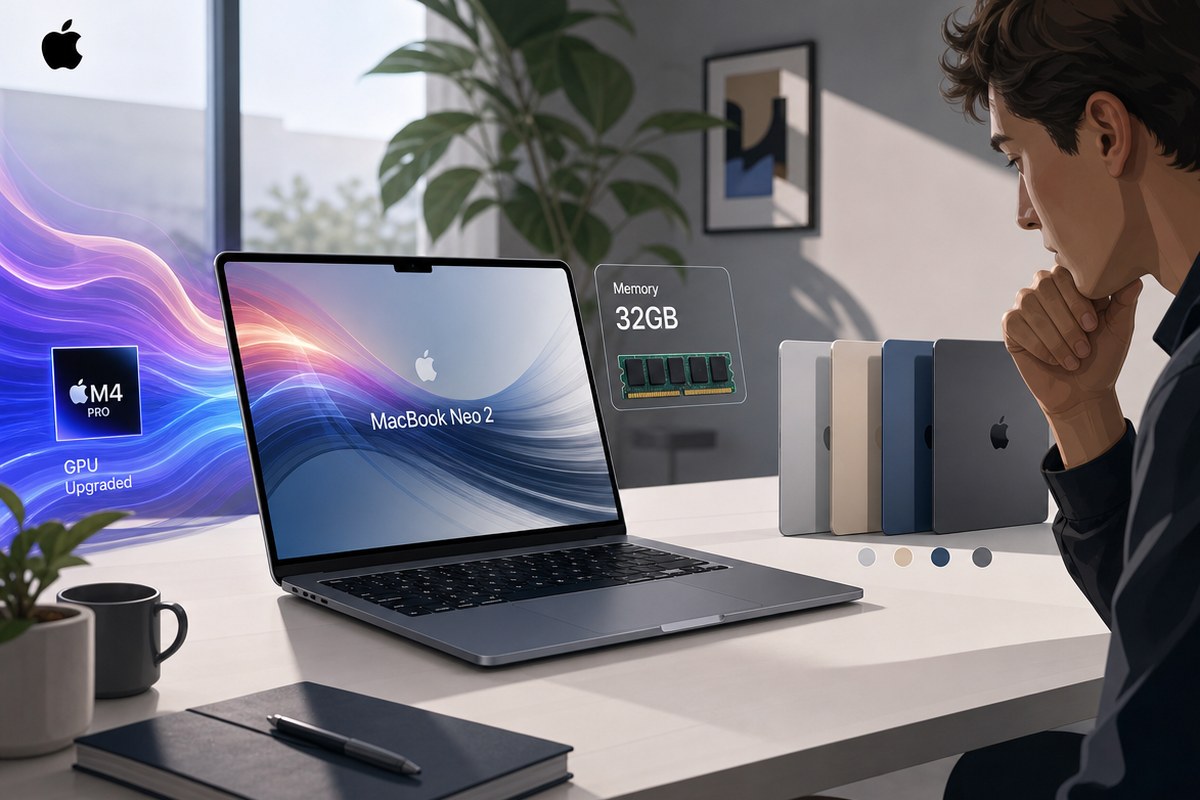
Apple’s second-generation MacBook Neo, due in 2027, ships with the A19 Pro chip and 12GB of RAM. That upgrade may sound incremental — it is not. The combination crosses the threshold for running Apple’s next tier of on-device AI models, and it raises the floor for every Windows-on-ARM laptop maker trying to compete at the budget end.
The original MacBook Neo launched in March at $599 with an A18 Pro chip and 8GB of RAM. By June Apple raised the price to $699. The machine filled a gap: Apple’s remaining Mac lineup starts at 16GB, leaving students and casual users with fewer entry points. The Neo sold well enough that Bloomberg’s Mark Gurman reported Apple is already planning the successor.
Ram is moving from 8GB to 12GB, not 16GB. Nine to Five Mac called the change a meaningful improvement without calling it a revolution. The real story sits in the silicon.
A19 Pro: a big GPU bump, a smaller core count
The A19 Pro is the chip behind the iPhone 17 Pro and iPhone Air. Benchmarks show a 10 to 15 percent uplift in single-core and multi-core CPU performance over the A18 Pro. The GPU story is bigger. Apple has integrated neural accelerators into every GPU core on the A19 Pro, pushing measured GPU performance gains toward 40 percent in some tests.
Not all of that headline strength will make it into the MacBook Neo. Analyst Tim Culpan expects Apple to ship a binned version of the chip — some cores disabled at the factory. The iPhone 17 Pro uses a six-core GPU; the MacBook Neo variant is expected to top out at five. Even trimmed, five A19 Pro GPU cores with on-chip neural acceleration still outpace what most Windows-on-ARM laptops run today.
That matters because the GPU acceleration is what makes on-device generative workloads feasible without burning through battery or paying for cloud inference.
The AI door opens at 12GB
The first MacBook Neo cannot run Apple’s upcoming stronger on-device AI models. Eight gigabytes of RAM and the A18 Pro simply do not provide enough headroom. The models need more memory to hold weights and more compute to process them in real time.
Twelve gigabytes plus the A19 Pro should clear that bar. Nine to Five Mac assessed the combo as sufficient for the new on-device AI features Apple hinted at during WWDC — models that deliver more accurate voice dictation and let users customize Siri’s voice and personality locally, without sending data to the cloud. Apple has not confirmed the specs. These are informed predictions based on published hardware details.
The implications reach beyond Apple. On-device AI is becoming a table stake for premium and mid-range laptops. Windows OEMs that ship AI-capable machines at attractive prices do so on Qualcomm’s Snapdragon X series or Microsoft’s own Copilot+ PC specifications. Raising the bar with a $699-to-$799 Apple machine forces rivals to either improve their value or risk looking stale.
Qualcomm’s margin problem
Qualcomm has spent years convincing OEMs that Windows on ARM is ready. The Snapdragon X Elite and later chips delivered solid benchmark numbers and decent battery life. But adoption has been uneven. Major OEMs built Copilot+ PCs, but many sat on the sidelines or shipped machines that confused consumers with overlapping branding and unclear performance tiers.
Apple’s move does not break Qualcomm’s position overnight. The Windows-on-ARM ecosystem is far larger, with dozens of OEMs and configurations. But it narrows the advantage Qualcomm has held at the low end. Apple is now using its own silicon to set the minimum spec for capable on-device AI in a sub-$800 laptop. Qualcomm will need to match or exceed that configuration in comparable Windows machines — and do so while OEMs are still struggling to differentiate on design, display quality, and peripherals rather than on raw silicon.
Dell is already responding in its own lane. The company recently launched the Dell Laptop 14S aimed at students, with a color and positioning strategy that mirrors the MacBook Neo. That response is tactical, not strategic. It acknowledges the market Apple created without challenging Apple’s chip advantage.
Who wins, who loses
Apple wins by extending its silicon moat. The A19 Pro in a budget Mac reinforces the narrative that Apple controls the best balance of performance and efficiency across its entire lineup. Students who cannot justify a Pro model still get a machine that supports the same AI features as the expensive ones — just a year later. That is a retention play as much as a product play.
MacBook Neo buyers win on paper. More RAM, faster GPU, AI support. Whether the final price stays near $799 remains unclear. Apple raised the first model’s price by $100 within three months. A second-generation increase is possible.
Qualcomm and Windows-on-ARM OEMs lose ground on perception. Every press release about a new Snapdragon-powered laptop now has to answer the question: how does this compare to an Apple device that costs the same and runs better AI features locally?
Cloud AI providers may also feel pressure. Apple is signaling that competent on-device models can replace some cloud-dependent workflows. That reduces short-term inference demand for features like dictation and basic personalization, even as it increases demand for heavier tasks that still require the cloud.
What happens next
Watch the pricing. If Apple keeps the MacBook Neo under $800 with A19 Pro and 12GB RAM, it forces every Windows-on-ARM competitor to either raise specs or lower prices — or both. Neither is easy when margins are already thin.
Watch the binned silicon story. If Apple continues to trim GPU and neural-engine cores for lower-tier Macs while keeping AI capability intact, it proves the company can stack more features into cheaper devices without fragmenting the software experience. That is the playbook Microsoft has struggled to replicate with its Copilot+ tiers.
Watch Dell and HP. Both have student-focused lines. Their next announcements will reveal whether they are doubling down on Qualcomm or reconsidering their strategy entirely.
The MacBook Neo was supposed to prove Apple could sell a cheap Mac. It did. Now Apple is proving the cheap Mac can also run the latest AI. That shifts the goalposts for everyone else.