Attack on Titan’s 99 Announcements Point to a Franchise in Full Expansion Mode
The Attack on Titan franchise dropped 99 simultaneous announcements on its official channel — streaming, theatrical re-releases, a new game, and merch. What looks like a fan celebration is actually a strategic signal about what comes next.
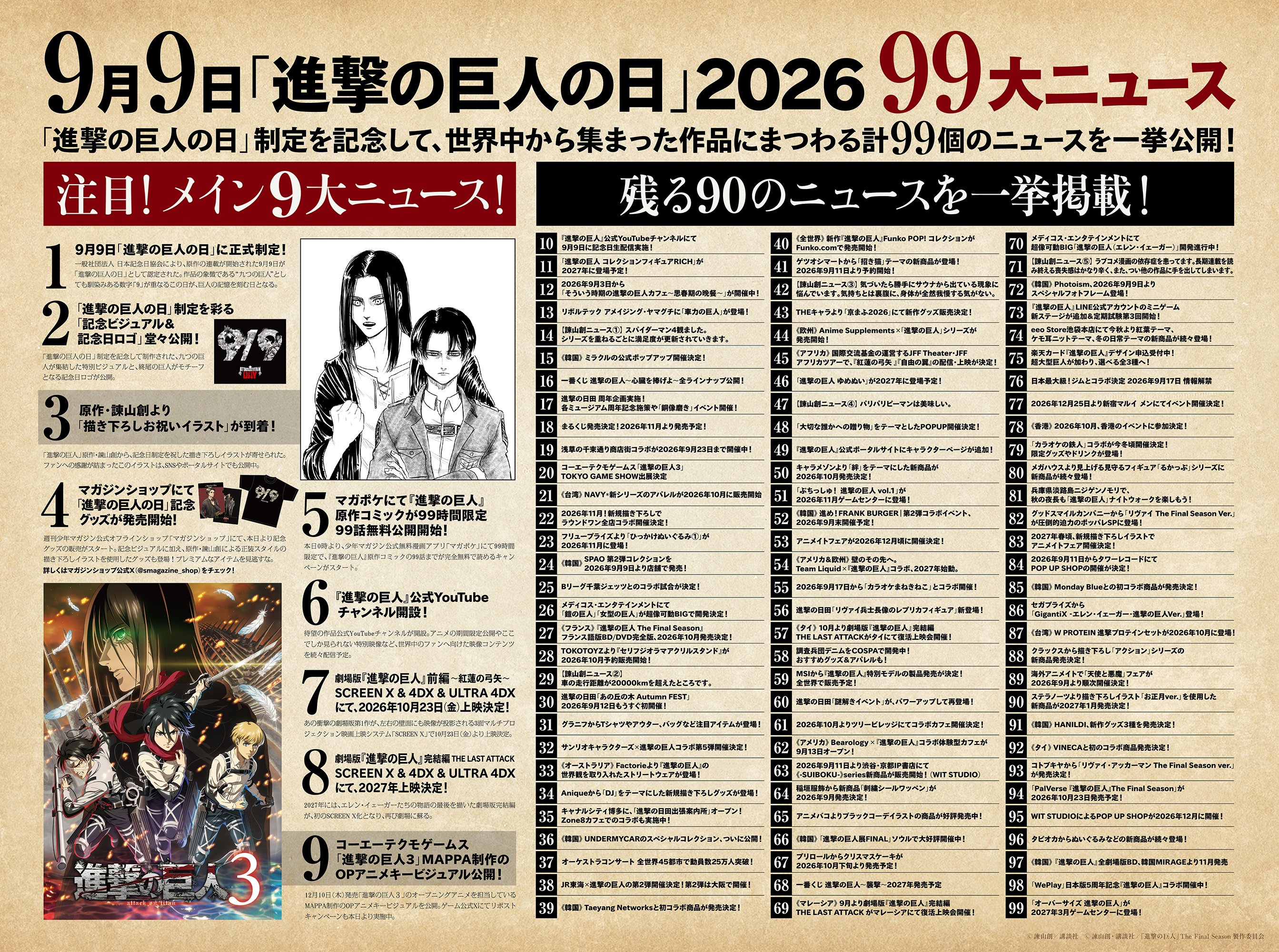
The 99-Announcement Event Wasn’t Just a Celebration. It Was a Roadmap.
On September 9, 2026 — a date chosen because 9 plus 9 equals 18, a number with deep resonance in Attack on Titan lore — the franchise’s official X account dropped what it called “99 Big News.” The list spilled across the official website, and the sheer volume of it tells a story that individual press releases rarely do.
What looked on the surface like a birthday party for fans is, in fact, a coordinated deployment across every major revenue vertical the franchise has yet to touch at scale. Streaming. Theatrical re-release. Gaming. Physical goods. New distribution channels. The question isn’t what Attack on Titan is doing. The question is where it isn’t already.
The Distribution Play: A YouTube Channel and a 99-Hour Manga Window
The most immediately visible move was the launch of the franchise’s official YouTube channel and the announcement that Season 1 of the anime would stream for free, beginning at 18:00 on September 9. Simultaneously, Magazine Pocket — Kodansha’s digital manga platform — made the original 99 chapters available for a 99-hour reading window.
Neither of these is routine. A standalone official YouTube channel for a property that has already been distributed globally through multiple partners (Crunchyroll, Netflix, etc.) signals a shift in strategy. This is about owning the viewer relationship directly, not routing it through intermediaries. The free-streaming window is designed to pull lapsed viewers back in — people who finished the series years ago and may have drifted — and to catch the enormous casual audience that knows the name but has never committed to watching.
The 99-hour manga window operates similarly. Digital manga readership in Japan has become fiercely competitive, and limiting access to a finite window creates urgency. It also drives measurable traffic to Magazine Pocket at a moment when Kodansha can showcase the platform’s value to advertisers and partners.
The Theatrical Gamble: SCREEN X and 4DX for a Completed Story
Perhaps the most surprising announcement was that the theatrical film Attack on Titan Part 1: Crimson Bow and Arrow will screen in SCREEN X, 4DX, and ULTRA 4DX formats starting October 23, 2026. A second film, The Final Act: The Last Attack, follows in 2027 in the same formats.
This is worth parsing. SCREEN X adds side-screen projection to theater walls, turning a 2D experience into something wider than the frame. 4DX and ULTRA 4DX add motion seats, wind, and other sensory effects. Neither format is cheap to roll out, and neither is typically used for retrospective theatrical re-releases of already-completed series.
The move suggests Kodansha and the production committee are treating Attack on Titan’s theatrical outputs not as one-off events but as a sustained cinema presence. That is unusual for an anime franchise whose narrative has already concluded. It points to a longer-term strategy: keep the brand visually present in theaters, build habit-forming engagement, and prime the audience for whatever comes next — whether that is new animated content, spin-offs, or simply maintaining cultural relevance between major releases.
The Game: MAPPA Handling the Opening for a Koei Tecmo Title
The biggest signal in the 99 announcements may have been the smallest visual detail. Koei Tecmo’s Attack on Titan 3, scheduled for release on December 10, 2026, will feature an opening animation produced by MAPPA.
MAPPA is currently one of the most prominent anime studios working in Japan — responsible for Chainsaw Man, Jujutsu Kaisen’s second season, and countless other high-profile projects. For MAPPA to take on a game opening, even a key visual and animation sequence, indicates that the Attack on Titan 3 project carries more creative weight than a typical licensed tie-in game. This is not a handoff to a budget shop. This is a studio with its own brand being brought in to elevate a product.
Koei Tecmo’s history with Attack on Titan titles spans several entries, and each has targeted a different segment of the fanbase. The decision to involve MAPPA suggests the company is aiming for a broader, more cinematically engaged audience with this installment — one that may not have played previous entries.
The Merchandising Infrastructure: A Magazine Shop and Exclusive Goods
The 99 announcements also confirmed that special merchandise, featuring Isayama’s commemorative illustration, will be sold at the first offline Magazine Shop for Weekly Shonen Magazine. This is a physical retail play from a publisher that has historically operated primarily through digital and wholesale channels. The opening of a branded storefront is a signal that the franchise’s commercial ecosystem is expanding beyond licensing deals into direct-to-consumer retail.
What This Means for the Franchise’s Future
Attack on Titan’s manga ended in 2021. The anime concluded with its final episodes in late 2023 and early 2024. By any conventional metric, the story is over. Yet the volume and scope of these 99 announcements suggest the production committee sees the franchise as entering a phase of expansion, not retreat.
The pattern is clear: own the distribution channels. Expand into premium theatrical formats. Invest in high-profile gaming partnerships. Open physical retail spaces. Keep Isayama’s visual identity central to every new product. None of this requires a new story to be in development — it requires only that the existing IP continue to generate engagement across multiple formats simultaneously.
For international fans, the implication is straightforward. The franchise is not winding down. It is multiplying. And the next major announcement — whether it is a new anime project, a spin-off, or something else entirely — may come sooner than those who followed the original conclusion assumed.