Beijing's SOE Robot Push Is Reshaping Asia's Automation Race
China's state-owned enterprises are deploying robotics at a scale and speed that outpaces Western analysis. A new alliance backed by SASAC aims to commercialize 10,000 humanoid robots by year-end — a move that compresses the automation timeline for the entire region and threatens Korean exporters.
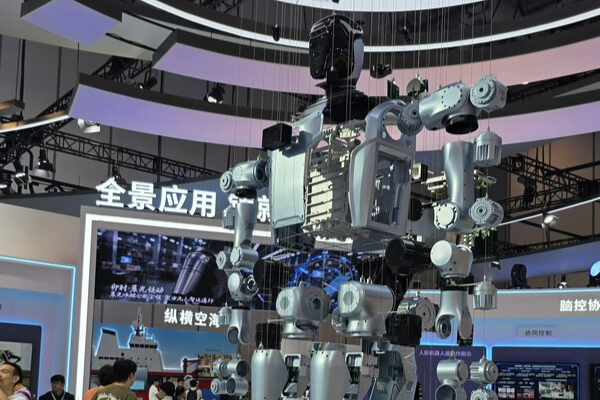
The display was the story.
At the 2026 World Robot Conference in Beijing, China’s state-owned enterprises carved out their own exhibition zone — a first at the event. This wasn’t a side stall or a corporate pavilion. It was a formally organized bloc covering aviation, shipbuilding, power grids, railways, construction, steel, and agriculture, each showcasing robots already deployed in real industrial settings.
The message was unambiguous: China’s robot push is no longer a collection of startup experiments or provincial pilot projects. It is being coordinated from the center, backed by the full weight of the state’s largest companies, and aimed squarely at commercial deployment at scale.
What made the display particularly striking was not just the breadth of sectors represented but the maturity of the hardware on show. Several SOE-affiliated firms demonstrated humanoid robots performing tasks that previously required human operators in hazardous or repetitive environments — inspecting high-voltage substations, welding ship hulls, sorting cargo in rail yards. These were not prototype demonstrations. The robots were running live workflows, and the companies presenting them spoke in terms of deployment counts and uptime metrics rather than research milestones.
What Beijing just announced matters more than what it displayed.
During the conference, SASAC — the State-owned Assets Supervision and Administration Commission, the government body that oversees China’s most powerful enterprises — announced the formation of the Central Enterprise Robot Innovation Alliance. The group’s mandate is straightforward: pool resources for joint technology development, share application sites across member companies, and accelerate the commercialization of robotic systems.
This is not a voluntary industry association. It is a top-down directive disguised as collaboration. And it is backed by policy directives that have already been published but only now being operationalized.
The alliance brings together enterprises under SASAC’s purview — China State Grid, China Railway, CSSC (China State Shipbuilding Corporation), CNPC, and others — each of which operates in sectors where automation has historically lagged due to scale, regulation, and risk aversion. By creating a shared procurement and development framework, SASAC is effectively converting dozens of individual SOE purchasing decisions into a single coordinated demand signal.
The timeline is aggressive, and it is not typical for Chinese industrial policy.
In March, the 15th Five-Year Plan identified embodied AI — robots that perceive and act in physical environments — as a new engine of economic growth. In June, MIIT and SASAC jointly launched a special action program targeting humanoid robots and embodied AI field deployment. The goal: by the end of this year, validate major embodied AI products at representative application sites, complete routine deployment, and enter “operational mode.”
The numbers attached to that timeline are concrete. The plan calls for identifying more than 100 high-value application scenarios and building a commercialization capacity of 10,000 units.
Ten thousand humanoid and embodied AI robots deployed in industrial settings by December. That is not a research target. That is a procurement target.
What makes this timeline remarkable is the institutional mechanism behind it. Chinese SOEs are evaluated on performance metrics set by SASAC, and robot deployment is now being woven into those evaluations. When the regulator ties executive bonuses and promotion prospects to specific technology adoption numbers, compliance follows. The 10,000-unit target is not aspirational — it is a binding commitment distributed across the largest industrial employers in the country.
The second-order effects are already visible.
Suppliers of actuators, sensors, and control systems get guaranteed demand. Software developers building for these applications get access to real-world test sites that no startup could replicate. Engineering teams accumulate deployment data at a pace that would take Western competitors years to match.
But the ripple effects extend beyond the immediate supply chain. Chinese robot manufacturers are beginning to standardize on common interfaces and modular architectures to meet the alliance’s scale requirements — a shift that will lower barriers for smaller firms entering the ecosystem and accelerate component-level innovation. The demand for high-torque joint motors, harmonic reducers, and force-torque sensors is creating capacity constraints that could tighten further as the year progresses, benefiting domestic producers of those components while squeezing import-dependent competitors.
There is also a data dynamic at play. Every robot deployed in an SOE environment generates operational data — terrain maps, fault patterns, efficiency metrics, human-robot interaction logs. That data feeds back into model training and product iteration. Over the coming months, Chinese firms will accumulate a dataset on industrial humanoid robot performance that no foreign competitor can replicate at comparable scale, because their robots simply will not be operating in those environments at the same density.
Why this compresses the automation timeline for all of Asia.
China’s SOEs operate in sectors where adoption cycles are normally measured in decades, not months. Power grid maintenance, shipyard automation, railway infrastructure, construction — these are industries with heavy regulation, unionized workforces, and conservative procurement processes. When a Chinese SOE decides to deploy robots at scale, it pulls the entire supply chain along with it.
The feedback loop closes faster. And faster feedback loops in robotics mean faster iteration, cheaper units, and more capable systems — all of which erode the cost advantage that has historically protected Korean and Japanese robot makers in the region.
For the broader Asian manufacturing ecosystem, the implication is that the cost curve for embodied AI deployment in industrial settings is shifting downward more rapidly than external analysts have priced in. Companies in Vietnam, Thailand, and India that were counting on Chinese robotics remaining expensive or unreliable for the next several years now face a different calculus. The robots are not just becoming cheaper — they are becoming available through procurement channels that prioritize speed of deployment over vendor origin.
Who loses if this works.
South Korea’s robotics exporters are the most exposed. Companies like Hyundai Robotics, which already operates robot production facilities in China, face a contradiction: they benefit from Chinese manufacturing scale but compete against Chinese buyers who now have state backing and a direct procurement channel through the SOE alliance.
Korean robotics strength has rested on precision, reliability, and established relationships with multinational manufacturers operating in China. Those advantages do not disappear overnight. But they are vulnerable to a procurement system that prioritizes domestic supply chains and treats robotics deployment as a matter of national industrial policy rather than a market decision.
The exposure is asymmetrical. Korean robot exports to China represent a meaningful revenue segment for companies like Hyundai Robotics and Doosan Roboworks. If SOE procurement shifts even a fraction of that demand toward domestic alternatives — and the alliance structure makes that shift structural rather than incidental — the impact on Korean export volumes could be disproportionate relative to the share of the market at stake.
Japanese robot makers face a similar dynamic, though their deeper historical ties to Chinese industrial clients may buy them some time. Western firms are further removed from this procurement ecosystem entirely.
Who wins and what happens next.
The winners are the Chinese suppliers embedded in the SOE supply chain — the companies producing joints, reducers, controllers, and AI training infrastructure that feed the alliance’s deployment targets. They gain volume, they gain application data, and they gain a runway to refine their products before competing globally.
The immediate next move to watch is whether the Central Enterprise Robot Innovation Alliance publishes a procurement roadmap or opens a bidding process. If it does — and the tone of recent announcements suggests it will — the 10,000-unit target stops being aspirational and becomes a set of contracts.
Beyond the alliance itself, the structural shift is harder to reverse. China is building a self-reinforcing cycle: state-directed demand creates scale, scale drives down costs, lower costs broaden application scenarios, and broader applications justify further state investment. The WRC 2026 display zone was not a showcase of what China hopes to build. It was a demonstration of what it is already building — and a signal that the rest of Asia should expect the pace to accelerate.