Brazil's Election Shows Why the Americas Still Revolve Around Populism
Polls show Lula and Flavio Bolsonaro locked in a dead heat ahead of Sunday's vote, with a runoff nearly certain. The real question is whether Brazil's left or its populist right controls the future of the world's largest South American nation.
A Country Divided Down the Middle
Brazil’s presidential election opened Sunday with two names that mean more than two candidates. Luiz Inácio Lula da Silva is 80 years old and running for a fourth term — not consecutive, but still. Flavio Bolsonaro is 45 and carrying the political DNA of a man currently serving a 27-year sentence in a Rio de Janeiro prison for plotting to overturn the 2022 election.
The race is effectively a dead heat. The latest Quaest poll, cited by Reuters, puts Lula at 46 percent and Flavio Bolsonaro at 45 percent in the first round. In a simulated runoff, the numbers flip slightly: Lula drops to 42, Bolsonaro rises to 44. Either way, neither clears the 50 percent threshold needed to avoid a second round on October 25. The 2022 election, won by Lula by just 1.8 percentage points, is shaping up as a preview.
What makes this moment worth watching goes well beyond the margins. Brazil is the largest economy in Latin America, a permanent member of every BRICS grouping, and a country where the outcome of a single election ripples through commodity markets, climate policy, and U.S.–China competition in the Global South.
The Shadow Over the Ballot
Jair Bolsonaro sits in prison. But his son is using that fact as a central campaign feature, not a liability.
Flavio Bolsonaro has waved his father’s portrait at rallies. Supporters chant “mito” — Portuguese for “myth” or “legend.” He has pledged to pardon his father if elected. He calls him his “compass, my point of reference.” When asked whether he is more moderate than his father, he says yes. On gun control, climate change skepticism, and the general posture toward institutional checks on executive power, the two remain closely aligned.
This is not a candidate distancing himself from a problematic predecessor. This is a candidate building a political identity on top of one.
The elder Bolsonaro’s conviction for a coup attempt triggered a 50 percent tariff from Donald Trump on Brazilian imports last year — a punishment for defying Washington’s democratic expectations. Trump called the proceedings a “witch hunt” and has not endorsed Flavio, though he says he is watching “very closely.” The younger Bolsonaro’s campaign will have to navigate a tricky triangulation: staying close enough to Trump’s orbit to secure economic cooperation, while not appearing so subservient that it alienates Brazilian voters who resent foreign interference.
The Legal Fog Around the Campaign
Flavio Bolsonaro is not just dealing with his father’s shadow. He is also under active investigation for alleged corruption, money laundering, and tax evasion connected to the financing of a biopic about Jair Bolsonaro. He denies wrongdoing. The probe adds a layer of instability to a campaign that already runs on legal controversies.
If the investigations intensify or produce formal charges before the election, they could shift momentum. If they stall, they become background noise. Brazilian electoral law is complex, and the timing of any legal outcomes relative to the October 25 runoff will determine whether this factor matters.
What Each Side Stands For
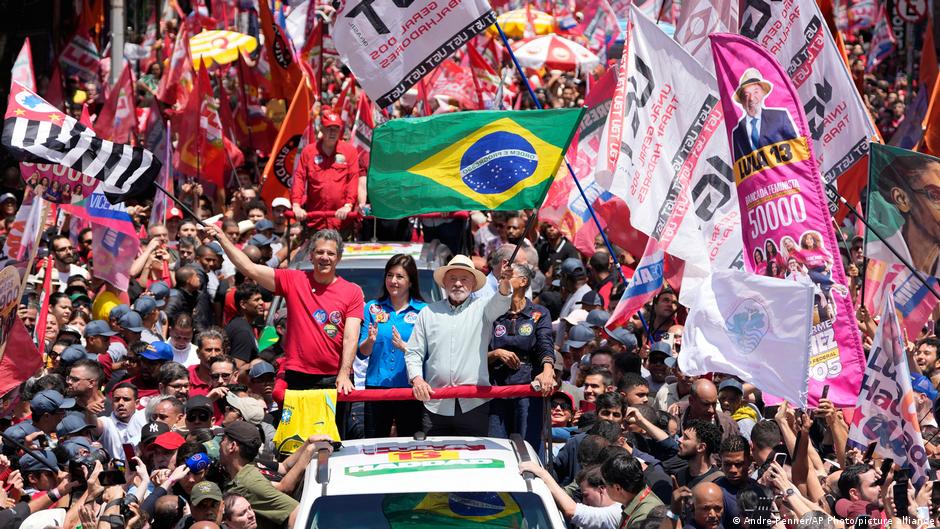
Lula’s campaign frames the choice as one between democracy and barbarism. He told supporters at a São Paulo rally attended by an estimated 150,000 people that Brazilians must choose between strengthening the democratic regime or embracing backwardness. His platform continues the Workers’ Party’s traditional emphasis on welfare programs, state-funded development, and income redistribution — policies that lifted millions out of poverty during his earlier terms but drew criticism for fiscal indiscipline and inflation.
Bolsonaro’s pitch is simpler: change. He blames Lula’s government for high taxes, economic stagnation, and what he calls a failure to protect women from violence. His policy proposals center on tax cuts and hardline security measures. On the international stage, he signals openness to closer alignment with the United States and a more transactional approach to multilateral institutions.
Both candidates are navigating a country where online operations on each side weaponize gaffes, accusations, and rumors, producing slick AI-generated content within hours. The information environment is already saturated and increasingly unreliable.
Why This Matters Beyond Brazil
A Bolsonaro victory would shift Brazil’s posture on climate policy toward rollback, on trade toward closer alignment with Washington, and on regional diplomacy toward a more assertive nationalism. It would also normalize, politically, a leader whose father was convicted of attempting to overthrow an election — a precedent with implications for other democracies in the region.
A Lula victory extends the status quo: continued engagement with China as a trade partner, maintenance of social safety net programs, and a foreign policy that balances between the Global North and the Global South. It also leaves unresolved the fiscal tensions that have constrained Brazil’s ability to invest in infrastructure and innovation.
Either outcome will test the resilience of Brazil’s democratic institutions. The 2022 election was followed by a January 8 riot at the Supreme Court and Congress — an attack inspired by the elder Bolsonaro. This cycle’s bitterness suggests those tensions have not dissipated; they have been waiting for the right moment to resurface.
What Happens Next
A runoff on October 25 is the most likely scenario. Historical patterns in Brazilian elections show that second-round voting tends to consolidate around the two finalists, with third-place candidates’ supporters making their picks. The dynamics of that transfer — and whether any remaining candidates can influence the outcome — will be decisive.
The Quaest polling gap is within the margin of error. The race is tight enough that a single scandal, a policy misstep, or an external event could tip it. Brazil’s 160 million registered voters, choosing not only the president but governors, senators, and lawmakers, will deliver a verdict that shapes the continent’s trajectory for years.