BTS Just Broke a 50-Year Touring Monopoly
BTS became the first pop group to surpass $500M in tour revenue, shattering a half-century of rock-dominant economics. What their 'ARIRANG' tour proves is that K-pop's fan-driven model scales globally—and that the math of live music is finally catching up to the streaming era.
The number that changes everything
Fifty hundred million dollars. That is not a round number pulled from thin air — it is the first time any pop group in history has crossed that ceiling on a single world tour. According to Billboard’s August monthly Boxscore released on the 1st, BTS’s “ARIRANG” tour has done what Rolling Stones, U2, Bruce Springsteen, Coldplay, Metallica and Guns N’ Roses only managed over decades of grinding stadium runs. Only seven acts across all genres have ever reached half a billion from one tour. Six of them were legacy English-language rock bands. BTS is the first pop act to join the list, and the first non-English-language, non-Western artist to do so.
The headline number is striking. But the pattern behind it is what matters.
Compressed stadium economics
Classic rock tours reached $500M after 110 to 170 plus shows — the kind of marathon schedules that required multiple years of touring cycles. BTS did it in 48 performances. The average per-show revenue sits at roughly $10.4 million. That is not a statistical fluke; it is a structural differentiator.
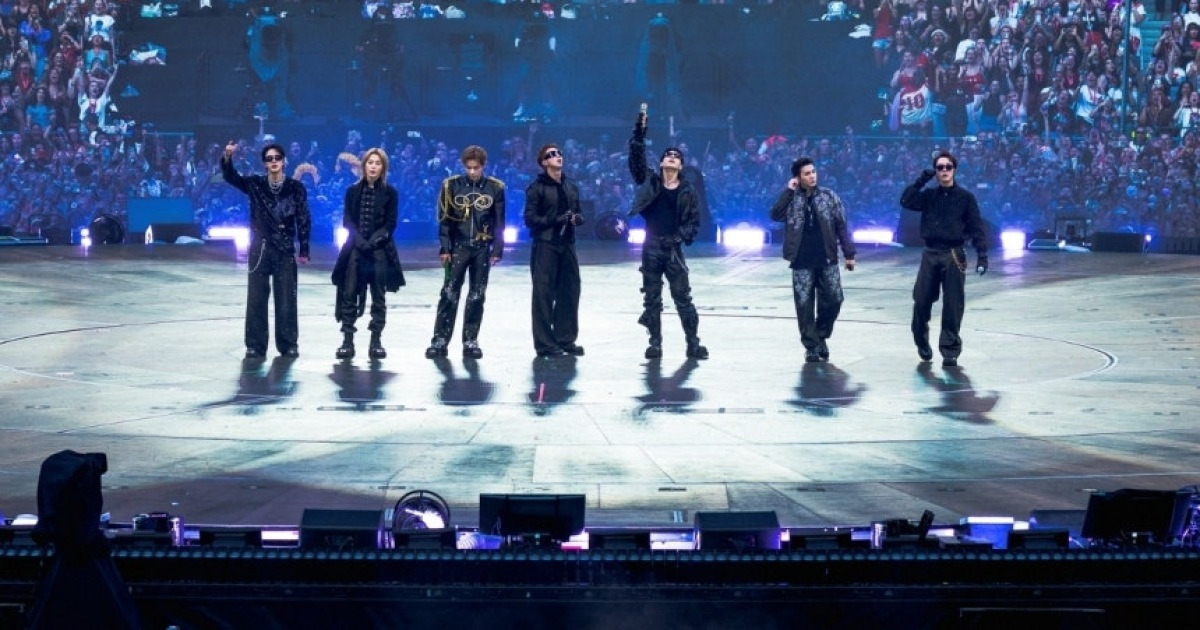
Consider August alone. In six North American cities, BTS played 12 stadium shows and drew 801,000 attendees. The gross: $171.7 million. That is the second-highest single-month gross in Boxscore history, trailing only Beyoncé’s $179.3 million in August 2023. A single weekend at MetLife Stadium in New Jersey — two shows on August 1st and 2nd — pulled in $32.7 million from 158,000 fans. Every other city on the North American leg between $24 million and $30 million. Five of those six markets cracked the monthly Top 10.
That consistency across markets is rare even for touring giants. Most legacy acts rely on a handful of ultra-dense markets to carry the rest of the schedule. BTS’s run was uniformly strong.
The ARIRANG timeline
The tour kicked off in April at Goheung with the opening date at Goyang Stadium. Forty-eight shows later, the $500M milestone had been hit. What comes next has already been mapped out. October holds fourteen shows across South America. Then the Asian leg begins on November 21st and runs through March 16th, 2027, adding another forty shows to the schedule. If all eighty-eight dates play out as planned, industry observers estimate the tour will land somewhere around $1 billion in total revenue.
That would make BTS only the fourth act ever to break nine figures from a single tour, alongside The Weeknd, Taylor Swift and Coldplay. The precedent did not exist until this year. The Weeknd, Swift and Coldplay have all crossed the threshold in recent cycles. BTS is now writing the fourth entry.
The rivalry that amplified the data
There is also a competitive layer worth noting. In July, The Weeknd took the Boxscore top spot from BTS. In August, BTS responded with a 67 percent month-over-month increase, reclaiming the number one position. This is only the third time in Boxscore history that two artists have both surpassed $100 million in a single calendar month, and the first time it happened in consecutive months. That duel may sound like pop trivia. It is actually evidence of how the market is expanding. The total addressable audience for premium stadium touring has grown enough to support two top-tier acts simultaneously instead of crowding out competition.
What this means beyond the chart
Western music media will report the $500M figure and move on. The deeper story is about touring economics in the post-streaming era. For thirty years, the dominant model assumed that physical ticket sales scaled with time on the road. More dates, longer runs, more cities — revenue followed distance. BTS flipped that assumption. High yields, high capacity utilization, and a globally concentrated demand curve allowed the group to compress a traditional three-year tour cycle into a fraction of that time.
K-pop’s fan structure enabled this. ARMY is not a passive streaming audience. It is a coordinated consumption ecosystem that translates directly into ticket demand. Pre-sale access, fan-club priority, and secondary-market engagement created a floor for attendance that legacy acts take years to build. The result is not simply more revenue per show — it is higher revenue per show in fewer shows, which reduces variable costs and increases net margin.
Who wins, who loses
The winners are clear. Artists with globally loyal, organized fan bases will now benchmark against the 48-show path instead of the 150-show path. Management companies will recalibrate tour planning around yield density rather than date volume. Ticketing platforms will face sustained pressure from fan-driven pre-sale demand that outpaces traditional allocation models. Venue operators in secondary markets — Dallas, Boston, Baltimore, Chicago, Toronto — gained proof that non-traditional touring headliners can fill stadiums when fan economics align.
The losers are less dramatic but real. Mid-tier acts who relied on the old long-tour strategy to build revenue will face steeper competition for arena and stadium dates. Agencies that have not yet developed global fan infrastructure will find it harder to close the gap. And the assumption that only English-language rock acts could command multi-year stadium dominance is now demonstrably false. That assumption shaped booking decisions for half a century. It will not shape them for much longer.
The structural shift
What BTS has done is not merely a box score achievement. It is a shift in the underlying mathematics of live music revenue. The fifty-year rock monopoly on touring economics has not been quietly eroded — it has been broken in under fifty shows. The next question is not whether other acts can replicate this model, but how quickly the industry restructures around it. Streaming made recorded music accessible everywhere. The ARIRANG tour has now proven that the same global reach translates into ticket sales. The rest of the business will adjust accordingly.