BYD Just Put LiDAR on a $20,000 Car. The Auto World Is Panicking.
BYD's upcoming Great Seagull hatchback packs roof-mounted LiDAR and advanced driver-assistance tech into a sub-$20,000 package, upending the economics of ADAS and forcing Western rivals to rethink their sensor strategies.
The Seagull Flies Low—and Costs Less Than You Think
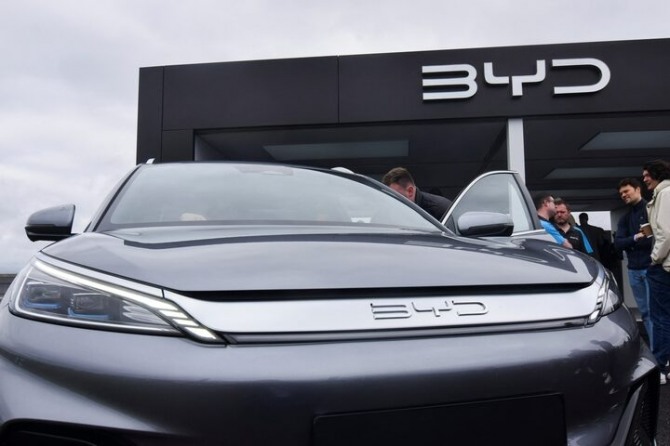
BYD is preparing to unleash a compact electric hatchback that should not exist under the old rules of automotive economics. The model, internally dubbed Dahai’ou—Great Seagull—is positioned between BYD’s Seal and Dolphin as a value-oriented addition to its growing EV family. But the real story is what sits on its roof: a LiDAR sensor paired with BYD’s DiPilot 300 driver-assistance system, technology that has historically been reserved for vehicles costing two or three times as much.
Official pricing has not been announced, but BYD itself signals that the Great Seagull will sit above the Seal’s starting price of 69,800 yuan (roughly $14,300 at current rates). Even at a modest premium, we are looking at a vehicle that could land below $20,000 once tariffs, shipping, and local taxes enter the equation—in China. That price range has never before come with a roof-mounted LiDAR array.
LiDAR Was the $10,000 Question Mark. Now It’s a Commodity.
For years, the automotive industry treated LiDAR as the optional extra you paid extra for. In Western markets, a LiDAR-equipped ADAS package often added $3,000 to $10,000 to a vehicle’s sticker price, or was bundled only into top-trim luxury models. The sensor itself was expensive. The software to interpret it was complicated. The supply chain was thin.
BYD has collapsed all three barriers at once. The Great Seagull uses a 95kW permanent-magnet synchronous motor and chooses between two lithium iron phosphate (LFP) battery packs—30kWh or 39.2kWh—supplied by BYD subsidiary FinDreams. CLTC-range figures sit at 320km and 420km respectively, translating to roughly 259km to 340km under WLTP testing. Top speed is capped at 150km/h. The dimensions are compact: 4,205mm long, 1,810mm wide, 1,570mm tall, with a 2,650mm wheelbase that stretches 150mm beyond the existing Seal.
But inside, the instrument cluster disappears. There is no traditional driver display—just a large central touchscreen and a two-spoke steering wheel. The roof carries the LiDAR. The system it feeds, DiPilot 300, is BYD’s proprietary name for its advanced driver-assistance stack, referred to in internal materials as “God’s Eye B.”
That DiPilot 300 is the product of years of BYD investment in software-defined vehicle architecture. BYD designs its own chips, builds its own batteries, and now appears to be driving its own LiDAR supply chain. The vertical integration is what makes this economically plausible at a budget price point. A company that sources every major component from third parties cannot absorb the cost of a roof LiDAR on a $20,000 car. BYD can.
The Gap Between Seal and Dolphin Was a Revenue Hole. The Seagull Fills It.
July 2026 sales data paints a clear picture. BYD moved 11,103 Seals and 16,829 Dolphins in China that month, according to the China EV DataTracker. The Dolphin dominates at the entry level; the Seal serves a higher rung. But between them sits a demand gap—buyers who want more than the Dolphin offers without committing to the Seal’s price.
The Great Seagull is aimed squarely at that gap. And unlike previous attempts to fill mid-market slots, BYD is not simply offering more space or a slightly larger battery. It is offering a technology tier that was previously unavailable at this price level.
This is the non-obvious implication: BYD is not just competing on price. It is redefining what “standard equipment” means for a mass-market EV. When a $20,000 car arrives with LiDAR-level ADAS as standard, every competitor in that segment faces an immediate credibility problem. Do you match it and sacrifice margin? Do you hold the line and look backward-looking? Either choice is expensive.
Who Wins, Who Loses
BYD wins obviously. It gains a new high-volume product in a segment that already works, with a technology moat that is difficult to replicate quickly. The Great Seagull also extends BYD’s software narrative—DiPilot 300 on a budget car is a statement that autonomous driving assistance is no longer a luxury good.
Western legacy automakers lose the most. Their ADAS strategies were built around camera-and-radar architectures that kept costs down but limited perception fidelity. Tesla bet against LiDAR entirely and is now re-evaluating. General Motors, Ford, and others have layered on Super Cruise and similar systems, but these remain premium features on premium vehicles. None of them are offering roof LiDAR on sub-$20,000 crossovers.
Chinese rivals face a different pressure. NIO, Xpeng, and Li Auto all built brands around advanced driver assistance as a differentiator. If BYD brings that capability to a price tier these companies cannot compete with, the perception gap narrows significantly. XPeng’s XNGP is excellent but sits on cars starting well above the Great Seagull’s projected price.
Emerging-market buyers win in the long run. The Great Seagull’s 320km to 420km range is adequate for urban commuting. Its LiDAR-equipped ADAS means features like adaptive cruise control, lane-keeping assist, and automated emergency braking—typically expensive add-ons in India, Southeast Asia, and Latin America—could become standard on vehicles priced for those markets. BYD already sells the Dolphin and Seal in dozens of countries outside China. The question is whether the Great Seagull follows, and at what price.
What Comes Next
BYD has not yet announced an official launch date or confirmed pricing for the Great Seagull. The images and specifications surfaced through CarNewsChina on September 21, indicating the vehicle is close to production readiness. The “Ink Green” exterior color and the removal of a traditional instrument cluster suggest BYD is intentionally breaking with design conventions that have persisted in the segment.
The competitive ripple effects will begin immediately. Every OEM developing a sub-$20,000 EV will need to answer a single question: can we offer comparable ADAS without LiDAR, or do we accept that LiDAR is now table stakes at this price?
The answer will shape the next five years of the global EV market. BYD has just moved the goalposts—and it did so on a car that most of the world has never heard of.