Canada's Last Epic Shelf Lake Vanished in Months — What It Means for the Arctic
An ancient Arctic lake held behind ice for millennia drained into the ocean within months after the Milne Ice Shelf collapsed in 2020. The loss of Canada's last large epishelf lake is a measurable signal that permafrost and hydrological feedback loops are accelerating faster than most climate models account for.
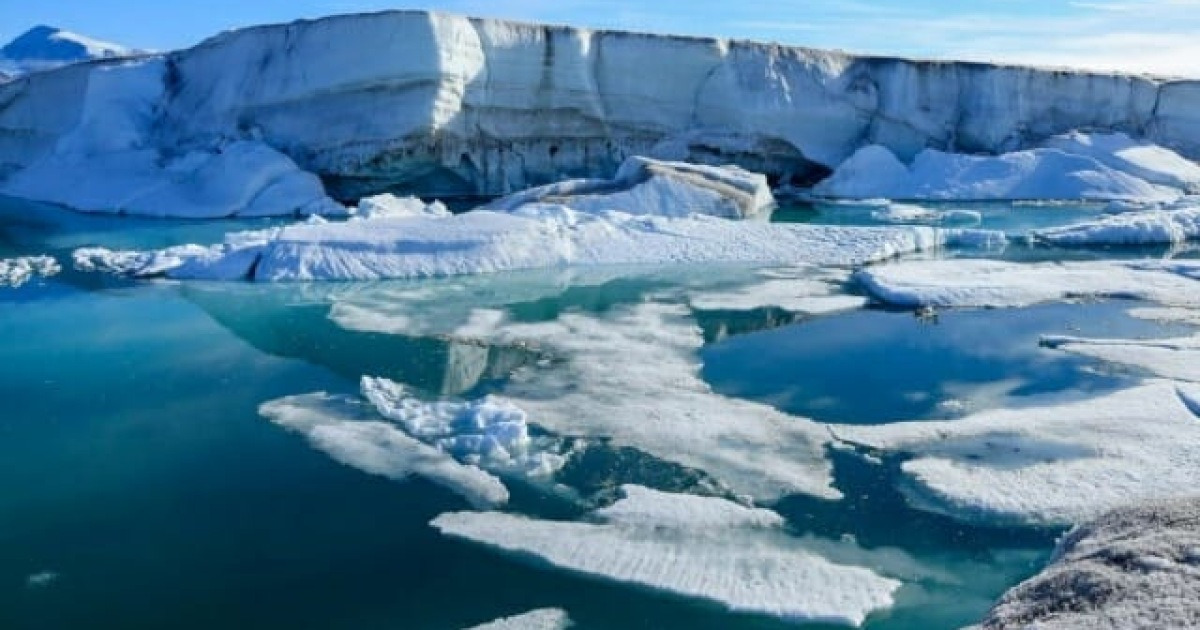
The Lake That Took Millennia to Form and Disappeared in Months
In July 2020, the Milne Ice Shelf — one of the last substantial ice shelves remaining in the Canadian Arctic — lost more than 40 percent of its surface area in two days. Behind it lay something rarer: an epishelf lake, a body of freshwater trapped against the coast by the shelf itself, sitting precariously above seawater with a boundary so thin it could be disrupted by a single warm current.
Within months, the lake was gone. Its water drained into the Arctic Ocean. The ice shelf that had acted as a dam was too damaged to hold it back, and by fall 2020, both the lake and its unique ecosystem had vanished from the world.
This is not a minor ecological event. It is a quantifiable moment that exposes a gap between how we model climate change and how fast the Arctic is actually changing.
What an Epishelf Lake Is — and Why Its Loss Matters
An epishelf lake forms when an ice shelf blocks a fjord, trapping freshwater from melting glaciers above denser seawater. The interface between the two layers is remarkably thin — sometimes only a few meters thick — and hosts a biological community that exists nowhere else. Freshwater species live above; marine species below. The boundary itself becomes a zone of concentrated life, a fragile threshold that cannot survive if the physics holding it in place break down.
Canada’s last remaining large epishelf lake sat in Milne Fjord on the northern tip of Ellesmere Island. Its disappearance means that particular ecological configuration no longer exists in the Canadian Arctic. Research published in Scientific Reports, led by Andrew Hamilton of the University of Alberta and Jeremy Bono of Laval University, used satellite imagery, field measurements, and oceanographic data to reconstruct exactly how the lake drained. The answer was swift and total.
Bono noted that the ice shelf and the lake behind it had been thinning gradually for decades. The 2020 collapse was not the beginning of the process — it was the point at which the process became irreversible.
“These ecosystems take thousands of years to form,” Bono said. “They will not return within any human timeframe.”
The Non-Obvious Implication: Feedback Loops Are Faster Than Models Assume
The obvious takeaway from this story is that ice shelves are disappearing and lakes are vanishing. That is true and important, but it is also the surface reading.
The deeper implication concerns how climate models treat feedback loops in polar regions. Most global circulation models represent ice shelves as relatively stable boundaries that melt gradually. They do not adequately capture the speed at which a single collapse event can trigger cascading hydrological and ecological changes — the way the loss of one ice shelf removes not just ice, but an entire freshwater system, an ecological niche, and a localized albedo effect all at once.
When the Milne Ice Shelf collapsed, it did not merely lose volume. It removed the physical barrier that had separated freshwater from seawater for millennia. The lake did not evaporate or seep away slowly. It drained. That is a different kind of change — abrupt, threshold-driven, and difficult to predict from gradual melt curves alone.
This matters for sea-level projections because epishelf lakes and the ice shelves that hold them represent stored freshwater that is currently isolated from the ocean. When those systems fail, that water enters the ocean pathway — not through direct ice melt, but through hydrological reorganization. Current models account for ice shelf collapse but underweight the secondary effect: the rapid release of terrestrial and glacial freshwater that was previously trapped behind ice.
Who Loses — and Who Gains
The losses are concrete. The epishelf lake ecosystem is gone. Species that lived in that thin boundary zone between freshwater and seawater have lost their habitat. The local hydrology of Milne Fjord has been fundamentally altered — freshwater input patterns, sediment deposition, and nutrient cycling will all shift in ways that researchers are only beginning to measure.
On Ellesmere Island itself, Inuit communities that have relied on these fjord systems for subsistence and navigation face changing conditions that are difficult to predict. The disappearance of the lake is a marker, not just an event.
The gains are more abstract and far more concerning. The draining of the lake into the Arctic Ocean contributes to freshwater input that can alter ocean circulation patterns. The loss of reflective ice surface reduces albedo, accelerating local warming. Each of these is a positive feedback loop — change that begets more change.
What Comes Next
Hamilton and Bono have been monitoring the Milne site since 2011. Their data shows a decades-long trend of thinning before the 2020 collapse. The lesson is not that the collapse was sudden and therefore unpredictable — it is that gradual change masks an eventual threshold, and once crossed, recovery is unlikely.
The researchers stated that if current warming trends continue, the conditions necessary for a new ice shelf to form and sustain an epishelf lake are unlikely to return. This means the loss is permanent on human timescales.
For climate science, the Milne case should serve as a stress test for existing models. If one of the last remaining epishelf lakes in the Canadian Arctic can vanish within months of its supporting ice shelf collapsing, then other similar systems — there are fewer than two dozen known epishelf lakes worldwide, mostly in Antarctica and the Canadian Arctic — may be closer to their own thresholds than current projections suggest.
The lake did not disappear because the Arctic warmed slowly. It disappeared because a single structural failure — the ice shelf breaking — unmade a system that had taken thousands of years to accumulate. That distinction matters. It means the next vulnerable system may not melt away. It may simply fall apart.