China's AI Bubble Is Cracking — And Korea's Already Pricing It In
CXMT's 30% market-cap wipeout, the PBOC's first public warning about AI revaluation risk, and a utilization gap between hyper-scalers and state-backed data centers reveal the first real cracks in China's AI infrastructure boom — signals Korean financial press is already digesting before global desks.
The Stock That Lost Its Crown in 52 Days
On a cold morning in mid-October, CXMT — the Chinese memory-chip maker that had seized the title of A-share market’s biggest company barely three months earlier — handed that crown back.
Its shares fell 5.24 percent, erasing roughly 1 trillion yuan in market value and dropping it below Industrial and Commercial Bank of China, which clawed its way back to No. 1 in a single session. The number CXMT will be remembered for now isn’t the 4.2 trillion yuan peak it reached in August. It’s the 1 trillion yuan that simply disappeared between then and mid-October.
That’s a 24 percent wipeout in six weeks. Not a crash — a slow, deliberate unwinding. And it didn’t happen in isolation.
Cambricon, the country’s flagship AI-chip designer, shed 39.6 percent from its July high of 1,485 yuan to 897 yuan by mid-October. Zhipu AI, one of China’s most-hyped large-language-model startups, lost 75 percent of its value over the same stretch. MiniMax, another large-model player, fell 56 percent. The declines weren’t concentrated in one corner of the AI stack. They spanned chips, models, and — most tellingly — the infrastructure companies built to serve both.
The PBOC Speaks
What made the CXMT stumble notable wasn’t just the numbers. It was the timing of the warning that preceded it.
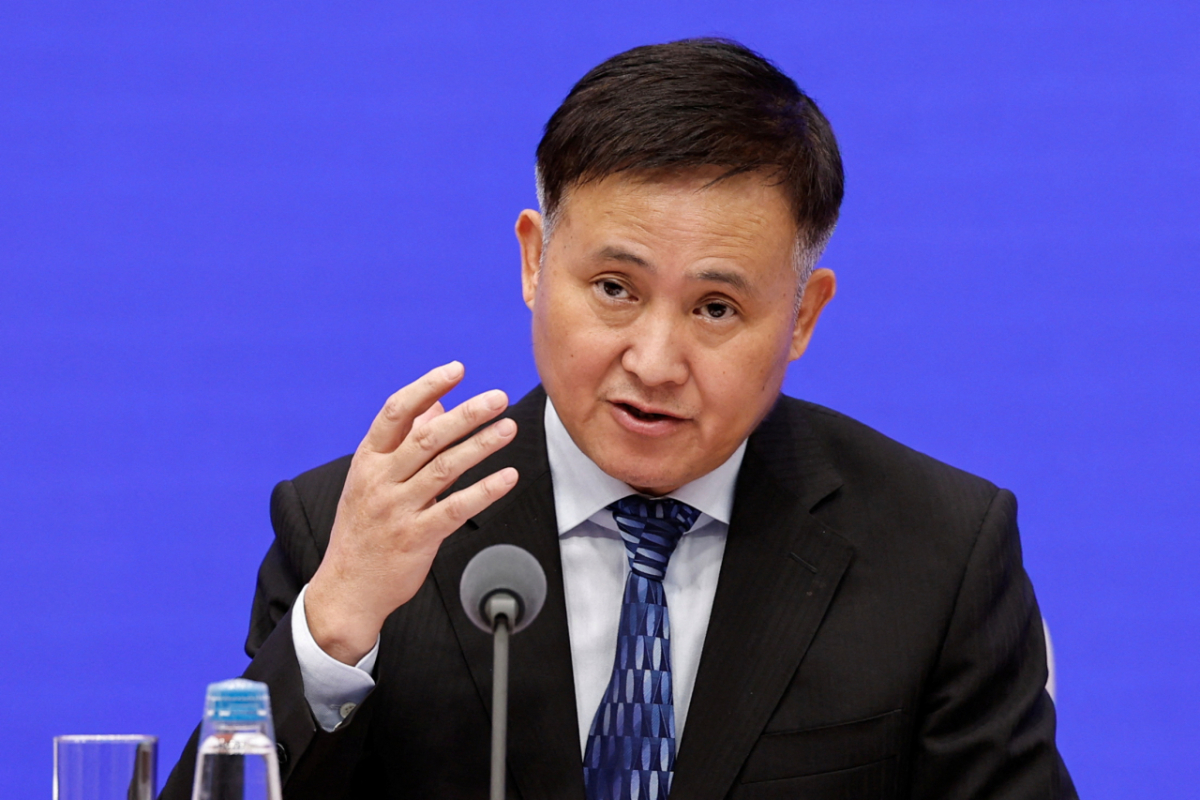
At the G20 finance ministers and central bank governors meeting in Bangkok on September 15, Pan Gongsheng, governor of the People’s Bank of China, didn’t mince words about the risks lurking in the system. He pointed to “large volatility in some countries’ sovereign bond markets” and explicitly flagged “the risk of valuation adjustments in AI-related assets” as factors increasing financial vulnerability.
He followed up with a statement that read like a caution to China’s own financial regulators: “modernizing financial supervision does not mean deregulation.” He stressed that the stability of the financial system and the ability to respond to risks must not be undermined.
Critically, Pan wasn’t talking about China’s AI sector by name. His comments were framed within a discussion of global financial-market risks. But the specificity of the language — “valuation adjustments in AI-related assets” — was unmistakable. It was the first time a top Chinese central banker had publicly flagged revaluation risk in AI, and it landed less than a month before CXMT gave back its market-cap throne.
The Utilization Gap
There’s a deeper structural story behind the stock declines, and it has nothing to do with sentiment. It’s about who’s actually using all this AI infrastructure — and who isn’t.
According to Chinese financial press reports, the country’s major tech giants are running their AI data centers at or near capacity. Their clusters are busy, their workloads are commercial, and their utilization rates reflect genuine demand. The picture is radically different at the provincial and municipal level, where state-backed compute centers are sitting largely empty.
The reason is simple and brutal: local governments raced to build first and find demand later. In the scramble to position their regions as AI hubs, they constructed data-center capacity that the market never needed. The result is a portfolio of commercial-grade assets — expensive to power, expensive to maintain — that can’t find tenants.
This isn’t a new problem in China’s industrial policy. The tension between central ambition and local execution has always been a feature of the system. But it’s becoming impossible to ignore at this scale. The National Development and Reform Commission estimates 4 trillion yuan in new direct investment in computing networks over the 2026–2030 five-year plan period. That’s real money — money that, if allocated to facilities with no demand, becomes a drag on returns for years.
It’s Not Just a Bubble Narrative
It would be easy — and wrong — to reduce all of this to “the AI bubble is deflating.” The dynamics are more nuanced, and that nuance matters for anyone trying to price what happens next.
For one, the global rate environment is doing real damage to tech valuations independent of any China-specific story. Long-term yields remain elevated, which raises the discount rate on future cash flows and compresses multiples across the board. The strategy team at CITIC Securities noted in a recent research note that oil price stability and weaker-than-expected non-farm payrolls haven’t enough to shift the trajectory of rising global long-term bond yields. “Until we reach the turning point in the AI investment cycle,” the team wrote, “the high-rate environment is the new normal we have to adapt to.”
In other words: part of what’s driving down Chinese AI stocks is a global macro force that has nothing to do with China. The rest is a China-specific repricing — and the two shouldn’t be conflated.
Why Korea Is Already Moving
The reason this story matters beyond China’s borders — and why it’s showing up first in Korean financial press rather than on Wall Street research desks — is that the CXMT stumble is a leading indicator of something bigger: the semiconductor cycle is turning, and AI valuations are being recalibrated against real-world utilization.
Korea’s markets have a direct exposure to this dynamic. Samsung Electronics and SK Hynix are the world’s dominant memory-chip producers. CXMT is their primary Chinese competitor, and its struggles signal weakening pricing power and demand uncertainty that will eventually flow through the entire memory-chip value chain. When the world’s cheapest alternative to Korean memory starts losing market value at 30 percent a month, it’s worth paying attention — even if you’re not invested in Chinese equities.
The Korean press is already connecting the dots. Money Today’s headline — “249 trillion won evaporated” — isn’t just describing CXMT’s losses. It’s framing them as part of a broader reassessment of the AI investment thesis that originated in China but will reverberate through Seoul, Tokyo, and San Francisco in sequence.
What Comes Next
Three things to watch.
First, whether the PBOC follows Pan Gongsheng’s warning with policy action. A central banker doesn’t flag revaluation risk casually, and the next step would be sharper regulatory oversight of AI-related lending and investment. That would put additional pressure on the speculative positions driving much of the recent AI infrastructure buildout.
Second, the utilization gap. If the 4 trillion yuan in committed compute-network investment flows primarily into facilities without demand, the resulting idle capacity will weigh on returns for the entire sector — including the Korean memory-chip companies that supply much of that hardware.
Third, the pace of the repricing. CXMT’s stock bounced roughly 5 percent on the morning of October 16 after its multi-month decline. Bounces like this are normal in volatile markets. The real question is whether the recovery has any fundamental support — or whether it’s just short-covering before the next leg down.
China’s AI boom isn’t dead. But the era of pricing it as if demand were infinite just ended, and the market is adjusting faster than most outside observers realize.