China's 4F² Gamble Could Reshape the DRAM Market
China's CXMT is racing to commercialize 4F² DRAM—a fabrication breakthrough that could chip away at Samsung's decade-long dominance. Here's what the move means for global memory markets.
The 4F² Signal That Shook Seoul
When CXMT’s chief executive Cao Kanyu took the stage in Shanghai on June 9 and 10, he didn’t announce a new fab or a major funding round. He unveiled something smaller and far more consequential: a claim that his company had made “core progress” toward implementing the 4F² DRAM cell architecture, with server-grade DDR5 RDIMM products expected before year’s end.
The reaction in Korea was immediate and brutal. On June 13, Samsung Electronics shares dropped 7.39%. SK Hynix fell even harder—10.09%. The market wasn’t reacting to a shipable product. It was reacting to a signal.
What 4F² Actually Means
DRAM cell size has long been measured in F² units—where F is the critical dimension of the Lithography process. A 6F² cell occupies six times the area of that feature size squared. Compressing that to 4F² doesn’t just shave off a few percent. It cuts the per-cell footprint to roughly one-third of what 6F² demands.
That is not an incremental improvement. It is a structural leap. More cells per wafer means higher yields per unit area, lower cost per bit, and a meaningful edge in an industry where margins are already razor-thin.
For server memory—the high-margin tier that powers AI training clusters and cloud infrastructure—this is especially significant. DDR5 RDIMMs are the workhorses of data centers. A cost advantage here translates directly into purchasing power against incumbents like Samsung and SK Hynix, which have controlled this space for over a decade.
The Elephant in the Room: No EUV
CXMT’s claim is even more provocative when you consider the equipment gap. The United States has restricted China’s access to ASML’s extreme ultraviolet (EUV) lithography tools—the very machines that make sub-7nm memory fabrication economically viable. Without EUV, CXMT is supposedly chasing a cell architecture that traditionally requires it.
Industry analysts remain deeply skeptical. Yield rates are the lifeblood of memory production, and history suggests CXMT will struggle to achieve them without the most advanced patterning tools. Several experts on Korean media have called the worry overblown.
But dismissing CXMT entirely would be a mistake. Chinese memory makers have spent years mastering alternative process paths—multi-patterning with deep ultraviolet (DUV), advanced etching tricks, and aggressive process optimization. The question isn’t whether CXMT can replicate Samsung’s exact manufacturing route. It’s whether it can reach a commercially viable yield floor faster than anyone expects.
Samsung Is Already Behind the Curve
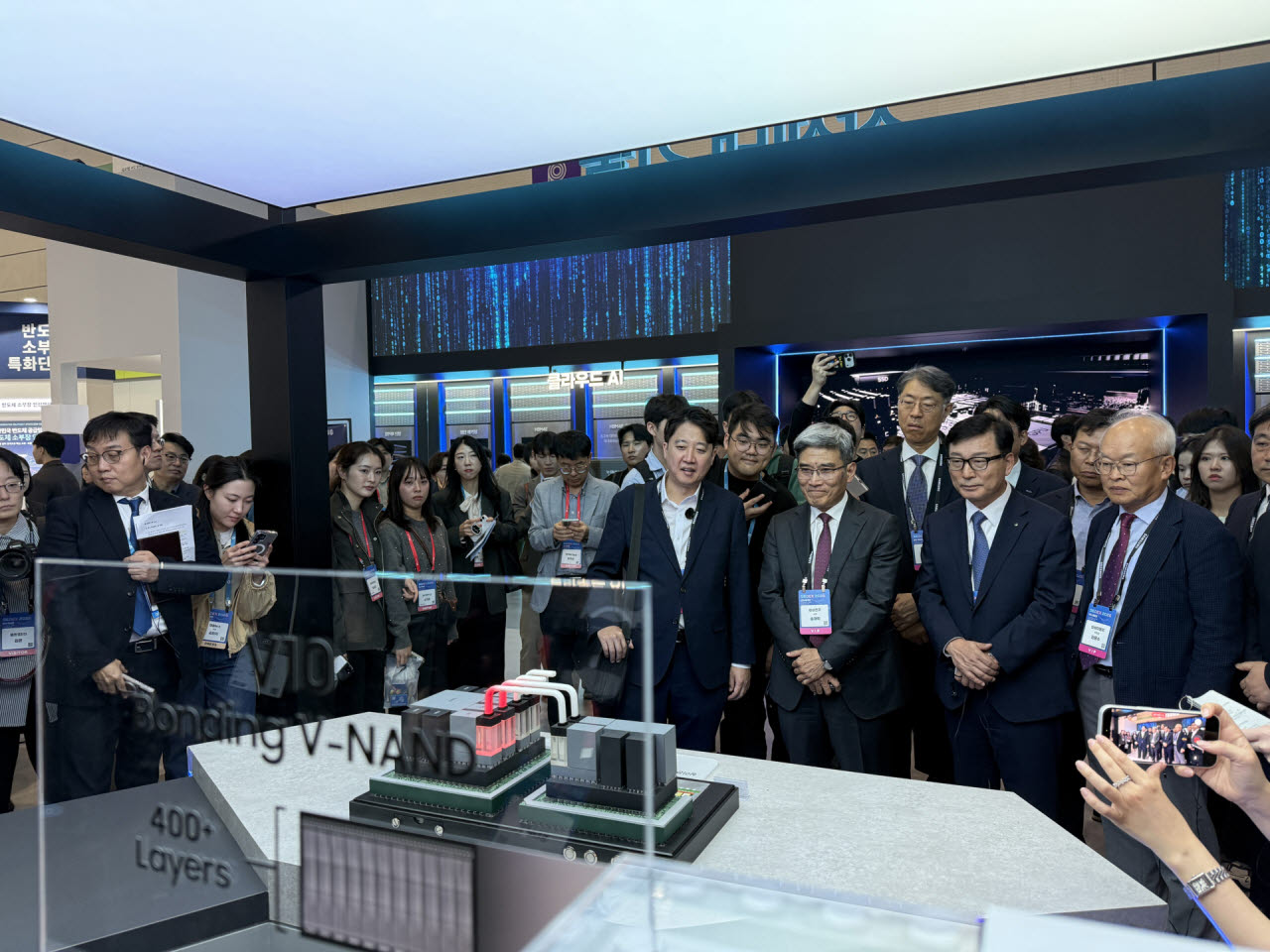
Perhaps the most uncomfortable detail came from Song Jae-hyuk, Samsung’s CTO, at SEDEX 2026 in Seoul on June 14. When asked directly whether Samsung was also developing 4F² technology, he didn’t deflect. “Yes,” he said. When pressed on readiness, he offered only: “We are working hard on it.”
Notably, he gave no timeline. No production target. No yield numbers. That silence is telling.
SK Hynix has been slightly more transparent. In June 2025, its CTO Cha Sun-yong stated at the IEEE VLSI Symposium that the company is preparing a “4F² square VG platform” and 3D DRAM technology for nodes below 10 nanometers. But again, no commercialization date was attached.
Both Korean giants are pursuing 4F². But CXMT is talking about shipping products this year. The narrative advantage—the one that moved stock prices—goes to the company setting the tempo.
Why This Matters Beyond Memory
The 4F² contest is not just a pricing fight over server RAM. It is a proxy battle in the broader semiconductor cold war.
If CXMT achieves anything close to commercial success with 4F² DRAM using non-EUV routes, it would validate the Chinese strategy of technical self-reliance under sanctions—a playbook Beijing has been funding for years through state-directed R&D programs and the Big Fund investment vehicles. It would also prove that export controls, while painful, are not a full containment strategy.
For Samsung and SK Hynix, the stakes are existential in a different way. Memory is their core business. Server DRAM is the fastest-growing segment, driven by AI demand. A Chinese competitor with even a fraction of Samsung’s market share in high-density memory would compress margins across the board and force painful capital expenditure decisions.
What Happens Next
Several outcomes are plausible, and none of them favor complacency in Seoul.
If CXMT ships functional 4F² DDR5 RDIMMs by late 2026—or even prototypes that pass validation—young data center buyers will test them. Supply chain diversification is already a priority for many OEMs who see the risk of over-concentration in Korean production. Even a 5% market share gain for CXMT in server DRAM would be a psychological milestone.
Samsung will likely respond with aggressive pricing and accelerated 4F² roadmaps. But it cannot simply outspend a rival that is being subsidized by a sovereign wealth apparatus with virtually unlimited capital and no profit timeline constraints.
The most likely scenario is a slow grind: CXMT struggles with yields, ships limited volumes, and faces scrutiny from customers who need reliability at scale. But the direction of travel is clear. The gap between Korean and Chinese memory manufacturers is narrowing—not because China has overtaken Samsung, but because the barrier to entry for next-generation DRAM architecture is shifting.
The Real Story Isn’t CXMT—It’s the World’s Reaction
The stock drops on June 13 weren’t just about one Chinese company’s announcement. They were about a market waking up to the possibility that the rules of memory semiconductor competition are changing. Samsung and SK Hynix built their dominance on process superiority and EUV access. CXMT’s 4F² claim suggests there may be another path—one that sanctions can’t fully block.
That path is unproven. Yields are uncertain. But the fact that Samsung’s own CTO felt compelled to confirm active development at a public event, without offering any counter-narrative, is itself a sign that the competitive landscape has shifted.
The next twelve months will determine whether 4F² is a paper milestone or a market-moving technology. For the $100 billion DRAM industry, that timeline is already ticking.