China's Foldable Lock-In: How Huawei and Xiaomi Beat Apple to the Punch
Huawei and Xiaomi are aggressively launching next-gen foldables right as Apple prepares to enter, turning the market into a Chinese-first battleground. Apple's late move may cost it more than just first-mover advantage.
The Foldable Field Is Already Staked Out
Huawei and Xiaomi did not wait for Apple to show up. They showed up first.
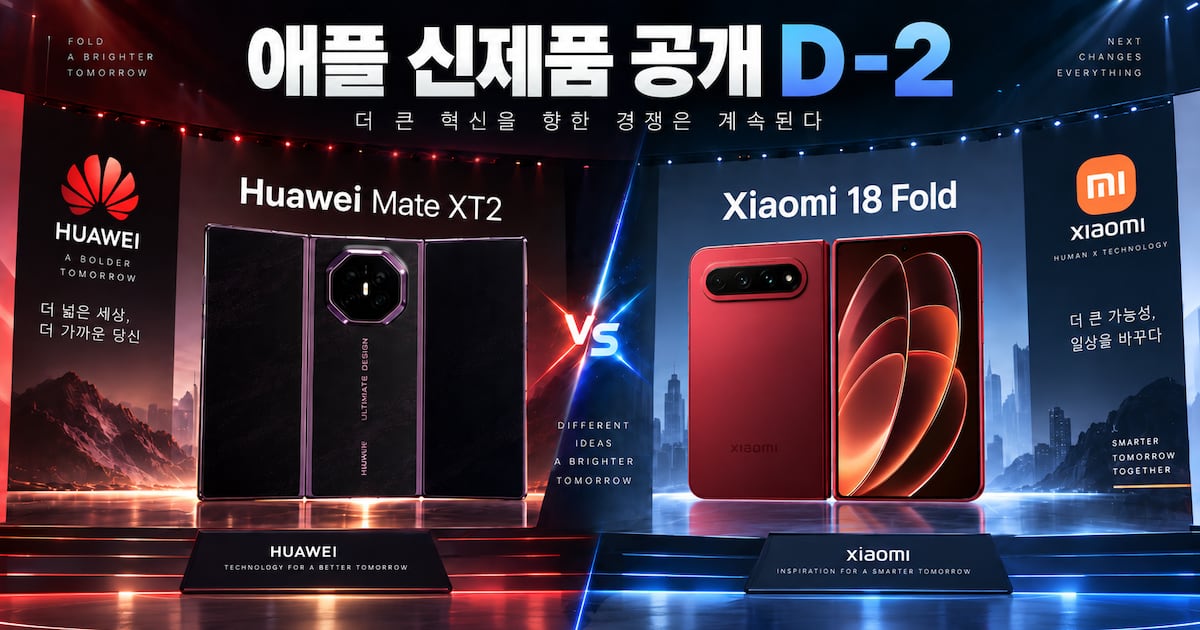
On September 7, Reuters reported that Huawei unveiled the Mate XT2, a trifold flagship that folds inward in a G-shape rather than the Z-shape of its predecessor. Xiaomi launched the Xiaomi 18 Fold, a passport-style device running on its own Xring O3 AI processor. Both were positioned explicitly as alternatives to the iPhone Pro Max line Apple has yet to release.
This is not coincidence. It is a coordinated preemptive strike.
The timing is deliberate. Apple’s event is scheduled for September 9. Chinese manufacturers released their most advanced foldables in the two days leading up to it, forcing Apple to respond in a market that no longer looks new.
Huawei’s Domestic Domination Is the Real Story
Huawei’s Mate XT2 is priced from 19,999 yuan to 24,999 yuan. Pre-orders sold out instantly. The company now holds 68% of China’s foldable market according to Smart Analysis Global. In the broader smartphone market, Huawei captured 22.6% share in the second quarter, surpassing Apple’s 18.1%.
The numbers tell a specific story: Apple is already behind in the one market where foldable technology matters most right now.
Huawei is not competing on price. Its devices are premium products — some exceeding 5 million won per unit. But domestic consumers in China are willing to pay that premium. National pride, supply chain resilience after U.S. sanctions, and a growing belief that Chinese hardware can match or exceed Western flagship quality have all contributed to this shift. Huawei’s Kirin 9050 Pro chip, built on its so-called tau-law architecture, delivers higher performance with lower power consumption compared to previous generations.
Xiaomi took a different but equally pointed approach. Lei Jun, the company’s CEO, directly compared the Xiaomi 18 Fold to Apple’s iPhone Pro Max, claiming the device is lighter and features a processor that outperforms Apple’s A19 Pro. The phone uses memory chips supplied by China’s CXMT, another signal of self-reliance in a sector where Western export controls have been tightening.
Samsung Is the Quiet Loser Here
The Korean foldable pioneer faces a squeeze from both sides.
Counterpoint Research projects Samsung will hold just 32% of the global foldable market this year, with Apple and Huawei each at around 25%. Samsung’s early lead in foldable design — the Galaxy Z Fold series pioneered the book-style form factor — has not translated into lasting market dominance. Chinese manufacturers are now matching the form factor while bundling it with domestic chip stacks that appeal to nationalist consumers at home and price-sensitive buyers abroad.
Samsung’s problem is structural. Korean manufacturers cannot replicate Huawei’s level of vertical integration. The company relies on external chip suppliers and cannot control the full stack the way Huawei has been forced to do since 2019. Meanwhile, Xiaomi and others are building proprietary AI processors specifically optimized for foldable form factors.
This is not a short-term competitive gap. It reflects a deeper realignment in who controls the component layers of smartphone innovation.
Apple’s Production Problem Could Be Bigger Than Its Design Problem
Apple is entering the foldable market with a book-style design, a 5.3-inch outer display and a 7.7-inch inner display, and a target thickness of 4.5 to 4.8 millimeters when unfolded. The company is reportedly prioritizing a nearly invisible crease over camera versatility — potentially dropping the telephoto lens entirely.
But the bottleneck may not be design. It is production capacity.
Nikkei Asia reported on September 4 that Apple’s initial daily output is limited to several hundred units, constrained by strict quality control standards. The company aims to produce 8 to 10 million foldable iPhones this year. To hit that target, it would need to ramp to tens of thousands of units per day. That ramp is not happening fast enough.
If Apple cannot meet demand at launch, the window Chinese manufacturers have opened will remain open far longer than Cupertino hopes. Every month of delay reinforces the narrative that Huawei and Xiaomi are the foldable leaders.
Counterpoint projects Apple’s global foldable share could reach 40% by 2027, but that projection assumes smooth production scaling and immediate consumer adoption. Neither assumption is guaranteed.
What Happens Next
The foldable market is transitioning from a novelty category to a mainstream battleground, and the first movers in China have established advantages that will not disappear when Apple enters.
Huawei controls 68% of China’s foldable market and has a domestically produced chip stack. Xiaomi is building proprietary AI processors tailored to foldable use cases. Both companies have demonstrated that they can ship devices at scale before Apple can begin.
Apple’s ecosystem lock-in remains powerful. But ecosystems matter less in a market where the hardware itself is the differentiator, and where Chinese consumers increasingly view domestic brands as superior to Western alternatives.
For Samsung, the threat is double: Chinese manufacturers are capturing the high end in China while Samsung loses ground globally. The company’s foldable first-mover advantage, earned over half a decade, has proven insufficient against a combined Chinese push backed by nationalist demand and accelerating semiconductor independence.
The foldable phone market in 2026 is no longer about who can fold a screen first. It is about who controls the components, who ships at volume, and who defines the category before the biggest name in tech arrives with a late entry.
So far, that is not Apple.