China Just Proved It Can Land Rockets. SpaceX Should Take Note
LandSpace's second successful rocket stage recovery in under a month signals that China's commercial space sector is closing the gap on SpaceX — fast. The implications for global launch pricing and satellite constellation wars are already unfolding.
China Is No Longer the Follower in Reusable Rockets
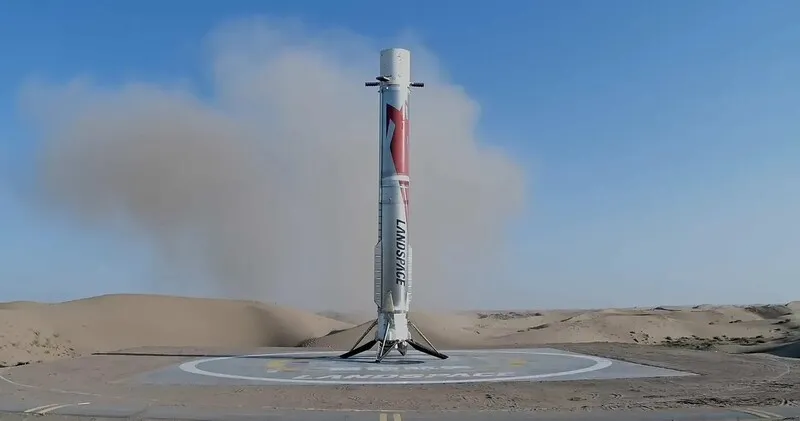
Eight months after its first attempt failed spectacularly, Chinese private space company LandSpace pulled off something that should quietly rattle Elon Musk: it landed the first stage of its Zhuque-3 rocket back on solid ground on July 19, less than eight minutes after liftoff from the Jiuquan Satellite Launch Center in Gansu province.
This was China’s second successful rocket stage recovery ever — the first going to state-owned CASC on July 10 with the Long March 10B, which used a net on a sea platform. LandSpace went a different route entirely: grid fins for mid-air steering, a mid-descent engine relight, and four landing legs for a soft touchdown 390 kilometers from the launch pad. It is, in almost every mechanical detail, a Chinese Falcon 9.
The speed at which both milestones arrived — one week apart — is the real story here. CASC achieved recovery in July, then LandSpace repeated it by mid-July of the following month. Two different organizations, two different recovery architectures, two different institutional cultures, both succeeding within days of each other. That is not incremental progress. That is acceleration.
What makes this sequence particularly striking is the institutional friction it overcame. CASC is a state-owned behemoth with decades of ballistic missile and satellite experience. LandSpace is a privately funded startup that was operating well below the radar until 2022. The fact that both hit recovery success in the same narrow window suggests China’s space leadership has deliberately accelerated reusable rocket development across the board — not as a single program but as a coordinated push involving both the state apparatus and the commercial sector. That is a structural signal, not a coincidental one.
The Economics No One in the West Is Talking About
The Zhuque-3 is built from stainless steel, not carbon composite. It uses nine methane-fueled engines in its first stage — more engines than a Falcon 9, burning a propellant combination that is cleaner-burning and easier to reignite than RP-1 kerosene. LandSpace’s stated goal is 20 reuses per first stage. Twenty.
For context, a Falcon 9 first stage currently achieves between 15 and 20 flights before retirement in practice, and each reuse drops the marginal launch cost by roughly $10 million to $15 million depending on contract terms. If LandSpace hits even half of SpaceX’s utilization rate, the math changes for anyone selling launch slots internationally.
Here is what most English-language coverage has missed: the Zhuque-3’s raw payload capacity to low EARTH orbit without stage recovery is 14.2 tons. The Falcon 9 carries 22.8 tons. That gap is meaningful but not insurmountable — and it narrows every time LandSpace adds engines, scales up fuel tanks, or optimizes the landing sequence. The rocket is still young. Judging its ceiling by today’s spec sheet is a mistake.
What matters more is trajectory. LandSpace was founded in 2015. Its first test flight was suborbital. Its first orbital attempt came later. The first attempted stage recovery failed. Eight months later, it works. CASC’s recovery happened less than two weeks ago and already a private competitor has matched it. Multiple other Chinese private firms — Galaxy Energy, Orienspace, Space Pioneer — are running parallel reusable programs. This is not a one-company story.
The propellant choice is worth examining more closely. Methane — specifically liquid methane, or LCH4 — has become the propellant of choice for next-generation reusable rockets precisely because it burns cleaner than kerosene, leaving less coking buildup in engine turbopumps and combustion chambers. That translates directly into faster turnaround times between flights. SpaceX’s own Raptor engines on Starship run on methane for exactly this reason. LandSpace is not reinventing the wheel here; it is adopting the same logic that SpaceX itself followed after years of flying kerosene-fueled Merlin engines.
Who Wins, Who Loses
The immediate winners are Chinese satellite operators. LandSpace’s second stage placed the Honghu-3 demonstration satellite into its target orbit on this flight — a test payload for a low-Earth-orbit internet constellation called Qianfan. That constellation is China’s direct answer to Starlink, and it needs hundreds, eventually thousands, of launches. Reusable rockets are the only way that math works.
Qianfan, also known as Guowang when viewed through the lens of state planning, has received explicit backing from China’s central government as a strategic infrastructure project. The constellation is projected to field over 13,000 satellites across multiple orbital shells. At current unrecovered launch costs, that deployment is economically unfeasible. Every successful reuse multiplies the number of satellites that can be launched within a given budget window. That is why recovery is not a nice-to-have for Qianfan — it is the single most important technical requirement for the entire project.
The losers are launch providers who have not yet figured out reusability at scale. Axiom Space, Astra, and smaller providers in Europe and India are already under pressure from Falcon 9 pricing. If China enters that fight with a functional recovery fleet, pricing drops further and faster — and western firms that charge premium rates for unrecovered launches will struggle to justify their margins.
SpaceX itself is not threatened today. The Falcon 9 flies roughly once a week globally. LandSpace is not anywhere near that cadence. But SpaceX’s moat has always been speed of iteration. The question is whether China’s parallel development model — multiple companies, multiple architectures, state support — accumulates data faster than any single western company can respond.
There is also a geopolitical dimension that gets underrepresented in launch cost analyses. China’s space sector operates under a different subsidy regime, different procurement rules, and different export controls than its western counterparts. Western analysts tend to compare costs dollar-for-dollar without fully accounting for the degree of state capital infusion that Chinese firms receive. That does not mean Chinese launches are artificially cheap — it means the competitive landscape is not a level playing field, and western providers should not assume they can win on price alone.
What Happens Next
LandSpace is already inspecting this first stage for reuse. Industry observers expect it to fly again as early as the next Qianfan deployment, potentially carrying operational internet satellites rather than test payloads. The company has publicly stated that the upgrade from its failed December attempt included major revisions to the engine ignition system, descent trajectory adjustments to reduce structural stress, and reinforced thermal protection on the lower stage — all classic SpaceX-style iteration loops.
CASC, meanwhile, will likely refine its sea-platform recovery approach, which has advantages for heavier rockets that cannot safely return to land. Both architectures will mature in parallel. The sea-based approach also positions CASC to recover boosters for future heavier-lift vehicles, including the Long March 10 series designed for China’s crewed lunar program. Recovery success on the lighter Zhuque-3 validates techniques that will transfer upward.
The broader implication is that the commercial launch market is about to become genuinely multipolar. For years, the narrative was simple: SpaceX dominates, everyone else catches up. That narrative is no longer accurate. China has two successful recovery programs operating inside a single month. Multiple private competitors are fielding their own versions. The cost curve for launch is about to bend harder than most analysts projected.
What happens next depends on whether LandSpace and its peers can translate recovery success into flight readiness at scale. Recovery is the easy part. Turning around a landed stage, inspecting it, refueling it, and flying it again within weeks or days — that is where the real economics live. SpaceX has spent nearly a decade perfecting that loop. China is now running the same race on multiple tracks simultaneously, and it is moving faster than most people outside the industry realize.
The next twelve months will be decisive. If LandSpace achieves a second flight with the same stage, the credibility gap with SpaceX narrows dramatically. If CASC demonstrates recovery of a heavier booster in the same window, the strategic implications extend beyond commercial launch into national security — China would possess two independent recovery capabilities spanning different payload classes. Either outcome reshapes the global launch market. Neither outcome benefits providers clinging to expendable architectures.