China Just Overtook Samsung in Image Sensors, and Sony's 50% Share Hides It
Chinese CMOS image sensor makers leapfrogged Korean rivals into second place in 2025, reshaping a market where Sony still holds half but the real action is happening around it. The implications ripple through every phone, car, and AI-vision system on earth.
The number that doesn’t tell the whole story
Sony held roughly 50% of the global CMOS image sensor market in 2025. On paper, that looks like a monolith. But look two spots down the rankings and something quieter is happening — and it matters more than Sony’s dominance for where this industry is heading.
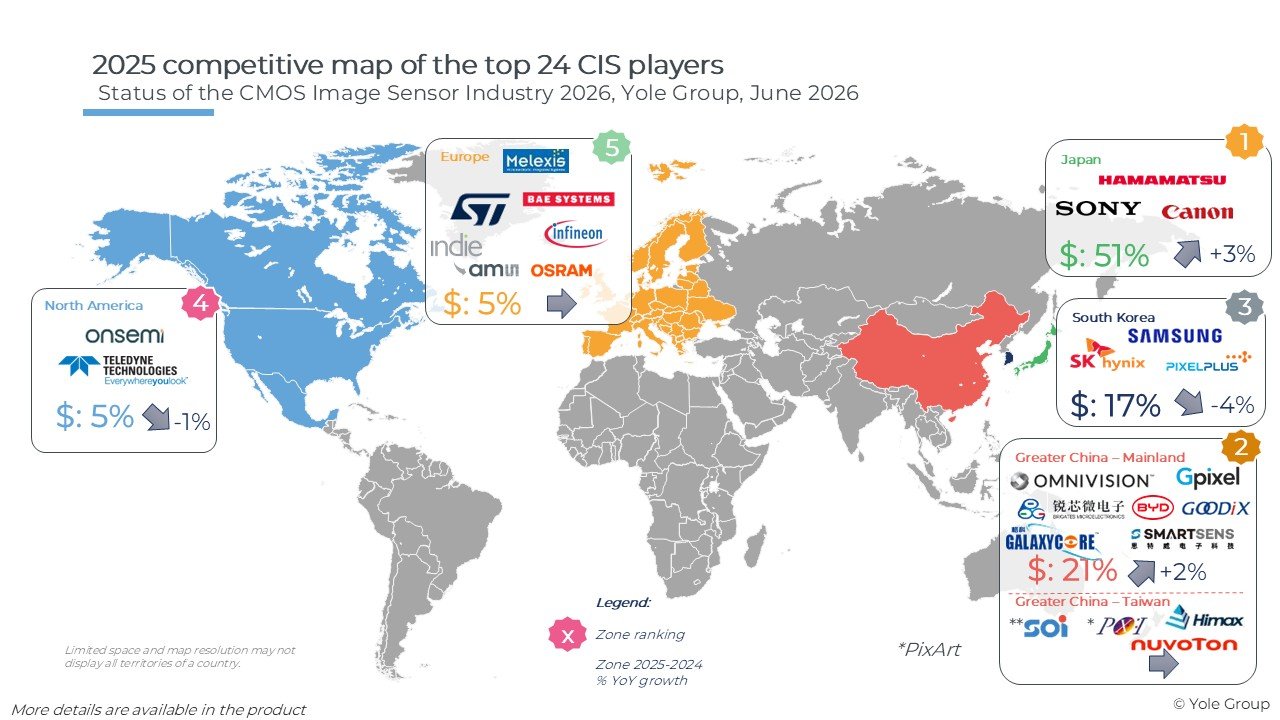
Chinese sensor makers collectively reached 21% share last year, overtaking Korea’s 17%. Samsung remained the single largest Korean player, but its revenue was flat as it faced索尼 in premium phones and Chinese rivals in the mid-range. SK Hynix is effectively disappearing from the conversation, having announced its exit from the image sensor business to redirect resources toward memory. Together, Korea slipped from a consolidated force to a fading one.
The data comes from Yole Group’s August 2026 report on the CMOS image sensor industry. The total market hit $25.3 billion, up 9% from 2024 — a new record. But the composition of that growth tells a different story than the headline number.
Value over volume — and why it favors the new entrants
The market is no longer growing because more sensors are being sold. It’s growing because each sensor is worth more. Yole projects revenue will reach $30.3 billion by 2031, growing at a 3.1% compound annual rate, while unit shipments grow at just 1.9%. The gap between those two numbers is where the strategic shift lives: manufacturers are making money by selling harder-to-make products, not by selling more of the same ones.
In mobile, that means larger optical formats, stacked architectures, and more sophisticated front-camera systems. Apple’s supply chain is the obvious beneficiary — Yole specifically cites Apple-related demand as a key driver of Sony’s growth. But the structural change runs deeper.
Premium phones are pulling revenue upward. Mid-range phones are where the fight is happening now, and this is where China is gaining ground. Omnivision posted double-digit growth, largely on the strength of automotive and security applications. SmartSens expanded across mobile, security, automotive, and consumer segments — Yole called it one of the fastest-growing manufacturers in the industry. GalaxyCore and Gpixel are part of the same cohort, though their revenue scales are smaller.
How China built this — without a Sony-sized factory
Chinese image sensor companies didn’t overtake Korea through superior technology alone. They overtook them through supply chain architecture. That distinction is easy to miss from outside the region but critical to understanding why the shift is durable.
Chinese CIS makers combine access to domestic foundries with overseas manufacturing routes, then pair that with relationships with local camera module manufacturers. The result is lower costs, faster product certification, and shorter time-to-market. When a mid-range phone brand in Southeast Asia or India needs a new sensor qualified quickly, the Chinese supplier is structurally closer to that decision than a Korean one.
The demand side supports this too. China’s domestic smartphone market, security infrastructure buildout, automotive sector expansion, drone and robot production, AIoT deployment, and smart home ecosystem growth all create internal demand that Korean suppliers don’t have equivalent access to. A Chinese sensor company sells to a Chinese car maker, a Chinese security camera manufacturer, and a Chinese phone brand — often in the same quarter.
Who loses when Korea fades
Samsung’s image sensor business has been a cash cow funded by its memory empire’s profits. Flat revenue in 2025 signals that the model is straining. Premium smartphone sensors remain Sony’s fortress — Samsung doesn’t come close there. In the mass market, Chinese competitors are eating share on price and lead time. Samsung’s response has been largely defensive.
SK Hynix’s exit is the clearest signal. The company announced it would leave the image sensor business entirely. That removes a second Korean player from a field where Korea already held roughly a fifth of global revenue. For a segment where R&D cycles are long and foundry relationships are critical, losing a major competitor isn’t just a market share adjustment — it’s a contraction of options for downstream buyers.
Onsemi, the North American player, also saw revenue decline in 2025, pressured by intensifying competition in automotive sensors. North America’s overall share dropped 1% to 5%. Europe held flat at 5%. The consolidated Japanese share rose 3% to 51%, almost entirely on Sony’s contribution.
What comes next
Yole expects a slight revenue dip in 2026. Smartphone cycle volatility is the primary risk, but there’s a secondary pressure most reports underweight: AI-driven memory demand is consuming wafer capacity, and that could constrain the advanced architectures that high-value CIS products depend on. If memory fabs absorb priority, image sensor makers — even Sony — face a supply bottleneck at exactly the moment the market is asking for more complex sensors.
The structural tailwind remains strong. Automotive, defense and aerospace, and security applications are growing faster than mobile and showing less cyclicality. These segments reward complexity over cost, which favors Sony and the Chinese firms that have already embedded themselves in those supply chains. The question isn’t whether the market grows — it’s who captures the value as it does.
Sony’s 50% share will likely hold. But the ordering beneath it — China above Korea, value above volume, supply chain integration above standalone capability — is a rearrangement that will define the next five years of every device with a camera in it.