How China Turned IFA Into a Robot Showcase
Chinese firms now make up nearly half of IFA 2026 exhibitors, flooding Berlin with humanoid robots that pick up cups and play piano. Korean and European appliance giants are responding differently — and the gap is widening.
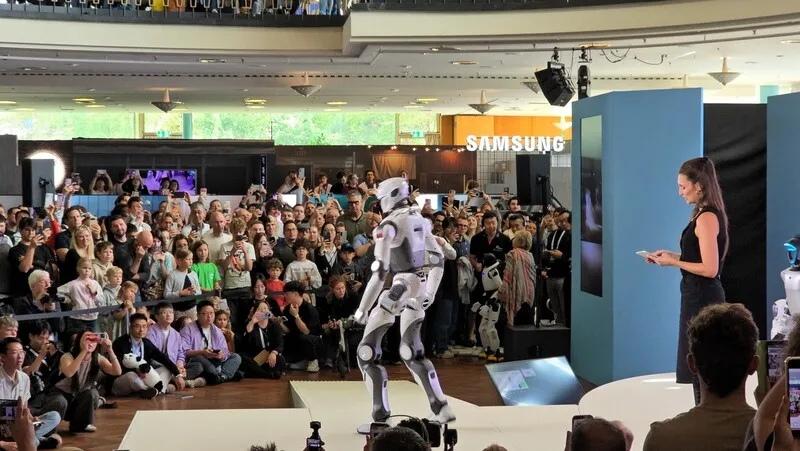
The Floor Was Full of Robots, Not Fridges
Walk into the main hall of IFA 2026 in Berlin and you would have expected, well, nothing like what was actually there.
The International Consumer Electronics Fair, long defined by refrigerators that play music and washing machines that talk to your phone, had quietly become a robotics showcase. The headline act — an event called “Robot on the Runway” — featured humanoid robots waving, dancing, and interacting with the crowd. Attendees didn’t just watch; they held up phones, cheering as if watching pop idols take the stage.
But the spectacle was the tip of something far more consequential. This was a signal that the center of gravity in consumer robotics has shifted decisively, and not toward the players most expected to lead.
China Occupies the Center
The numbers tell the story. Of the more than 1,900 companies and brands exhibiting across 49 countries, 932 were Chinese — nearly half of all participants. That figure has climbed every year, according to industry sources in Germany. Korean participation dropped to 79 companies this year, down 27 from last year.
German business dailies put it bluntly: China is moving to the axis of the fair. Humanoid robots are now the default exhibit.
The Chinese presence wasn’t abstract or speculative. These were working robots on display, performing tasks that required dexterity — picking up glass bottles, handling soft plastic balls, lifting paper cups of coffee without spilling. Mob’s Knot80, a robotic arm with fingers designed to mimic human joints, moved through a station of delicate objects with a calm precision that made the surrounding crowd stop and watch. Unitree served up something more absurd: a robot assembling a sandwich, pulling toast from a toaster and laying lettuce on top with mechanical fingers that were close, but not quite smooth, in their motion.
Xiaomi, making its first appearance at IFA, brought its CyberOne humanoid robot. It did something surprisingly warm — when a visitor made half a heart shape with one hand, CyberOne completed it with the other. It responded to fist bumps and peace signs. But the robot wasn’t only performing for cameras. Xiaomi disclosed that CyberOne has been tested on its EV assembly line for about four months, raising the nut-tightening success rate from 90 percent to 98 percent. That number matters more than the hand-heart trick. It means the robot is already proving itself in industrial conditions, not just on a demo floor.
The Korean and European Response: AI, Not Humans
If Chinese exhibitors were building humanoid robots, Korean and European appliance giants were building a different argument. Their pitch was not that a machine should look and move like a person, but that artificial intelligence should simply make existing appliances smarter.
LG showcased 150 products under its “LG AI Home” umbrella, tied together by an autonomous AI agent called Cloi. At a press briefing, Baek Seung-tae, head of LG’s Home Solution business, emphasized that LG’s differentiation came from making its own motors and compressors in-house and combining that hardware control with software. He confirmed the company is in active cooperation talks with several big tech firms, though he did not name them.
Samsung took a similar route: a Family Hub refrigerator that uses AI to recognize ingredients and suggest recipes. Miele, the German heritage brand, applied an AI camera to its G8 dishwasher, enabling it to identify dish types and loading patterns and auto-select wash programs. A product called Culinary Coach recommends oven settings based on the food being prepared.
The contrast between approaches is stark. Chinese companies are betting that humanoid form factors — robots that walk, gesture, and manipulate objects with human-like hands — are the future of consumer robotics. Korean and European manufacturers are treating AI as a feature layer on top of machines that already work, not as a replacement for the appliance altogether.
What’s Actually Different
The reason this divergence matters goes beyond trade show strategy. The two camps are solving different problems.
Chinese robotics startups are chasing general-purpose manipulation — robots that can navigate unpredictable home environments and perform novel tasks. The sandwich-making robot at the Unitree booth was still visibly jerky. The piano-playing robot from startup TermiTech drew crowds precisely because playing an instrument requires fine motor control that remains hard for machines. These demonstrations are impressive and still early, but they point toward a category of product that could eventually operate in your kitchen the way a Roomba operates in your living room today: an assistant that moves through space and interacts with objects it wasn’t explicitly programmed to handle.
The Korean and European approach is narrower but further along commercially. AI-enhanced refrigerators, dishwashers, and robotic vacuums are products people can buy today. They don’t walk. They don’t wave. But they also don’t risk dropping a coffee cup.
Who Wins, Who Loses
In the near term, the Korean and European appliance giants have an advantage in revenue and distribution. Their products fit into existing supply chains and consumer expectations. The Chinese humanoid robots don’t — not yet. A sandwich-making robot isn’t something most households are lining up to purchase.
But the longer-term bet belongs to whoever solves the dexterity problem first. If a Chinese humanoid can reliably tidy a kitchen, load a dishwasher, or fold laundry — tasks that require the very sort of gentle, adaptive manipulation demonstrated at IFA — the entire value proposition of standalone appliances collapses. Why buy a smarter dishwasher when a robot can load and unload it for you?
Xiaomi’s EV factory results suggest that particular hurdle is already being cleared. A 98 percent success rate on nut tightening in a factory setting is not a research paper. It is a product.
The risk for Korea is that the competitive gap, already visible in the drop from 106 to 79 participating companies, may widen. LG’s strategy of embedding AI into existing hardware is defensible, but it cedes the higher ground — the question of what form factor the home of the future will actually take. If that future is populated by humanoid assistants rather than smarter boxes with screens, LG’s current positioning looks increasingly like optimizing a product category that’s being replaced.
The Race Is Real
IFA 2026 was not merely a trade show. It was a mirror held up to a global competition that most Western coverage has treated as speculative. Chinese companies are exhibiting production-level robots, not concept models. They are testing them in factories. They are drawing crowds that treat them like celebrities.
The lesson for anyone tracking the robotics industry is simple: the shift from lab to living room is no longer a forecast. It is already happening, and the companies leading it are not the ones most Western consumers recognize.
What happens next depends on whether the dexterity gap closes fast enough to make humanoid robots affordable and reliable in home environments. If it does, the appliance industry faces an existential disruption. If it doesn’t, we get a longer plateau of AI-enhanced gadgets and humanoid robots that remain expensive novelties.
Either way, the center of the robotics conversation has already moved.