China Just Recaptured SpaceX's Moment — and the Price War Follows
China's LandSpace successfully brought a rocket stage down vertically for the first time, replicating SpaceX's 2015 breakthrough. But the real story is what happens when two companies race to collapse the cost-per-kilo to orbit.
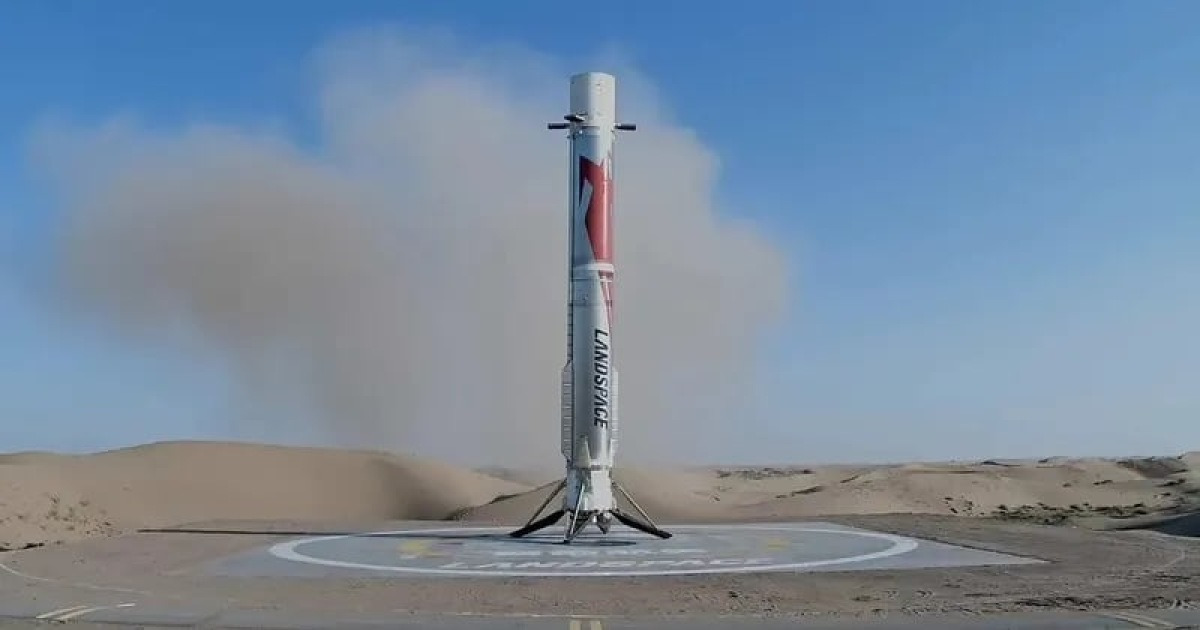
The landing that wasn’t supposed to happen yet
On August 19, a Chinese rocket fell back to Earth the way Elon Musk watched his first Falcon 9 do eleven years earlier.
LandSpace’s Zhuque-3 Yao-2 lifted off from Jiuquan in Gansu province. Two minutes and twenty seconds into the flight, the first stage separated and continued upward alone while the second stage pushed its payload toward orbit. The first stage then turned around, traveled roughly 390 kilometers back across desert terrain, and touched down vertically at a landing zone in Minqin County — landing legs deployed, engines firing final corrections.
The footage looked unmistakably like a SpaceX moment. It wasn’t. And that mismatch is precisely why this matters.
China ran both recovery strategies in one month
The vertical landing was only the second recovery attempt in thirty days.
On August 10, the China Academy of Launch Vehicle Technology (CALT) took a Long March 10B first stage and gently lowered it into the South China Sea using cables and a net. No landing legs. No fuel reserved for a powered touchdown. Just a controlled descent into water for a ship-based recovery operation.
One month apart, China demonstrated both the SpaceX playbook — vertical landing on solid ground — and a Russian-style ocean recovery approach. That dual-path testing is significant. SpaceX committed exclusively to the ground-landing model early on and bet everything on making it work. China is running parallel tracks, gathering data from both architectures simultaneously.
That doesn’t mean both will succeed. Ocean recovery avoids the weight penalty of landing legs and heat shielding, but introduces its own complications: salt corrosion, refurbishment logistics, and the difficulty of rapidly turning around a stage fished from the sea. Ground landing requires more structural mass but enables faster refurbishment cycles — which is exactly why SpaceX chose it.
The re-flight gap is still enormous
Here is where the comparison to SpaceX breaks down most sharply.
SpaceX landed its first stage in 2015. It re-used that same stage in 2017. By now, individual Falcon 9 first stages have flown dozens of times. Recovery and re-flight are routine operational procedures, not experiments.
China has not yet re-launched a recovered stage. The Zhuque-3 achievement is recovery — a necessary first step, but only a first step. The harder problem is taking a landed engine, inspecting it, certifying it, and flying it again. That cycle is where the actual cost reductions live. Until China demonstrates it, the economic argument for reusability remains theoretical rather than proven.
Why China is rushing
The deadline is not abstract. It is measured in satellite counts.
China is building two low-earth-orbit communications constellations — Guowang and Qianwang — targeting a combined total of several thousand to over ten thousand satellites. As of now, the two networks together hold approximately 400 satellites. SpaceX’s Starlink alone has more than 10,000 in orbit.
That gap cannot close with expendable launch vehicles. Sending thousands of satellites to low earth orbit on single-use rockets makes the economics impossible. You cannot out-build Starlink if every launch costs what a conventional rocket costs. Reusable launch vehicles are the transportation infrastructure that makes a Chinese Starlink rival feasible at any scale.
South Korea is watching the same equation. The Korean government has committed 2.29 trillion won (roughly $1.6 billion) to develop a reusable next-generation launch vehicle, with a goal of ten or more launches per year by the early 2030s. The timeline targets a lunar lander in 2032 and a K-Starlink constellation to follow. China’s acceleration raises the floor for what regional competitors must achieve — and raises the stakes of missing it.
Who wins, who loses
The immediate winner is the launch market’s pricing dynamics.
SpaceX has held a垄断 on affordable access to orbit partly because no one else could match its reusability model. A Chinese competitor demonstrating the same capability — even in prototype form — changes the conversation. Buyers who currently accept SpaceX pricing as unavoidable gain a second option. That option may not be cheaper today. But the mere possibility of competition pressures margins across the board.
The loser is anyone banking on SpaceX’s reusability advantage remaining unchallenged for another decade. China’s pace suggests it will not be.
Defense implications are quieter but real. Reliable, frequent launch access matters for constellation-based intelligence, surveillance, and communications. A nation that can launch thousands of small satellites affordably reshapes the strategic calculus in ways that traditional rocket programs never could.
What happens next
Three things to watch.
First, whether LandSpace or CALT attempts a re-flight within the next six to twelve months. Recovery is one milestone. Re-use is another. The gap between them is where the economics live, and where China’s claim to seriousness will be tested.
Second, how SpaceX responds. Musk has repeatedly framed reusability as the fundamental constraint on space economics. If China narrows the gap, SpaceX will narrow it further — likely through improved turnaround times, higher flight rates, and eventually fully reusable systems like Starship. The race compresses rather than stalls.
Third, whether China’s dual-recovery approach yields a third option. If ocean-recovered Long March stages prove viable, China could operate two parallel reusable architectures — one optimized for rapid turnaround, one optimized for lower structural mass. That would be a genuine divergence from the SpaceX model, not simply a copy.
The Zhuque-3 landing was a replica of a moment everyone in aerospace recognized instantly. Replication is not invention. But replication at speed — eleven years after SpaceX, not fifty — changes the math. The question now is not whether China can land rockets. It is whether it can fly them again fast enough to matter.