Chinas bluntest admission yet reveals the cracks in its lunar plan
China's abrupt Chang'e-7 postponement uses language no Chinese space official would normally risk. The bluntness is the story — and it signals that the 2030 crewed landing clock may be ticking faster than Beijing admits.
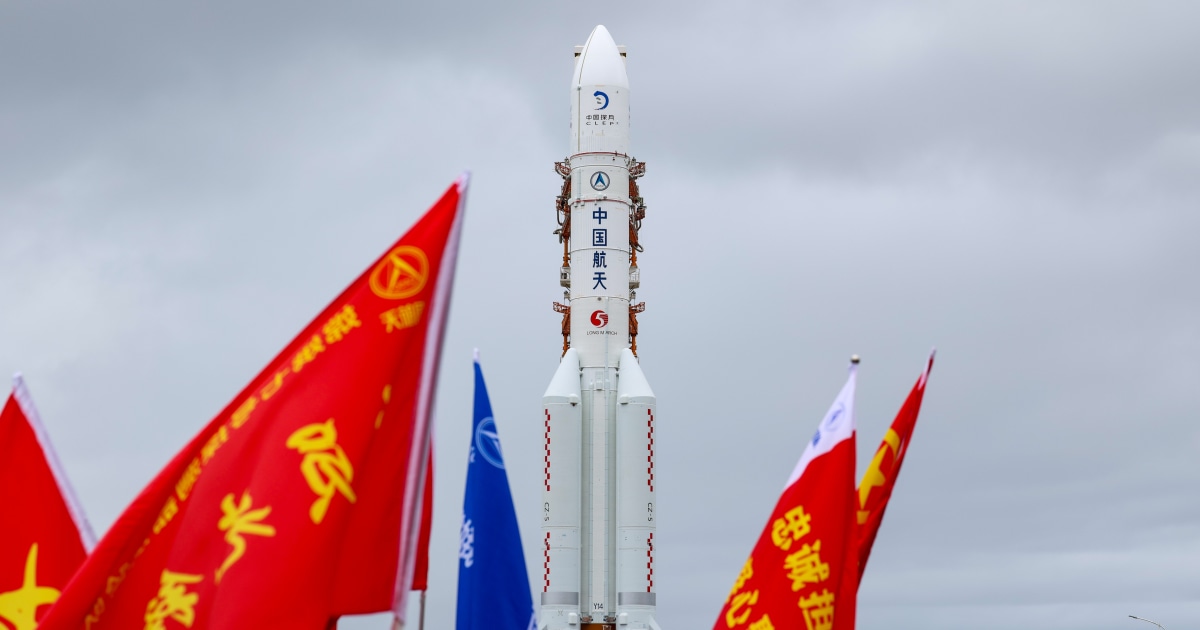
The language was the story.
China’s announcement that Chang’e-7 “does not meet the launch conditions” and “cannot take place during the planned window this year” arrived on a Sunday morning, brief and almost brutally plain. There was no softening about “technical optimization” or “further integration testing.” No mention of a new target date. Just a flat statement from the China Manned Space Agency that the mission cannot proceed when planned.
In the calibrated world of Chinese space diplomacy, that is not nothing.
Chinese officials rarely describe problems in plain terms. When a rocket explodes on the pad, it is a “technical problem.” When a satellite fails, it is an “anomaly in normal operations.” The usual script reframes failure as control, delay as prudence. The Chang’e-7 notice skipped the script entirely. That is either a sign of confidence — a government secure enough to say exactly what it means — or a sign of something significantly wrong inside the spacecraft or its launch system that no amount of euphemism can contain.
What Chang’e-7 was supposed to do
The mission carried ambitions that go beyond any previous Chinese lunar probe. Chang’e-7 is designed to explore the lunar south pole, specifically targeting permanently shadowed craters where water ice is believed to be trapped. It carries a lander, a rover, and a planned vertical takeoff and landing demonstration vehicle — a prototype for the kind of precision descent needed for a crewed landing. It also includes an asteroid sample-return component, extending the probe’s reach well past the Moon itself.
Getting all of that right in a single flight, in an environment that already defeats the best American and European equipment, is not a trivial engineering problem. The rover must survive temperatures below minus 230 degrees Celsius for months on end. The landing zone — likely near the south pole — is among the most terrain-challenged targets humanity has attempted. And the power systems must manage a winter that lasts for weeks at a time, with only nuclear or highly engineered solar solutions viable.
The pattern that matters
Chang’e-6’s successful return of far-side samples in 2024 was a milestone China celebrated widely. The mission required a relay satellite at the Earth-Moon L2 point, a landing on the far side with no direct radio link, and a complex ascent and rendezvous sequence in lunar orbit. China pulled it off. But Chang’e-6 was, by design, a focused and relatively contained mission. Chang’e-7 multiplies the complexity by roughly three.
That jump is exactly where programs tend to reveal their limits. The Chinese lunar effort has enjoyed remarkably smooth execution to date — Chang’e-1 through Chang’e-6 each achieved their primary objectives without publicized failure. A streak like that creates an expectation of infallibility. When something goes wrong under that pressure, the silence around it becomes louder than any explanation.
Why the bluntness now
Several possibilities deserve consideration, none of which can be confirmed from the available information. The launch vehicle — likely a Long March 5 variant — may have encountered a recurrent issue with its upper stage engines. The spacecraft bus may have a systems integration problem that became apparent only during final checkout. The landing site itself may no longer be classified as safe, and a site revision could force a delay while new orbital data is processed. Any of these would be solvable. All of them are the kind of problems that get swallowed into bureaucratic ambiguity in China’s usual practice.
The fact that Beijing chose not to do that suggests the agency overseeing the mission felt the public had already guessed something was wrong, and the cost of coming clean was lower than the cost of appearing deceptive. That is a judgment call worth noting. Chinese institutions rarely make that calculation unless they expect scrutiny.
The 2030 landing clock
Here is what the postponement obscures and also quietly reinforces: China has committed to landing taikonauts on the Moon before the end of this decade. The crewed landing is expected to arrive shortly after Chang’e-7, using many of the same technologies — precision descent, surface operations in extreme cold, regolith handling. If Chang’e-7 runs into trouble that forces a year-long delay, the crewed mission shifts with it, and every subsequent international player recalibrates their expectations.
NASA’s Artemis program has suffered its own delays and technical controversies. The Orion capsule’s heat shield issues, the Space Launch System’s cost overruns, and the repeated postponement of Artemis III have eroded the sense that the United States is ahead. China’s delay does not hand that lead back to Washington, but it narrows the gap that Beijing had been exploiting in its messaging. The narrative of Chinese inevitability in lunar exploration — the one that attracted partners across the Global South — loses a little force when the seventh mission cannot launch on schedule.
Who wins, who loses
China loses credibility for the first time in its lunar program. Not catastrophically — the announcement was responsible, not chaotic — but the image of seamless progress is harder to sustain. International partners watching closely, particularly countries considering cooperation on lunar infrastructure, now have data about Chinese reliability that previously did not exist. They will factor it in.
NASA and the commercial partners surrounding Artemis gain an indirect advantage. The Moon does not care which flag lands there first, but the perception of momentum shapes procurement decisions, research funding, and diplomatic leverage. A Chinese delay of even a few months tips the psychological balance toward the Artemis side, especially if the United States maintains its schedule.
The lunar south pole community — scientists, engineers, and the governments that fund them — loses time. Water ice maps refined by Chang’e-7’s planned sensors will arrive later. Rover data that could guide future crewed routes will be delayed. The scientific return is not destroyed, only deferred.
What comes next
China will likely reschedule Chang’e-7 for late 2027 or early 2028, assuming the current delay spans roughly a year. That would preserve a path to the crewed landing by 2030, but the margin for error becomes vanishingly thin. One more problem, one more unpublicized snag, and the entire architecture compresses into a single risky window.
The more interesting question is what this delay says about the Chinese space establishment’s willingness to be transparent. The blunt language may well be a one-off — a response to a specific media environment or a calculated trust-building gesture toward international partners. Or it may signal a broader shift, an institutional recognition that in an era of open-source satellite imagery and independent telemetry tracking, concealment is no longer viable.
If it is the latter, the implications extend well beyond the Moon. The same transparency that produced this announcement will shape how China presents future missions, how it cooperates with international partners, and how it positions itself as a space power that does not need to hide its stumbles.
China reached the far side of the Moon. It returned samples no other country has collected. It built a lunar relay network on the first try. But the bluntest sentences in Sunday’s announcement were not about triumph. They were about a program still discovering its limits, and choosing — unusually — to say so out loud.