Daifuku bets on warehouse humanoid robots to close the 15 percent
Japan’s Daifuku is building a warehouse-specific humanoid robot aimed at automating the last 15 percent of logistics operations by 2030. The move is a direct challenge to the general-purpose humanoid narrative—and a bet that task-optimized machines will win where Boston Dynamics’ style robots cannot.
The 15 Percent Problem
Japan’s Daifuku Corporation is making a bet that’s both quietly confident and sharply focused on a problem most humanoid-robot manufacturers are sidestepping: the last 15 percent of warehouse automation.
Daifuku has stated that roughly 85 percent of intralogistics processes—receiving, transporting, storing, picking, packing, sorting, shipping—are already automatable with existing technology. What’s left behind is messy, irregular, and stubbornly resistant to conventional robotic solutions.柔性物—cloth, flexible packaging, oddly shaped items—is one of the canonical hard problems. Vacuum grippers and X-Y gantry systems handle rigid boxes with ease. They falter when the product bends.
This is where Daifuku is placing its human-oid gambit.
A Different Kind of Humanoid
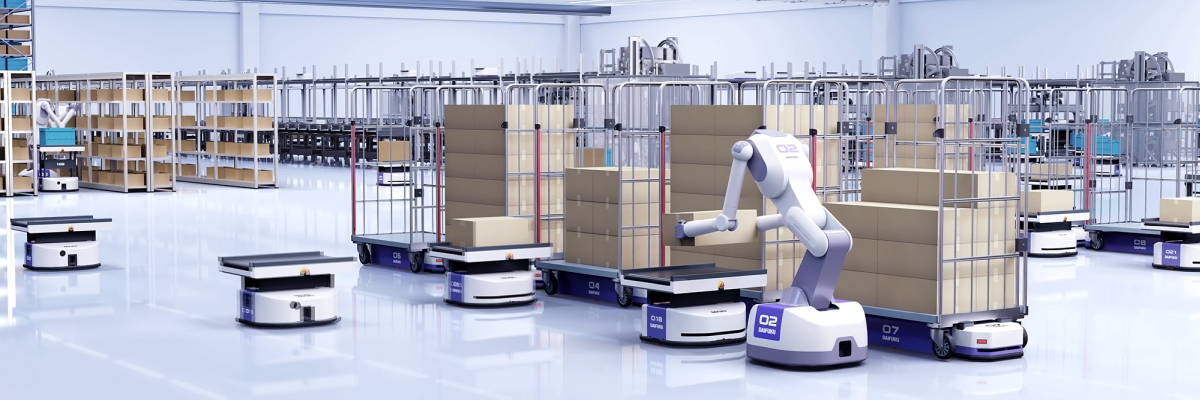
At the International Logistics Comprehensive Exhibition 2026 (September 8–11, Tokyo Big Sight), Daifuku showcased integrated automation solutions combining its own automated storage systems with autonomous mobile robots (AMRs). The star of the display was not a humanoid—it was a portfolio of proven, deploying automation: the Fine Shuttle hanger-case storage system, the SOTR-M and SOTR-S medium and small AMRs, an XY-picking robot, the 4-Way Shuttle Rack LX, the unmanned forklift SOTR-F, and the large SOTR-L AMR.
But it was the humanoid announcement that carried the most significance. CEO Tomohisa Derai told reporters on September 8 that Daifuku aims to have a warehouse humanoid ready for verification testing by 2030.
“We will advance the use of humanoids through physical AI for material handling,” Derai said. “We want to be able to run verification experiments by 2030.”
The company’s vision for this humanoid diverges from the prevailing trend in the industry. Rather than mimicking human form for the sake of general-purpose versatility, Daifuku is engineering a purpose-built, two-armed warehouse robot—one designed specifically to interact with the layouts, workflows, and irregular cargo of modern logistics centers.
“We know what humanoids that manufacturers don’t know about which fit into the layout of the logistics system,” Derai noted. “And current humanoids use too many motors, which reduces durability. We aim to reduce the number of motors so the robot can operate with once-a-year maintenance, which also cuts power consumption.”
Why This Matters Beyond Japan
Daifuku is not a startup testing a concept. It is one of the world’s largest intralogistics system providers, with deep roots in semiconductor manufacturing lines, automotive production lines, and airport cargo handling. Its expertise is in moving things—efficiently, reliably, at scale. The company already builds the automation infrastructure inside warehouses; the humanoid is the next logical layer on top of that foundation.
This is critical context that English-language coverage often misses. Daifuku is not entering the humanoid race as a newcomer chasing a trend. It is extending an existing, dominant position in warehouse automation into the final unautomated frontier. The company’s claim that 85 percent of warehouse processes are already automatable is a bold one, but it comes from a company that has been building automated storage and retrieval systems (AS/RS) for decades. The remaining 15 percent is not a theoretical gap—it is the known, stubborn edge case that blocks full automation.
The Task-Specific vs. General-Purpose Argument
The humanoid boom in popular tech media has been dominated by narratives of general-purpose robots that can perform a wide range of tasks across diverse environments. Companies like Boston Dynamics, Figure AI, and 1X have pitched humanoids as multi-domain workforces. Japan’s本田 and Sony have pushed similar visions.
Daifuku’s approach is a contrarian thesis: in a warehouse, a robot that does one job exceptionally well—picking irregular items, folding clothes, handling non-rigid packages—is more valuable than a robot that claims it can do many jobs poorly.
The motor-count reduction strategy is telling. General-purpose humanoids often prioritize flexibility in movement, which requires more joints and more actuators. More actuators mean higher maintenance, higher failure rates, and higher energy consumption—all fatal flaws in a 24/7 warehouse environment where uptime is everything. Daifuku’s focus on reducing motor count while achieving once-a-year maintenance suggests a design philosophy rooted in industrial reliability, not research-lab versatility.
Who Wins, Who Loses
If Daifuku succeeds in deploying a purpose-built warehouse humanoid by 2030, it will have created a significant moat. The company already controls the storage systems, the AMRs, the shuttle racks, the picking arms, and the integration layer. A Daifuku humanoid would plug directly into that ecosystem—no third-party integration costs, no compatibility headaches, no new software stacks to learn. That is a powerful competitive advantage.
Companies selling general-purpose humanoids to warehouses will face an uphill battle. Their robots must either prove they can match Daifuku’s task-specific performance or convince operators to accept higher maintenance and lower uptime in exchange for versatility. In a margin-thin logistics industry, that is a hard sell.
On the labor side, warehouse workers in Japan—a country facing severe labor shortages in logistics—could see the humanoid as either a lifeline or a threat. The 85-percent automation figure suggests that most jobs are already being displaced or augmented by existing systems. The humanoid targets the remaining roles that resist automation: tasks involving dexterity with soft goods, irregular handling, and adaptive decision-making in unstructured environments.
What Happens Next
Daifuku’s 2030 verification timeline is ambitious but grounded. The company has the engineering depth, the customer relationships, and the domain knowledge to execute. What remains to be seen is whether the physical AI challenges—real-time perception, adaptive grasping, real-world robustness—can be solved within that timeframe.
The broader implication is that the humanoid narrative may splinter. General-purpose robots will continue to attract venture capital and media attention. But in industrial settings, task-optimized machines may deliver value faster and more reliably. Daifuku’s move signals that some of the most serious players in automation are betting on specialization over generality.
The question for the rest of the industry is whether there is room for both strategies—or whether the warehouse is the proving ground where the general-purpose humanoid thesis first fails to deliver.