DLSS 5 Is a Generative AI Disguised as Upscaling, and English Tech Press Missed It
NVIDIA's DLSS 5 is technically a one-step pixel-space diffusion transformer, not a conventional upscaler. PC Watch's Kenji Nishikawa was the first journalist to unpack its architecture — and the gap between Japanese and English technical reporting on GPU innovation is widening.
The Article That English Tech Press Hasn’t Replicated
NVIDIA disclosed DLSS 5’s architecture in September 2026. What emerged was not an incremental upscaling improvement but a fundamental reclassification: DLSS 5 is, at its core, a one-step pixel-space diffusion transformer. It is a generative-AI image synthesizer wearing the uniform of a supersampling technique.
No major English-language outlet has published an equivalent architectural breakdown. The most thorough public dissection comes from PC Watch’s Kenji Nishikawa, whose September column, 「ディリスの正体は1回推論の画像生成AI」, translated and restructured here for an international audience, represents the kind of GPU-architecture journalism that English trade media have yet to match.
The gap matters. DLSS 5 is not a footnote in NVIDIA’s roadmap. It is the company’s boldest statement yet that real-time graphics and generative AI are converging into a single pipeline. And the reporting infrastructure to explain that convergence to a global audience is lagging.
What DLSS 5 Actually Is
DLSS has always stood for Deep Learning Super Sampling. Through DLSS 3.5, it operated as a restoration engine: the game renderer produced a low-resolution or noisy frame, DLSS repaired it using information from the G-Buffer, motion vectors, and prior frames.
DLSS 5 breaks that lineage. NVIDIA calls its approach “3D-Guided Neural Rendering.” The paper calls it a “One-Step Pixel-Space Diffusion Transformer.” In plain language: the model starts from the raw game frame, receives only motion-vector data from the previous frame, and outputs a photorealistic image in a single inference pass.
This is the same class of architecture behind Stable Diffusion. The difference is the constraint structure. A text-to-image diffusion model generates from noise guided by a prompt. DLSS 5 generates from a real-time render guided by temporal state and pixel-space geometry. It does not denoise. It does not upsample in the conventional sense. It re-renders photorealistic appearance from a low-fidelity source image.
Why the English Press Flinched
When NVIDIA previewed DLSS 5 in March 2026, the comparison shots from Resident Evil Requiem caused immediate controversy. The shadow detail on Grace’s face looked altered in ways that went beyond sharpening or denoising. The discussion in English-language forums and outlets clustered around a single question: is this acceptable?
The question was misplaced. The controversy assumed DLSS 5 was an image-restoration tool pushed too far. It is not. It is an image-generation tool constrained by 3D scene information. The distinction changes everything about how to evaluate it.
English-language coverage has so far treated DLSS 5 as a controversial variant of existing upscaling. PC Watch’s Nishikawa treated it as a new class of rendering technology. That framing gap explains why the technical depth of the two bodies of reporting diverges so sharply.
The Architecture, Decoded
Three design choices define DLSS 5’s departure from prior DLSS generations.
One-step inference. Conventional diffusion models iterate hundreds or thousands of denoising steps. Early optimizations reduced that to dozens. DLSS 5 collapses the process to a single pass. The trade-off is architectural: the model must be far more capable per step. The benefit is latency: a single transformer forward pass fits inside a frame budget.
Pixel-space processing. Most diffusion models operate in latent space, compressing images through a variational autoencoder before the generative network touches them. NVIDIA chose pixel space instead, accepting higher computational cost to avoid the detail loss that latent-space compression introduces. Thin lines, small text, micro-textures—all preserved at the pixel level. This is the engineering choice that makes real-time operation possible but expensive.
Temporal state carryover. DLSS 5 retains an internal “Temporal State” across frames, separate from the motion-vector buffer the game engine supplies. This is how the model maintains frame-to-frame consistency without falling into the flickering that plagues naive generative applications. The specific data structure of that state remains unpublished, which is itself a telling omission.
What G-Buffer Training Changed
NVIDIA trained the model using G-Buffer data—the material parameters (albedo, normals, roughness, metallic) that modern deferred renderers produce—but does not feed G-Buffer data into the model at runtime. The G-Buffer serves as a supervisory signal during training, teaching the model to respect object shape, surface orientation, and lighting relationships. At inference time, the model has internalized those constraints and needs only the color buffer and motion vectors to generate correctly.
This is the “3D-guided” part of “3D-Guided Neural Rendering.” The guidance is baked into the weights, not injected at runtime.
The Appearance Model Choice
DLSS 5 ships with three Appearance Models, labeled A, B, and C. NVIDIA describes them as three different interpretations of photorealism, analogous to the difference between film stocks or lens profiles in photography. The models differ in tone response, color behavior, and material handling.
They are not quality tiers. They are aesthetic orientations. Game developers select one per title, or switch between them at runtime. They cannot be mixed within a single scene—no skin uses Model B while foliage uses Model A.
Fine-grained control sits in two parameters: Structure Intensity, which governs high-spatial-frequency detail enhancement, and Tone Intensity, which governs low-spatial-frequency lighting and shading. Together they form a two-axis control surface that developers can modulate globally or per-pixel through engine-level masking.
What DLSS 5 Does Not Change
NVIDIA is explicit about the boundaries. DLSS 5 does not fix geometric errors. A misaligned window frame stays misaligned. Missing geometry is not restored. Aliasing from the base render passes through unchanged—that work belongs to the preceding DLSS super-resolution stage. The model’s design constrains it to appearance enhancement, not structural correction.
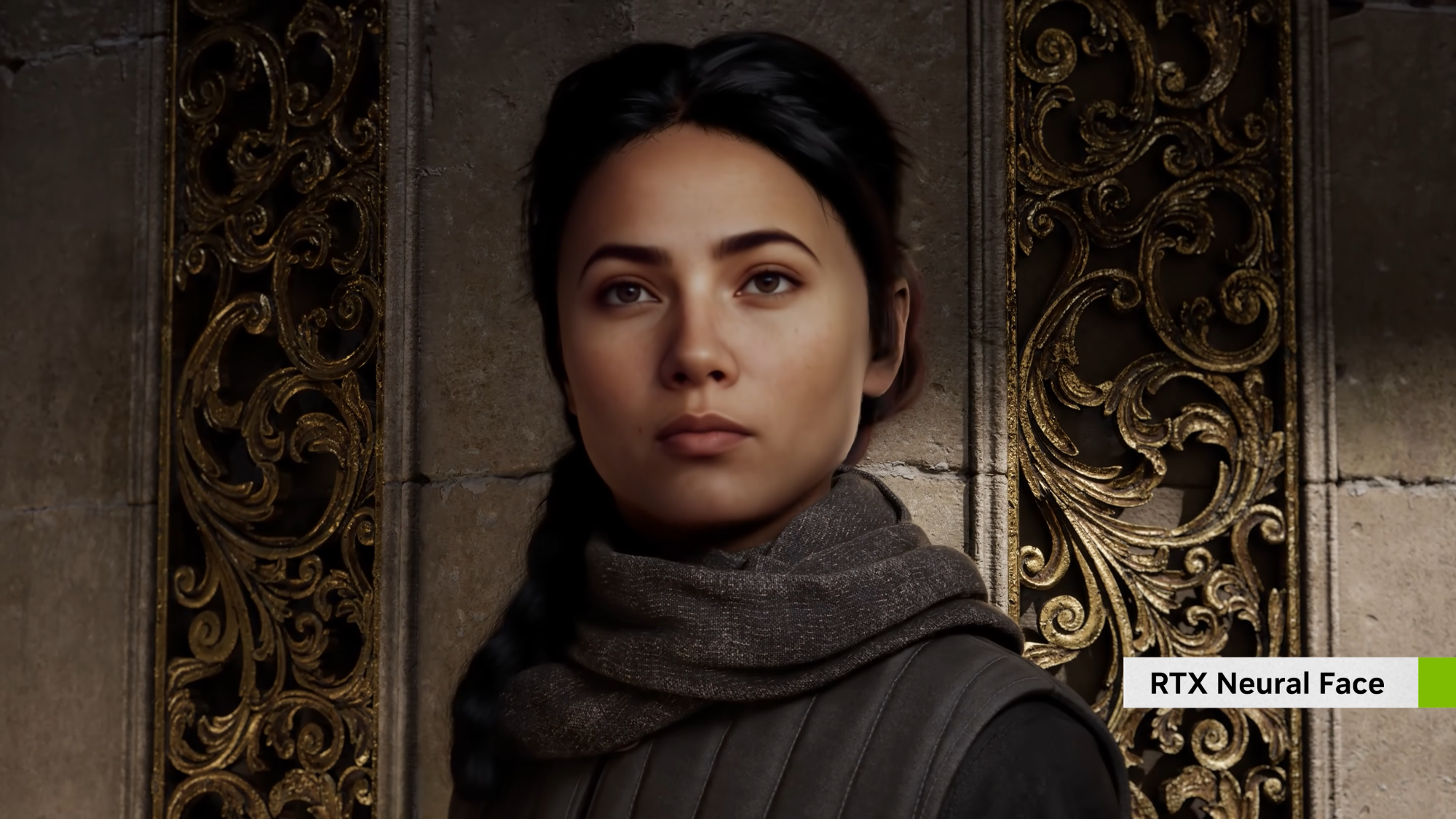
This boundary is deliberate. It separates DLSS 5 from NVIDIA’s earlier RTX Neural Faces technology, which was misidentified by some as a precursor to DLSS 5. RTX Neural Faces altered facial geometry through per-character training. DLSS 5 leaves geometry untouched. The distinction matters for anyone evaluating whether NVIDIA is overpromising on real-time rendering capabilities.
What Changes Instead
Skin subsurface scattering. Hair highlight behavior. Fabric sheen. Light transmission through leaves and translucent materials. These are the specific surface phenomena that real-time rasterization and even path tracing struggle to render convincingly at interactive frame rates. DLSS 5 treats them as generative targets.
The results, as demonstrated in NBA 2K27, are most visible on faces—particularly NPC faces that receive minimal lighting budgets in the base render. The technology elevates background characters to visual parity with protagonists without changing a single polygon.
The Control Problem
General users will not have access to DLSS 5’s parameter controls. NVIDIA’s position is that artistic direction belongs to developers, not players. Some in-game option—likely a simple weak-medium-strong slider—may appear, but granular Structure and Tone adjustment will remain developer-controlled.
This is both a design decision and a liability management strategy. Generative AI applied frame-by-frame carries inherent risk: temporal artifacts, unexpected stylistic drift, localized hallucination. Restricting user-facing controls minimizes the chance that a player will discover an unstable configuration and blame the technology.
The consequence is a fragmented DLSS menu. Previous generations offered three clearly labeled features: Super Resolution, Ray Reconstruction, Multi-Frame Generation. DLSS 5 adds a fourth item with ambiguous naming. Players will face a settings screen that no longer maps cleanly onto their mental model of what each toggle does.
Why This Matters Beyond the GPU
DLSS 5 is the first mainstream real-time graphics technology to fully embrace a diffusion-based architecture. It proves that single-pass pixel-space generation can operate within interactive frame budgets on consumer hardware. The implication extends beyond gaming: any application that requires photorealistic appearance enhancement from low-fidelity input—medical visualization, architectural rendering, simulation—now has a validated architectural template.
The reporting gap is the secondary story. Japanese tech journalism, led by outlets like PC Watch, continues to produce architectural deep dives that English-language trade media have not matched on this topic. That is not a commentary on capability—it is a commentary on editorial priority. NVIDIA’s architecture decisions are being decoded in Tokyo before they are understood in San Francisco’s media ecosystem.
For anyone tracking the convergence of generative AI and real-time graphics, the question is no longer whether diffusion-based rendering will appear in games. DLSS 5 proved that in 2026. The question is whether the press covering it is keeping pace.