A Landmine in the DMZ, a Fracture in Seoul's Power Structure
A suspected landmine explosion in the DMZ during Chuseok has become the latest flashpoint between Han Dong-hoon's prosecutorial instincts and the military's operational caution — revealing who gets to control the national security narrative in South Korea.
The explosion that shouldn’t have been political
A South Korean corporal collapsed from a suspected landmine blast in the DMZ during the Chuseok holiday. A company commander entered to rescue him and was injured by a second explosion. Both are receiving treatment. The United Nations Command is assisting. None of that should be controversial.
It is already controversial.
The fault line running through this incident is not between South and North Korea. It is running straight through South Korea’s own institutions — between a former prosecutor demanding immediate forensic access to a hazardous crime scene and a four-star general telling him, publicly and brutally, to shut up and stop sending soldiers into a field full of unexploded ordnance.
Two professionals, two instincts
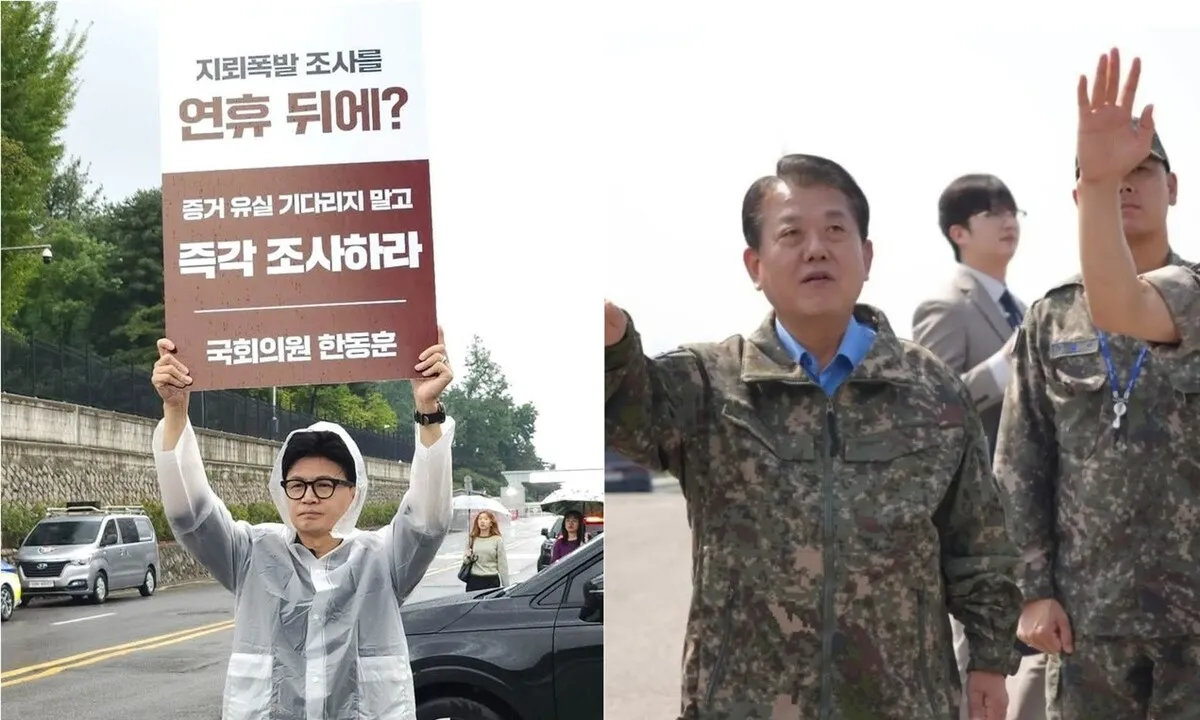
Han Dong-hoon is the leader of the main opposition bloc and a former prosecutor general. On the first day of the Chuseok holiday, he stood alone in front of the National Defense Ministry in Yongsan, holding a sign that said: if North Korea attacks during the holiday, will we wait until after to fight? He then escalated the message across social media, arguing that delaying a site investigation is functionally equivalent to helping destroy evidence.
His framing is familiar: treat the DMZ blast as a crime scene, apply the prosecutorial timeline. One week without a formal investigation, he argued, tips the balance toward evidence degradation. Not to mention the optical damage — every day without transparency is a day his political opponents can claim there is nothing to see.
Kim Byeong-ju, a former four-star general and member of the ruling Democratic Party, responded in a Facebook post that read less like political rebuttal and more like a battlefield correction. Send troops into a field where additional explosives may be buried, he wrote, and you are not securing evidence. You are sending subordinates to their deaths.
The Blue House echoed this assessment. Past incidents along known patrol routes allowed rapid deployment because the ground had already been flagged. This blast occurred in an area where a new route was being established — untested, unmarked, potentially littered with ordnance. The government says it is proceeding cautiously, in coordination with UN Command. That is not stalling. That is mine clearance protocol.
The institutional split
What makes this story worth watching beyond the immediate political brawl is what it reveals about South Korea’s civil-military architecture. The country has spent decades building formal barriers between civilian authority and military operational judgment, precisely because of its history of military rule. But those barriers are not always visible when a crisis hits.
Han’s instinct is civilian and legalistic: the state must account for everything that happens on its territory, especially involving its soldiers. His language — comparing the delay to covering up a murder — is deliberately inflammatory. It is also effective. It frames the government not as cautious, but as negligent or worse.
Kim’s instinct is operational and institutional: you do not turn a live minefield into a police perimeter. The corporal and company commander already paid for that confusion. Adding political pressure to accelerate a forensic sweep into an active hazard zone does not serve the government’s case. It serves a headline.
The government’s own party is already分裂. Park Ji-won, another Democratic Party lawmaker, published his own critique: why is the administration staying silent instead of explaining? If a soldier was injured by a landmine, the public deserves the facts — even if the incident occurred in territory near the North. “You can’t manage what you don’t understand,” he wrote, using the Korean idiom that roughly translates to: ignorance is costly. He told the president to stop looking only upward and to keep the prime minister and all cabinet members in check.
What happens next
The immediate question is whether the investigation site will be opened to independent observers and when. The Blue House has not set a date. The military has cited ongoing safety assessments. Any announcement that comes too fast will look like political theater. Any that comes too slow will confirm Han’s narrative that the government is hiding something.
There is a second question, one that rarely surfaces in English-language coverage of South Korean politics: what does Han Dong-hoon actually want here? He has built a political brand on anti-corruption rhetoric and institutional reform. A DMZ landmine incident that kills or injures South Korean soldiers is, by definition, an institutional failure. Pinning the delay on the executive branch gives him a running narrative heading into whatever legislative battle comes next.
But Kim Byeong-ju’s response suggests the military establishment does not intend to be drawn into a prosecutorial framing of its own operations. The message was blunt: know your domain before you issue orders about it. That is not just criticism of Han. It is a boundary statement.
Why this matters outside Korea
South Korea manages one of the most heavily fortified borders on Earth with a force of roughly 500,000 active-duty personnel. Incidents in the DMZ — accidental or intentional — are inevitable. What is rarer is a public dispute between a civilian politician and a retired general over how to handle the aftermath, played out on social media during a national holiday.
The real story is not the landmine. It is the signal it sent: South Korea’s military establishment is willing to publicly defy a prominent civilian politician’s framing of a security incident, and it has the institutional credibility to do so. The civilian side insists on transparency and accountability. The military side insists on operational reality and soldier safety. Neither position is wrong. They are just irreconcilable in real time.
Rain is coming. The DMZ gets heavy autumn rainfall. Every day of delay degrades whatever forensic value remains at the site — not through conspiracy, but through weather. Han knows this. Kim knows this. The public does not. That gap is where the political damage will accumulate, regardless of who is right.